
The news: an airborne demonstration, not a flying-car delivery
CNN’s account describes an unoccupied Roadster climbing an inverted ramp, performing an aerial rotation and landing with air jets, followed by a leap over other Teslas. It attributes the propulsion to high-pressure air and reports Elon Musk’s production target of 2028. CnEVPost separately reports the redesigned car’s unveiling. These are attributed event reports: Lumacta did not attend, watch the complete livestream or independently measure the maneuvers.
That is a more interesting starting point than either declaring routine airborne commuting solved or dismissing every departure from the ground as meaningless. A short maneuver can demonstrate real integration work. It can also leave most practical questions unanswered. The distinction is not whether the spectacle looks impressive; it is which conclusions follow from the available evidence.
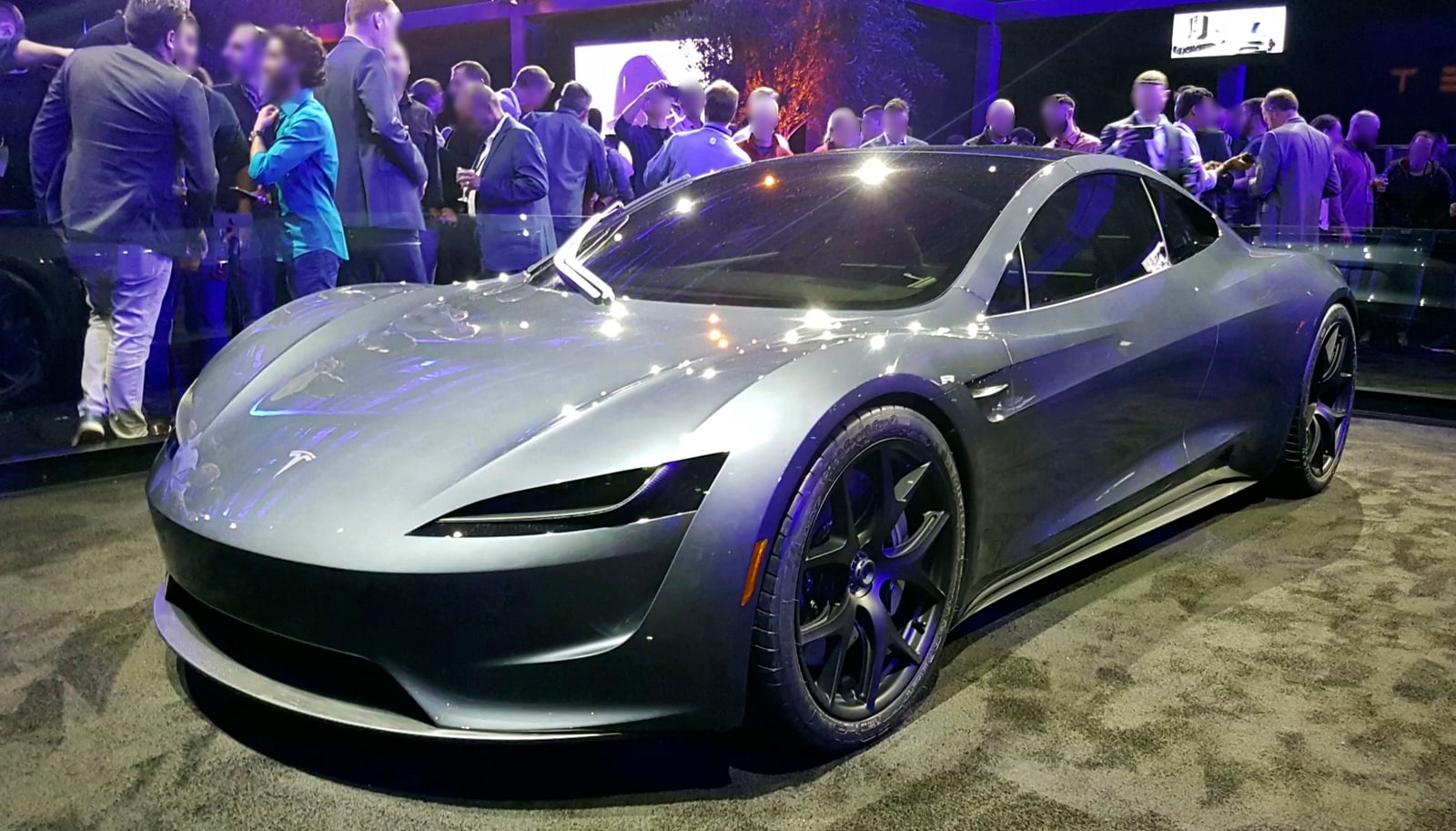
This is an explanatory analysis rather than a road test, purchase recommendation or aviation safety assessment. Our photograph is a genuine image of the earlier prototype from November 2017, clearly labeled as archive context. It does not show the redesigned vehicle or the new demonstration. We have not substituted a generated picture for missing event photography.
Source notes: 1, 2. Original editorial examples and interpretations are identified separately.
Performance, Thrust and Rocket are not interchangeable claims
Tesla’s indexed reservation text distinguishes Performance, a two-seat road-oriented configuration with active aerodynamics and suction; Thrust, a two-seat track-oriented configuration adding acceleration thrusters; and invitation-only Rocket, a single-seat configuration adding flight equipment. CnEVPost’s October 16 report corroborates that division. Direct access to the configurator was denied during our research, so this is not a complete, independently inspected order specification or confirmation of approval for any jurisdiction.
The practical implication is straightforward: do not attach the most dramatic capability of one configuration to every car sharing the Roadster name. A photograph of an exterior is not a parts list. A reservation category is not proof that the demonstration vehicle and the eventual customer vehicle have identical hardware, software or operating limits.
Our comparison therefore begins with intended use rather than a winner. Somebody interested in a road car needs road behavior and ordinary ownership evidence. Somebody interested in repeated circuit sessions needs repeatable performance and service requirements. Somebody interested in going airborne needs a completely different account of control, landing and contingency behavior. Combining those buyers into one headline obscures the actual engineering choices.
Source notes: 2, 3. Original editorial examples and interpretations are identified separately.
Why driving upside down is different from flying
An inverted vehicle can be supported by a pressure difference that holds it toward a nearby surface. That is not the same physical arrangement as a vehicle supporting itself in open air. In the first case, the surroundings and the controlled gap beneath the body are part of the system. In the second, a surface is no longer there to provide that particular relationship.
There is also relevant prior art. McMurtry’s own account of its 2025 Goodwood appearance describes an earlier inverted-drive demonstration using fan-generated downforce in a purpose-built rig. That manufacturer account is context, not a matched comparison with Tesla or independent certification of either company’s performance.
Our interpretation is that the interesting question is the transition between operating modes. A machine approaching the edge of a ramp changes its relationship with the supporting surface. Whatever follows must be understood as a separate force-and-control problem. An explanation that treats suction, tire grip and airborne thrust as one undifferentiated trick misses precisely the transition that makes the demonstration technically interesting.
For future testing, we would want to know how the system identifies that transition, how its control authority changes and what happens if the expected surface relationship is lost sooner than intended. Those are proposed evaluation questions, not claims about Tesla’s internal implementation or evidence of a defect.
Source notes: 4. Original editorial examples and interpretations are identified separately.
Compressed air is a reaction mass, not a source of free energy
NASA’s thrust explanation relates force to the momentum carried by moving gas, with an additional pressure term at the outlet. For stored gas discharged from a vehicle, expelling mass in one direction provides a force in the other. The general principle does not establish the Roadster’s tank capacity, pressure, nozzle efficiency or endurance; none of those quantities was independently verified here.
The useful distinction is between energy storage and the action that produces force. Calling a device air-powered does not remove the work needed to compress that air, nor the hardware needed to contain and release it. An electric system that replenishes a supply would still have an energy demand and an operating time. We are explaining the accounting, not specifying Tesla’s mechanism.
This changes how a reader should interpret a dramatic maneuver. A large force lasting briefly and a smaller force maintained for much longer can serve different purposes. Neither can be evaluated from a single peak number alone. The duration, direction and repeatability of useful force belong beside the headline performance claim.
It would be premature to derive an actual flight range from the exterior, the number of visible outlets or a social-media clip. A responsible calculation needs the working mass, usable stored supply, the thrust schedule and the reserves that remain unavailable for normal use. We do not have those inputs and do not present a simulated Roadster specification.
Source notes: 5. Original editorial examples and interpretations are identified separately.
A simple calculation: leaving the ground is only the first requirement
Consider an original classroom example, deliberately unrelated to any verified Tesla specification: a hypothetical 1,500-kilogram vehicle near Earth’s surface. Using gravitational acceleration of 9.81 meters per second squared, its weight is 1,500 × 9.81 = 14,715 newtons, approximately 14.7 kilonewtons. This is not the Roadster’s measured mass or thrust.
If upward thrust alone supports that imaginary vehicle in a stationary hover, its vertical component must balance that weight. To accelerate upward, it must exceed it. Tilting a given thrust away from vertical leaves less of that thrust supporting weight. This stripped-down calculation omits aerodynamic forces, transients and real control requirements; it is a way to distinguish force balance from a product-performance prediction.
Now change the question. In a straight-line, constant-mass approximation, suppose that same imaginary vehicle changes speed from rest to 60 miles per hour in exactly one second. Sixty miles per hour is 26.8224 meters per second. The average acceleration is therefore about 26.8 meters per second squared, and mass times that acceleration gives roughly 40.2 kilonewtons of average net horizontal force.
These are two different scenarios, not two forces that we have measured on Tesla’s car. The horizontal calculation does not establish how the force is generated, how it varies during the run or what the occupant experiences. Its purpose is to show why an acceleration headline, an upward hop and sustained support in the air answer different questions. This is physics literacy, not pressure-vessel construction guidance.
Source notes: 5. Original editorial examples and interpretations are identified separately.
What a very short acceleration time does—and does not—tell us
Tesla posted a 0–60 mph figure of 0.81 seconds on October 16. We verified the post’s text and Tesla account identity through X’s official syndication endpoint; we did not authenticate the timing equipment, inspect the run conditions or independently test the vehicle. The number remains a manufacturer claim, not a Lumacta measurement.
A useful independent test would establish the exact configuration, starting condition, timing convention and surface, then repeat the run with documented preparation between attempts. It should identify whether the reported interval excludes an initial movement, how speed was measured and which result is typical rather than merely the best of an undisclosed set.
The distinction matters more as intervals become very short. A small change in when timing begins can represent a meaningful part of a one-second event. A result should travel with its protocol, not arrive as an isolated decimal. Comparing two cars without matching that protocol can reward a difference in measurement rather than a difference in the vehicles.
Even a fully validated straight-line result would not rank braking, circuit consistency, occupant comfort, maintenance burden or flight capability. An exceptional result in one discipline is worth reporting on its own terms. It does not automatically provide a general answer to which vehicle is better, safer or more useful.
Source notes: 6. Original editorial examples and interpretations are identified separately.
The missing comparison is not altitude alone—it is a usable operating envelope
For an airborne vehicle, a useful description would connect payload, duration, maneuvering and landing margin. Maximum height, maximum forward movement and maximum operating time might occur under different conditions. Treating each separate maximum as though one mission can achieve all of them at once is an easy way to imagine a machine that no published test has established.
Our proposed evaluation is a complete mission rather than a highlight: begin with a documented preparation state, carry the stated payload, perform a defined maneuver, return to an intended landing area and record what usable capability remains. Repeat with the relevant environmental conditions documented. We have not performed or verified such a sequence.
Control also has direction. An off-center force can rotate a body as well as translate it. A system intended to manage both therefore needs a way to account for orientation and the distribution of mass. Adding an occupant or changing equipment changes the question that a test must answer. A successful unoccupied demonstration cannot silently supply every answer for a different loading arrangement.
The most revealing future evidence may look undramatic: repeated conservative maneuvers, clear operating limits and a documented decision not to take off when conditions fall outside them. Those results would help turn a spectacular capability into an understandable machine. They would not fit into a single acceleration statistic, which is exactly why they deserve attention.
Source notes: 5. Original editorial examples and interpretations are identified separately.
The landing and the interrupted attempt deserve their own evidence
A transport system must be judged by more than its intended successful sequence. Our engineering questions include what happens when a maneuver is interrupted, a sensor becomes unreliable or usable propulsion falls below the planned margin. These are questions about any proposed airborne system, not allegations that such failures occurred at Tesla’s event.
There is an important difference between showing a landing in a prepared area and describing the range of landings the system can handle. The latter needs conditions: payload, approach, surface, available space and the state of the vehicle afterward. Without those conditions, a viewer cannot know which everyday situations resemble the demonstration and which do not.
The surroundings matter too. A forceful gas discharge interacts with whatever is near its outlet. An eventual evaluation should establish exclusion areas and any relevant debris, noise and surface constraints through measurement, rather than assuming that a propulsion method is benign because the stored medium is familiar. We have not measured those effects for this vehicle.
This does not make an early demonstration worthless. It defines what the next meaningful evidence should add. A project becomes easier to assess when it explains not only what a trained team can make happen, but what the system prevents an operator from attempting and how an interrupted sequence is handled.
Source notes: 5. Original editorial examples and interpretations are identified separately.
An event, a reservation and an aviation authorization are different records
The FAA describes an airworthiness certificate as authorization to operate an aircraft in flight and distinguishes standard and special classifications. Its explanation includes an eligibility and safe-condition determination. That general framework is not a finding about Tesla’s vehicle, its legal classification or the conditions under which this particular demonstration took place.
We have not completed a certificate-registry investigation and do not claim that a specific approval exists or is absent. Nor do we infer European or Romanian permission from an American presentation. The relevant documentation would need to identify the vehicle, intended operation, jurisdiction and limitations. A consumer-facing phrase about readiness is not a substitute for that record.
For readers, the practical discipline is to keep documents in their proper categories. A demonstration report describes an event. A reservation describes a commercial relationship with its own terms. An authorization describes permitted operation under defined conditions. None should be silently used as proof of the others.
This article is not advice to operate or modify a vehicle. Its point is evidential: before describing a machine as available for routine airborne use, establish what use is actually supported and permitted. The burden of that explanation increases when the public description invites readers to imagine ordinary journeys rather than a controlled showcase.
Source notes: 7. Original editorial examples and interpretations are identified separately.
Why the project could matter without becoming an airborne commuter
Our editorial view is that the strongest possible contribution may be narrower than the flying-car slogan. A tightly defined performance system could be significant if its behavior is measurable, repeatable and useful for its intended setting. It need not replace a family car, a helicopter and a racing machine simultaneously to justify technical interest.
Equally, excitement about a demonstration should not erase the distinction between a development project and a delivered product. A future production target is not an inventory listing, and a deposit is not necessarily the final price. Because we could not inspect the full current order documents, this is not a comparison of final purchase costs, refund protections or delivery commitments.
For now, the sensible conclusion is specific: the reported Roadster presentation raises serious and interesting engineering questions. The next story should follow the evidence—independent timing, configuration-specific documentation, usable duration, repeated maneuvers and clearly stated limits. It should not become more certain merely because the same striking clip is shared more often.
That is also how we will distinguish progress from promotion. A spectacular first impression can earn attention. A comprehensible account of what the machine can repeatedly do, with a real customer load and a defensible operating margin, is what would earn confidence. Until those records are available, curiosity and restraint belong in the same article.
Source notes: 2, 4. Original editorial examples and interpretations are identified separately.
Sources & Methods
Prepared October 16. Event details come from fully read CNN/KESQ and CnEVPost reports, not firsthand attendance. Tesla reservation text was available in a search index; direct configurator access returned 403. Tesla post text and account identity were read through X’s official syndication endpoint, but its video timing and the complete livestream were not independently reviewed. NASA, McMurtry and FAA primary explanations were read for limited context. The force calculations and proposed evaluation framework are original, hypothetical analysis—not measured Roadster specifications, an interview or a safety certification. No direct quotations are reproduced.
- CNN / KESQ: report of the October 15 demonstration — Event reporting; complete article read; not our observation
- CnEVPost: redesigned Roadster and configurations — Event reporting; complete article read
- Tesla: reservation configuration text — Manufacturer; indexed text read; direct page returned access denied; not a full order-document review
- McMurtry: fan-downforce context, July 2025 — Manufacturer account; complete article read; separate vehicle and rig
- NASA Glenn: thrust force — Primary educational explanation; complete main text read; not Roadster data
- Tesla: October 16 acceleration claim — Manufacturer post text and identity read via official X syndication; timing not independently verified
- FAA: airworthiness certification — Primary general explanation; complete main text read; no Tesla-specific certificate finding