
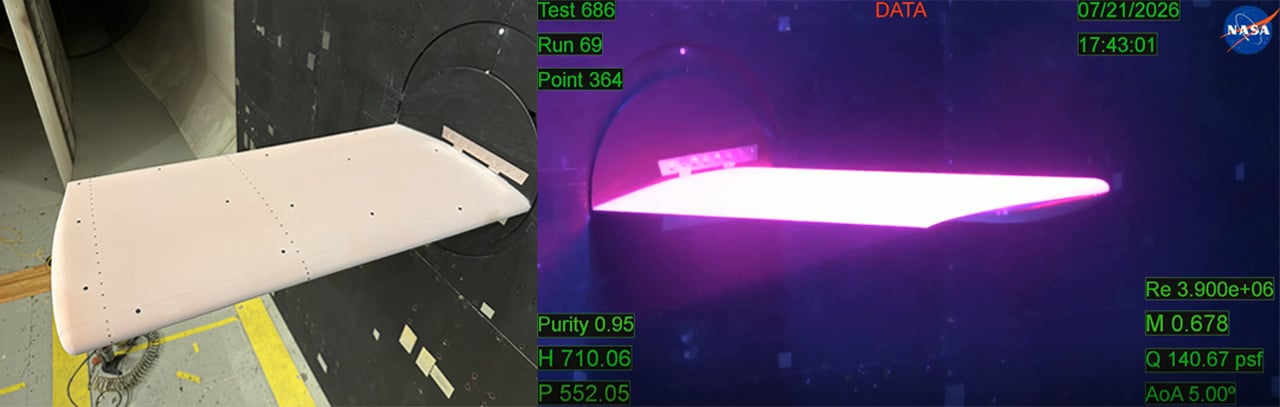
The milestone is the combination, not the color
NASA’s October 2, 2026 announcement describes the first use of unsteady pressure-sensitive paint, or uPSP, on a large, freely moving model in a low-oxygen setting. The Benchmark Supercritical Wing is a research model, not a named aircraft prototype.
That combination is the news. PSP is not a new invention, and a pink photograph is not evidence of improved fuel consumption. The announcement does not give the test schedule, recording speed or measurement uncertainty. Its supplied right-hand image displays July 21, 2026, but we have not independently checked that instrument clock. October 2 is the reporting date.
Source notes: 1. Editorial interpretation and illustrative calculations are identified separately.
The paint responds to oxygen, not directly to lift
NASA’s established explanation starts with light-emitting molecules in the coating. Illumination makes them glow; oxygen suppresses that glow. Under comparable conditions, higher pressure brings more oxygen and a dimmer signal. Lower pressure gives a brighter signal. Cameras record intensity, and processing converts it into pressure values. The new report describes ultraviolet illumination, not a wing glowing because aerodynamic heating made it hot.
Our reading aid is to keep four quantities separate: camera brightness, calibrated surface pressure, the force associated with a pressure distribution, and the behavior of a complete aircraft. They are related, but they are not interchangeable. A bright patch does not directly announce a lift value or a safety margin. Nor should a display’s false-color pressure scale be mistaken for the raw photographic color of the coating.
Source notes: 2, 3. Editorial interpretation and illustrative calculations are identified separately.
A moving surface makes the measurement more demanding
NASA describes the tunnel as a variable-pressure facility dedicated to aeroelastic problems: the interaction between aerodynamic forces and structures that can deform or move. It can use air or the heavy gas R-134a. Those are facility capabilities; the October announcement does not specify the latest test’s gas mixture.
The scientific reason to care about motion is that a changing wing position changes the flow, while the resulting pressure distribution can drive further motion. Recording pressure through time can help examine that interaction. But the camera sees motion too. A pixel that viewed one painted location may view another a moment later. Comparing its brightness without tracking the surface could confuse geometry with pressure. A pressure movie needs a consistent location on the model, not merely a consistent location on the screen.
Source notes: 1, 5. Editorial interpretation and illustrative calculations are identified separately.
Low oxygen raises a calibration question
The chemistry explains why low oxygen matters: the coating’s sensing mechanism depends on oxygen, so a calibration suitable for one gas composition cannot simply be assumed suitable for another. NASA’s 2022 technical presentation explicitly listed determining the oxygen concentration needed in low-pressure R-134a as future work. That historical question helps explain the new milestone; it is not a specification of the 2026 mixture.
The same presentation describes aligning images to account for small model movements, mapping them onto a model grid and converting intensity to pressure with a temperature-dependent relationship. The practical reading is that calibration is part of the instrument. Temperature, viewing geometry and the reference intensity must be accounted for before a brightness change is treated as a pressure change. An attractive image cannot substitute for those corrections or their uncertainty.
Source notes: 2, 4. Editorial interpretation and illustrative calculations are identified separately.
Fast frames help, but speed is not accuracy
The 2022 presentation describes recordings at 5 and 10 kilohertz. These are historical demonstration rates, not rates disclosed for the newly announced wing test. For a worked example, suppose a camera records 10,000 frames per second: the interval is 1 ÷ 10,000 second, or 0.1 millisecond. A hypothetical 500-hertz pressure oscillation repeats every 2 milliseconds, giving 20 frames per cycle.
That arithmetic explains why rapid recording can reveal changes that a slow snapshot sequence misses. It does not establish that every frame is an independent, accurate pressure measurement. Paint response, exposure, noise and processing still matter. The historical presentation compared optical results with pressure sensors and reported a higher harmonic lost to noise. The useful question is therefore which changes remain distinguishable from uncertainty, not simply how many images the camera produces.
Source notes: 4. Editorial interpretation and illustrative calculations are identified separately.
A stronger measurement tool, not a completed aircraft result
NASA’s July 2025 account describes uPSP as a way to resolve rapidly changing pressure and reports a development effort begun in 2019 and completed at the end of 2024. Conventional pressure taps measure selected points; a coating offers much denser spatial information over surfaces visible to the cameras. The new Langley application should be read against that existing development, not as the first invention of pressure-sensitive paint.
Our engineering perspective is that broader measurement access is valuable because it makes simulations easier to challenge. A useful next report would show the test conditions, motion tracking, calibration, sensor comparisons and errors alongside the pressure maps. NASA identifies flexible aircraft models as a possible next application. Whether those measurements eventually support a better vehicle remains a separate question requiring design work and further validation. For now, the achievement is an expanded experimental capability.
Source notes: 1, 3. Editorial interpretation and illustrative calculations are identified separately.
Sources & Methods
Prepared October 3, 2026. The news peg is NASA’s October 2 announcement, not a claim that the experiment happened that day. The right-hand image displays July 21, 2026; the complete test schedule and instrument clock are not independently verified. We separately read NASA’s 2016 chemistry explanation, its July 2025 development account and its tunnel reference. The official plain-text download of Reese and colleagues’ 2022 presentation was read through NASA’s download interface; the ordinary NTRS record page returned 403 and is not claimed as read. Historical rates and methods are explicitly separated from the new test. The timing calculation and interpretation framework are Lumacta’s original explanation, not a reanalysis of test data, an experiment, an aircraft simulation or an expert interview. The image is NASA’s existing juxtaposition of two documentary photographs, not a new composition or a thermal visualization.
- NASA: Model wing lights up during first pressure-sensitive paint tests — Primary announcement dated October 2, 2026; test scope and photographic credits
- NASA: Power of pink provides pressure pictures — Primary background published August 3, 2016; oxygen quenching, illumination and temperature sensitivity
- NASA: Advances in pressure-sensitive paint research capability — Primary development account published July 3, 2025; uPSP, spatial coverage and the 2019–2024 capability effort
- Reese and colleagues: Implementation of an unsteady PSP system in the NASA TDT — Official NASA plain-text presentation download read October 3, 2026; historical 2022 calibration, recording and validation methods
- NASA: Transonic Dynamics Tunnel facility — Primary facility reference updated March 3, 2026; aeroelasticity, variable pressure and test media