
A new report about the aftermath of distant impacts
NASA reported the findings on October 1, 2026. The authors’ public manuscript examines 21 extreme debris disks: 16 Webb systems and five Spitzer archival spectra. Kate Su of the Space Science Institute leads the study of these warm, unusually dusty inner-system environments.
The agency says the findings appeared in The Astrophysical Journal that Thursday. The authors’ manuscript was already public in July, and its observation log lists Webb measurements from 2023 and 2024. This is a fresh research report, rather than a claim that a telescope watched planets collide yesterday. That chronology matters: the scientific advance comes from comparing the surviving material across systems.
Source notes: 1, 2. Editorial interpretation and illustrative calculations are identified separately.
The useful measurement is a spectrum
Webb’s Mid-Infrared Instrument, MIRI, can measure how brightness changes across wavelengths as well as take images. NASA describes its mid-infrared coverage as roughly 5–28 micrometres and identifies cooler debris disks as important targets. A spectrum supplies information that a dramatic picture alone cannot: different materials leave different patterns in the light.
Our reading aid is to separate three steps. First, an instrument measures arriving light. Second, researchers interpret its wavelength pattern to identify likely mineral mixtures. Third, they connect those mixtures to physical processes capable of producing them. Each step answers a different question. A chemical signature can support a reconstruction of an impact without resolving the colliding bodies or measuring their original trajectories.
When reading a published spectrum, start with the axes and the uncertainty, then ask which features distinguish competing explanations. A brighter curve is not automatically a more violent collision. Total brightness, mineral composition and the confidence of the interpretation are separate quantities; a useful comparison keeps each visible.
Source notes: 3. Editorial interpretation and illustrative calculations are identified separately.
Dust chemistry points to different kinds of violence
The manuscript associates silica-rich mixtures with energetic impacts involving roughly Mars-sized embryos, and silica-poor material with smaller bodies or less energetic encounters. These are relative classifications of mixed dust, not pure-mineral bins; collision speed and geometry also matter.
Lumacta’s physical explanation is that an impact does more than break a rock into smaller pieces: sufficient energy changes the material itself. For a hypothetical fixed moving mass, kinetic energy scales with speed squared. Doubling its speed multiplies that energy by four; tripling it multiplies energy by nine. This illustrates why size alone cannot reconstruct a crash. It is explanatory arithmetic, not an estimate of any impact in the sample.
Source notes: 1, 2. Editorial interpretation and illustrative calculations are identified separately.
Read the fraction with its denominator attached
The manuscript classifies eight of the 21 systems as silica-rich. Our calculation gives 8 ÷ 21 = 38.1%. One different classification would move that fraction by 1 ÷ 21, or about 4.8 percentage points. The denominator shows why reporting the fraction to many decimal places would suggest more stability than a small sample can provide.
Our statistical reading is that this describes the studied group; it does not establish the fraction of every star that experiences a giant collision. To make that broader claim, a survey would need to account for which stars were searched, which dusty systems could be detected and how long the detectable phase lasts. Rare visible aftermaths can have several explanations. A snapshot cannot, by itself, distinguish infrequent events from short visibility.
Source notes: 2. Editorial interpretation and illustrative calculations are identified separately.
The Moon connection is a comparison to test
NASA reports that the silica-rich systems occur around stars younger than about 300 million years, while only three systems in the sample are older than that threshold. Separately, NASA’s lunar formation account explains why returned Moon rocks support an ancient energetic impact: they preserve evidence of melting, material loss and a close chemical relationship with Earth. Those local samples and distant spectra are different kinds of evidence. The manuscript cautions that one silica-rich system’s age is only a lower bound and could exceed 300 million years, so that boundary remains provisional.
Our scientific perspective is that the connection is valuable because it gives a familiar formation problem a wider comparison set. It does not replay Earth’s history or settle every detail of the Moon’s origin. A useful next test would enlarge the older-star sample and examine whether the proposed mineral pattern persists under consistent measurement and classification. The result worth following is a testable link between dust chemistry and planetary evolution, with the uncertainty visible beside the claim.
Source notes: 1, 2, 4. Editorial interpretation and illustrative calculations are identified separately.
Sources & Methods
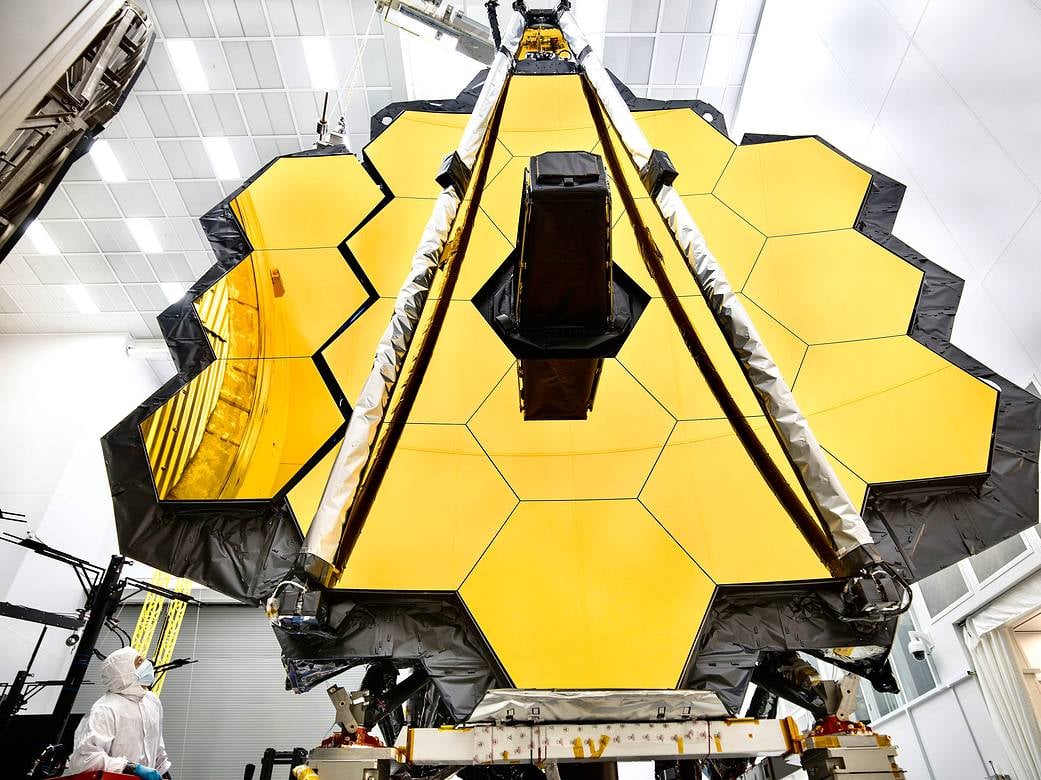
Prepared October 2, 2026. The news date is NASA’s October 1 release; the authors’ manuscript was submitted July 7, and its Webb observations predate the announcement. We read that public manuscript because the linked publisher full text was not accessible through the research browser. Collision reconstructions are the team’s interpretation. The fraction calculation, speed example and reading framework are Lumacta’s original explanation; no raw-data reanalysis, impact simulation, telescope operation or author interview is claimed. The photograph is documentary archive context showing Webb hardware, not a planetary collision or a new observation.
- NASA: Webb provides crash course on planet-shattering collisions — Primary research report dated October 1, 2026; links the journal article at DOI 10.3847/1538-4357/ae88fe
- Su and colleagues: Extreme Debris Disks — Authors’ public manuscript submitted July 7, 2026; methods, classifications, observation log and limitations; accepted for The Astrophysical Journal
- NASA: Mid-Infrared Instrument (MIRI) — Primary instrument reference checked October 2, 2026; spectroscopy and wavelength coverage
- NASA: Moon Formation — Primary background account checked October 2, 2026; evidence from lunar samples and limits on formation models