
The discovery came from a different way of looking
Astronomers have identified 84 unusual X-ray sources in six galaxies by examining Chandra observations, NASA announced on September 9. The study, published in Nature Astronomy, groups them by an unusual feature of their radiation: they appear at the lowest-energy end of the X-ray range, rather than behaving like more familiar sources.
This is not an announcement of 84 new planets, and it is not evidence for extraterrestrial technology. It is a finding about luminous cosmic objects whose physical nature still needs investigation. The observations were available in the Chandra archive. The novelty is recognizing a population that can be overlooked when researchers concentrate on different energy bands.
Sources: NASA: Chandra unveils mysterious X-ray objects, September 9; Muhibullah, Irwin and Di Stefano: Hypersoft X-ray sources
'Soft' describes the photons, not a faint or gentle object
X-rays and visible light are both electromagnetic radiation. They differ in the energy carried by individual photons, the packets of energy detected by a telescope. X-ray photons are more energetic than the visible light our eyes detect. Within X-ray astronomy, lower-energy photons are described as soft and higher-energy ones as hard.
The study's abstract places most or all of these sources' detected X-ray emission below 0.3 kiloelectronvolts, a unit of photon energy. Hypersoft identifies that unusually low-energy distribution. It does not mean the sources are weak overall: the authors report that some reach luminosities near ten to the power of 38 ergs per second in the narrow X-ray band alone.
Sources: Muhibullah, Irwin and Di Stefano: Hypersoft X-ray sources; Chandra: X-rays as another form of light
Why an object can appear in one image and vanish in another
A telescope does not only count where photons arrive; researchers can also sort detections by energy. Imagine making two views of the same field, one using lower-energy photons and another using higher-energy photons. An object concentrated in the first band can appear prominent there and barely register in the second, without physically switching off.
That is the key distinction behind this discovery. A missing dot in an energy-filtered image is not necessarily a vanished star. It may tell us that the object's radiation is distributed differently. The comparison is similar to examining the same scene through different filters, except the instrument is separating radiation outside human vision rather than the familiar colours of a photograph.
Sources: NASA: Chandra unveils mysterious X-ray objects, September 9; Chandra: X-rays as another form of light
Part of the light may never reach us
The researchers infer that much of these systems' energy could emerge in extreme ultraviolet light, just below the X-ray range. Gas between a source and Earth can absorb that radiation. The X-rays that survive therefore provide a clue to activity that cannot be measured simply by taking a normal optical photograph.
This creates an important distinction between detection and reconstruction. The detector records arriving photons. A model is then used to infer how much radiation the source may have emitted before some of it was absorbed. A model-based estimate can be scientifically useful without being a direct measurement of every photon leaving the object. The paper's interpretation should be read with that distinction intact.
Sources: Muhibullah, Irwin and Di Stefano: Hypersoft X-ray sources
The suspects are compact objects interacting with stars
The paper discusses several possible kinds of system, including accreting white dwarfs and black-hole systems. Accretion means gathering matter from the surroundings. In a binary system, material from one star can be drawn toward a compact companion. The resulting radiation can reveal the interaction even when the objects themselves cannot be resolved as a detailed picture.
A white dwarf is the dense remnant left by a star such as the Sun after its later evolutionary stages. Chandra's educational guide explains that material falling onto a white dwarf can heat gas enough to produce X-rays. Under some conditions, accumulated material can also undergo nuclear reactions. This is background about a possible mechanism, not confirmation that all 84 detections are white dwarfs.
Sources: Muhibullah, Irwin and Di Stefano: Hypersoft X-ray sources; Chandra: White dwarfs and accretion
Could some be stars on the road to an explosion?
One motivation for studying such systems is the origin of Type Ia supernovae. These explosions involve white dwarfs, and interactions with another star can be relevant to their evolution. The new paper suggests some hypersoft sources could belong to populations that help researchers investigate the systems preceding such explosions.
That possibility should not be translated into a prediction that these objects are about to explode. The study does not provide a countdown for the sample. Nor does identifying a possible precursor tell us that every system follows the same path. The value is a better set of candidates against which ideas about stellar evolution can be tested.
Sources: Muhibullah, Irwin and Di Stefano: Hypersoft X-ray sources; Chandra: White dwarfs and accretion
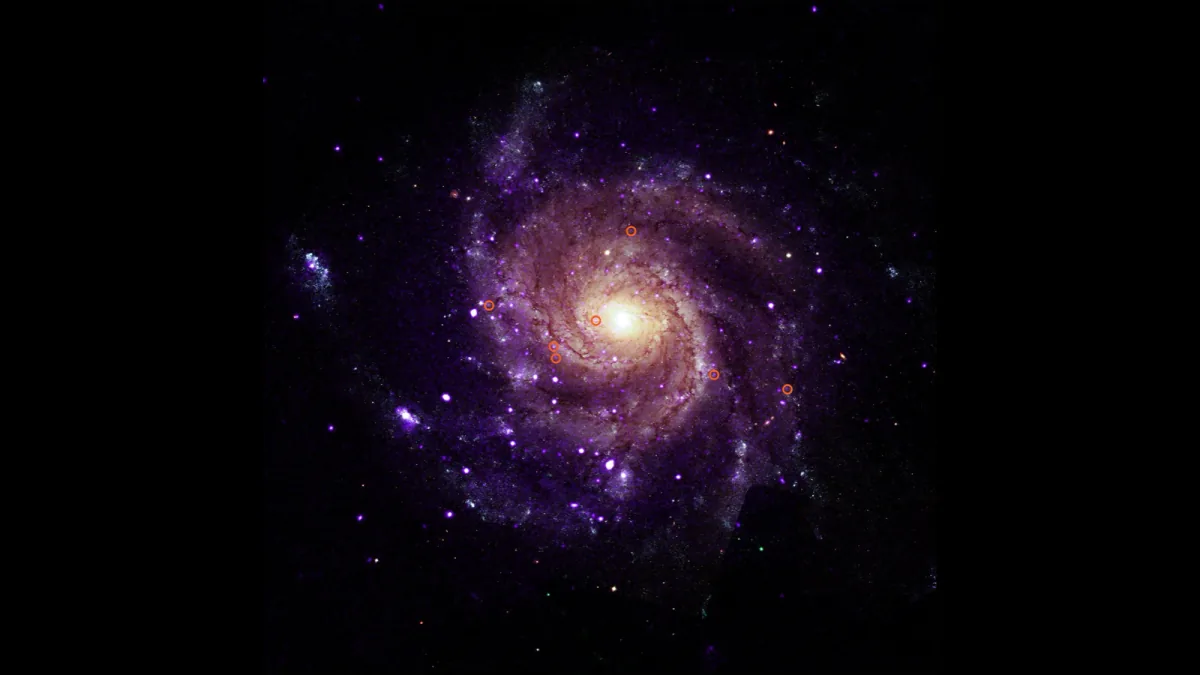
The image is real observational data, with assigned colours
The accompanying M101 image combines Chandra X-ray observations with optical data from Hubble. It is a scientific composite, not an AI-generated scene and not what a person would see through an ordinary telescope. Colours make different observational information visible; markers identify selected sources discussed by the release.
A composite can show where activity sits within a galaxy without resolving the machinery inside every dot. That is why the image and the proposed physical explanation carry different kinds of information. The former locates signals; the latter asks what could produce their distribution of energies. Treating a bright spot as a close-up photograph of a black hole would go beyond what is shown.
What would make this discovery more important
Lumacta's interpretation is that the useful next step is turning a shared observational signature into better-understood populations. Further observations and modelling could help distinguish systems that look similar in this narrow energy range but have different physical origins. Finding more objects is valuable; identifying which explanations survive the evidence is the deeper gain.
For the public, the story is also a reminder that a scientific archive is not a finished inventory. Existing measurements can reveal new patterns when researchers ask a different question. Chandra has not uncovered a new law of nature here. It has given astronomers a more specific mystery, with measurable clues and competing explanations.
Sources: NASA: Chandra unveils mysterious X-ray objects, September 9; Muhibullah, Irwin and Di Stefano: Hypersoft X-ray sources
Sources & Methods
Checked September 10, 2026 against NASA's September 9 release, the published Nature Astronomy abstract and Chandra's educational material. We did not reanalyse the observations or independently verify the paper's calculations. Proposed source identities are separated from detections; the image is a processed observational composite.
- NASA: Chandra unveils mysterious X-ray objects, September 9 — Primary source
- Muhibullah, Irwin and Di Stefano: Hypersoft X-ray sources — Research paper — abstract consulted
- Chandra: X-rays as another form of light — Scientific background
- Chandra: White dwarfs and accretion — Scientific background
- Chandra: M101 image and release record — Observational image record