
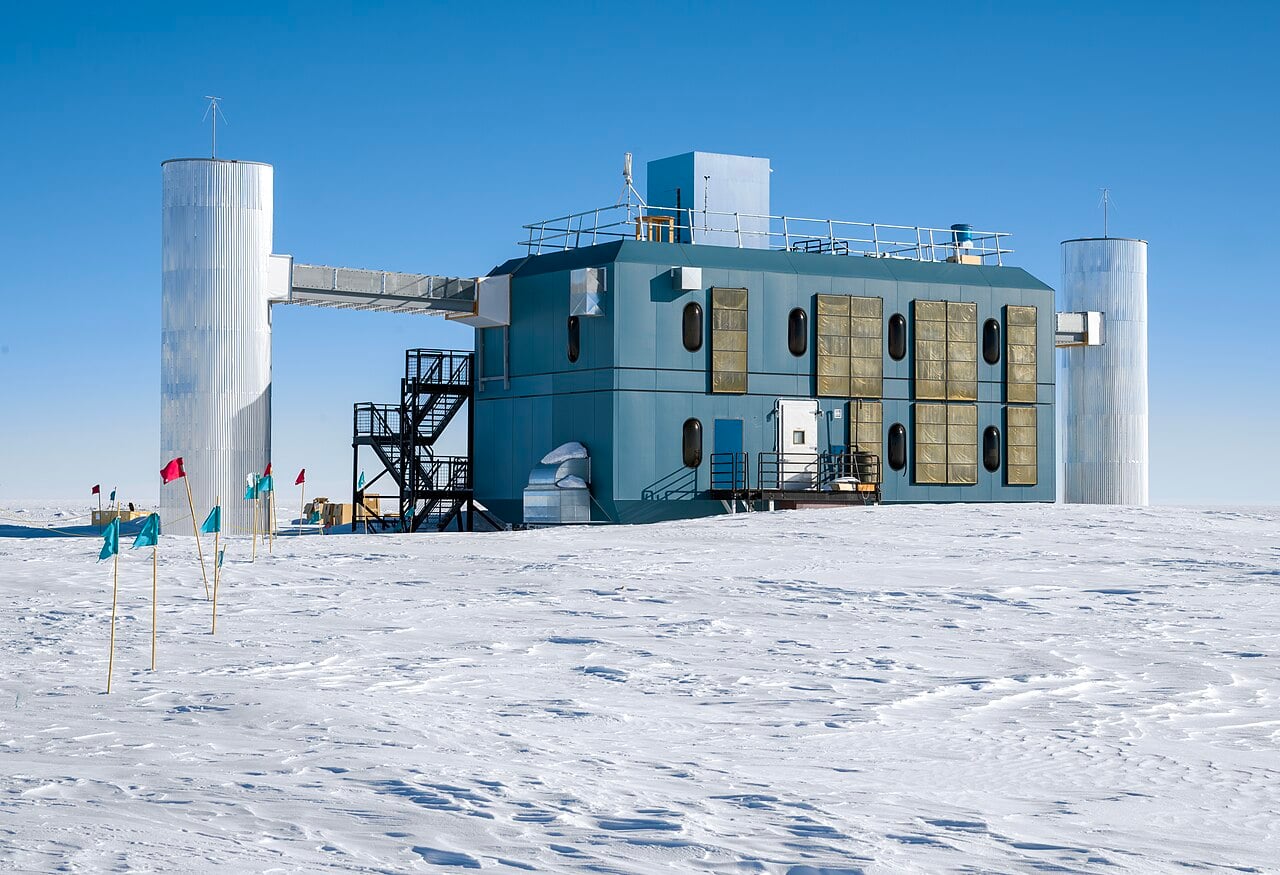
A new award, not a discovery made today
Francis Halzen of the University of Wisconsin–Madison has won the 2026 Nobel Prize in Physics. The Royal Swedish Academy of Sciences announced the decision on October 6, recognising his role in the IceCube observatory and the discovery of high-energy neutrinos from beyond Earth.
The distinction matters for a daily news edition. Today is the award date, not the date researchers first recorded these particles. A prize recognises a body of work; it does not reset the age of its supporting evidence. Our question is what that evidence actually looks like when the instrument is not a conventional camera.
Reading the announcement alongside the underlying measurement method turns a distant achievement into a useful lesson: an instrument can reveal an invisible process through a carefully understood consequence, provided alternative explanations are tested rather than merely ignored.
Source notes: 1. Editorial interpretation and illustrative calculations are identified separately.
The detector records light, not a neutrino photograph
IceCube’s description lists 5,160 optical modules in its principal in-ice array. Neutrino interactions can produce charged secondary particles, which emit Cherenkov light while travelling faster than light travels in ice, not faster than light in a vacuum. Sensors record and time-stamp that light; reconstruction uses its pattern to estimate particle direction and energy.
Our reading separates three layers: the recorded signals, a reconstruction of what produced them, and an astronomical interpretation. Calling all three a detection hides the intermediate work. A recorded flash is an observation; a direction estimate needs a model connecting possible particle paths with the signals a sensor would receive.
That distinction is not a weakness. It identifies where calibration, uncertainty and competing explanations must enter the argument, instead of treating an attractive event display as a literal view of a particle.
Source notes: 2. Editorial interpretation and illustrative calculations are identified separately.
A historical result shows why background matters
The collaboration’s 2013 research abstract describes data collected between May 2010 and May 2012. Across two searches, it reported 28 events and rejected a purely atmospheric explanation at the four-sigma level. It described the event properties as compatible with an additional extraterrestrial contribution. These are historical results, not fresh October 2026 measurements.
Our interpretation distinguishes a background test from a list of interesting objects. The important comparison is not simply whether a detector produced signals. It is whether the observed population resembles the population expected from the alternative being tested.
A significance statement also belongs to a particular analysis, with its assumptions and selection rules. It is not automatically the probability that a specific galaxy produced an individual event. Those questions require different evidence, even when both are discussed in the same news story.
Source notes: 3. Editorial interpretation and illustrative calculations are identified separately.
Finding a direction does not uniquely name a source
Consider a deliberately simplified geometric example, unrelated to IceCube’s measured accuracy. Draw a circular search region with a one-degree radius on a locally flat sky map. Its approximate area is π × 1², or 3.14 square degrees. A ten-degree radius gives about 314 square degrees: ten times the radius, roughly a hundred times the area.
These invented circles are not published event uncertainties or detector performance specifications. They illustrate why the width of a directional estimate changes the source-identification problem so much. A larger region allows many more possible associations before any timing or other information is considered.
Our proposed reading asks whether a claimed association uses the whole uncertainty region, rather than only a dot placed at its centre. Matching a point on a map can look persuasive while leaving the actual range of plausible directions unexamined.
Source notes: 2, 3. Editorial interpretation and illustrative calculations are identified separately.
Agreement is useful when it tests a different link
A practical evidence checklist should ask which link each additional observation tests. Another reconstruction of the same sensor signals is not the same kind of check as a separate instrument recording a corresponding phenomenon. Both can be informative, but they do not provide identical independence.
Likewise, increasing a detector’s scale and improving interpretation answer different engineering questions. More observations can help, yet a larger dataset does not automatically repair an incorrectly modelled background or an overconfident directional estimate. Quantity is most valuable when the measurement chain remains well understood.
This is Lumacta’s evaluation framework, not a claim that the collaboration neglected these checks. It lets readers distinguish better statistics, better calibration and stronger source association instead of compressing every improvement into one undifferentiated breakthrough.
Source notes: 2, 3. Editorial interpretation and illustrative calculations are identified separately.
The achievement is a trustworthy route from signals to astronomy
The most interesting implication is that astronomy can expand by changing what counts as a messenger, not only by making a familiar image sharper. To judge the resulting claim, follow the route from the instrument’s output to the physical conclusion and ask what could challenge each step.
Lumacta did not inspect detector hardware, analyse original event records or interview the laureate. We verified the announcement and read the instrument account and historical author abstract. The geometric example is our own reading aid, not a replication of the experiment.
The prize supplies the occasion to explain that chain. It does not supply a new event catalogue, a newly identified source or permission to discard uncertainty. Preserving those boundaries makes the story more compelling: the scientific achievement is meaningful precisely because the evidence has to survive them.
Source notes: 1, 2, 3. Editorial interpretation and illustrative calculations are identified separately.
Sources & Methods
Prepared October 6, 2026. The official Nobel press release was read directly from its HTTP 200 page after the web reader could not open it. We also read IceCube’s detector account and the authors’ 2013 arXiv abstract and bibliographic history; we did not reproduce the full research analysis. Award, data-collection and photograph dates are distinct. The search-area calculation and evidence checklist are original editorial explanation, not detector measurements. The real archival photograph was downloaded and visually inspected; no generated imagery is used.
- Nobel Prize: 2026 physics award announcement — Official primary announcement dated October 6, 2026; read directly from the source page
- IceCube: detector and reconstruction — Primary instrument account read October 6, 2026; principal array, light detection and signal reconstruction
- IceCube Collaboration: evidence for extraterrestrial neutrinos — Primary author abstract and bibliographic history read October 6, 2026; submitted November 20, 2013 and revised December 16; observations made May 2010–May 2012, not in 2026