An invitation to inspect the imperfect side of astronomy
The most useful contribution to a space mission is not always spotting something spectacular. Sometimes it is recognising that a mark in the data should not be there—or that a computer is about to remove something it should keep. That is the practical task behind NASA's September 11 invitation to join Artifact InSPECtor.
The project asks volunteers to examine real observations from Euclid and help assess artifacts identified by AI. The new announcement is a call for participation in an existing project, not evidence of a new telescope launch or a scientific discovery made that day.
For anyone curious about scientific AI, it is a revealing example. The work begins by assuming that automated decisions need checking. The human role is not to applaud an impressive output, but to look closely at where it may be wrong.
Sources: NASA: September 11 invitation to help refine telescope data; NASA: Artifact InSPECtor participation guide
Not every signal in a telescope's data comes from the sky
NASA lists several ways unwanted features can enter observations: stray light, reflections involving instrument structures, cosmic-ray hits and detector electronics. Such artifacts can interfere with the information researchers want to extract. The project's ambition is to help train automated tools to identify them more reliably.
The word artifact does not mean the telescope is useless or the observations are fabricated. It means that an observed feature may have an origin other than the astronomical phenomenon being studied. Distinguishing those origins is part of interpreting measurements.
Our explanatory example is a cleaning decision with two possible errors. Leave an unwanted feature in place and a later analysis might be misled. Remove a genuine feature and useful evidence may be lost. A good system needs to handle both risks, rather than simply remove as much as possible.
Sources: NASA: September 11 invitation to help refine telescope data
A spectrum answers questions a photograph cannot
NASA's spectroscopy guide explains how studying light at different wavelengths reveals information about matter, including composition, temperature and motion. A familiar astronomical image helps show where objects are and what they look like. A spectrum provides a different set of clues about what produced the light and what happened to it.
The project's name emphasises that spectral information. For a reader, the important point is that a subtle data-cleaning decision can matter even when it would not make a dramatic before-and-after photograph. Scientific value is not measured only by how attractive an image looks.
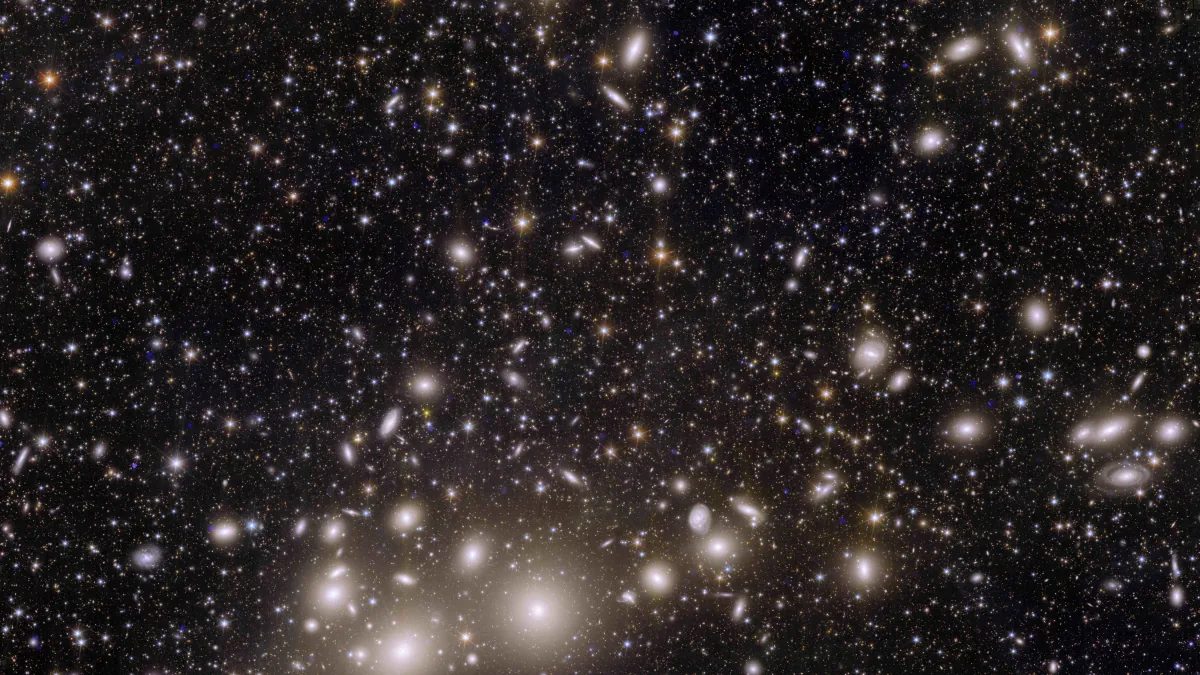
The archive image accompanying this article is a visible- and near-infrared composite of the Perseus galaxy cluster released in 2023. It provides Euclid context; it is not an example of an Artifact InSPECtor classification screen or a newly obtained 2026 result.
Sources: NASA: spectroscopy explained
What volunteers are actually asked to do
NASA's project guide says a tutorial takes around 10–15 minutes and no specialist knowledge is required. People can participate on a computer, tablet or phone. The task involves examining highlighted regions and judging whether the AI's identification of an artifact is appropriate, with a discussion area for questions.
The safest route is to start with the official NASA project page linked below and follow its participation link. Reading the tutorial before judging an example matters more than trying to make a large number of rapid classifications. This article does not submit answers or enrol readers automatically.
Our practical advice is to treat uncertainty as useful information, not a personal failure. A volunteer is contributing an observation to a research process, not certifying an entire telescope exposure. An unfamiliar or ambiguous case is a reason to use the project's guidance and discussion tools.
Many judgements can be useful, but agreement is not infallibility
Zooniverse, the citizen-science platform, explains that classifications from multiple volunteers are combined so researchers can assess agreement and uncertainty. This is a general platform principle. The sources reviewed here do not establish a specific vote threshold or number of reviewers for each Artifact InSPECtor example.
Our assessment is that repeated judgements can make the process more informative than relying on one hurried click. They do not automatically make it correct. People can share a misunderstanding, particularly if a difficult case resembles a familiar example from a tutorial.
That is why the research question should not stop at whether volunteers agree with one another or with the model. The more useful question is whether their contribution improves the treatment of genuinely new observations when assessed against carefully checked reference data.
Sources: Zooniverse: how citizen-science contributions are combined
Scientific perspective: human feedback needs a measured outcome
Lumacta's evidence-based assessment—not an independent evaluation of the project—is that this is a sensible use of human feedback for a task where errors have interpretable consequences. The September invitation reports no measured project-specific accuracy gain. We therefore cannot say how much the volunteers have improved the AI or any resulting cosmological estimate.
A convincing evaluation would test updated models on observations kept separate from the examples used for training. It would report missed artifacts and wrongly rejected scientific features separately, and examine difficult cases rather than only an overall average. These are our suggested scientific checks, not published findings from Artifact InSPECtor.
The positive possibility is a feedback loop in which public participation helps researchers understand and reduce an automated system's errors. The limit is equally important: a larger collection of labels is an input to scientific work. Its value still has to be demonstrated in the quality of the resulting measurements.
Sources: NASA: September 11 invitation to help refine telescope data; Zooniverse: how citizen-science contributions are combined
The connection to dark energy is a research goal, not today's result
Euclid is an ESA mission with important NASA contributions. Its mapping of the universe is intended to help investigate dark matter, dark energy and cosmic evolution. Cleaner observations can support that programme; they do not constitute an explanation of dark energy by themselves.
NASA's invitation also says observations from the Nancy Grace Roman Space Telescope are planned to enter the project in early 2027. That is a stated future plan, not evidence that Roman observations are available in this workflow now.
Our conclusion is that the immediate significance is modest but meaningful: an accessible way to take part in checking scientific data, and a reminder that trustworthy AI depends on visible limits and careful validation. The exciting destination is a better understanding of the universe. The work in front of volunteers is more concrete—helping researchers decide which pieces of a measurement deserve to be trusted.
Sources: NASA: September 11 invitation to help refine telescope data; NASA: Euclid mission overview
Sources & Methods
Checked September 13, 2026. News peg: NASA's September 11 participation invitation, not the project's original launch date. The NASA guide establishes the task and equipment requirements. Euclid and spectroscopy pages provide background; Zooniverse describes general aggregation, not a project-specific voting rule. Scientific interpretation and proposed evaluation criteria are Lumacta's analysis. We did not submit classifications, evaluate the AI, interview the project team or independently validate cosmological results.
- NASA: September 11 invitation to help refine telescope data — Official primary source
- NASA: Artifact InSPECtor participation guide — Official primary source
- NASA: spectroscopy explained — Scientific background
- NASA: Euclid mission overview — Mission background
- Zooniverse: how citizen-science contributions are combined — Platform methodology