
The discovery is a relationship, not an explosion
An MIT-led study published October 5 describes ZTF J0440+2325, about 300 light-years away: a brown dwarf supplies matter to a small star while the pair remains in a close orbit. MIT announced the result the same day.
The compelling part is the coexistence of feeding and continued orbiting. A destruction story ends with the disappearance of its smaller participant; a transfer story asks how the participants change while both remain. Those are different physical histories, and a headline about a star “eating” something can hide the distinction.
For readers, the useful starting question is therefore not how frightening the event looks. It is what measurements distinguish a surviving donor that loses material from an object already being destroyed.
Source notes: 1, 3. Editorial interpretation and illustrative calculations are identified separately.
A repeating pattern opened the investigation
MIT describes a recurring triangular brightness pattern in Zwicky Transient Facility data from Palomar Observatory. Follow-up observations measured the system’s motion. The small wobble supported a low-mass star and brown-dwarf pairing rather than the neutron-star system initially considered.
A light curve plots brightness against time. That can carry information absent from a single beautiful exposure: whether a change repeats, whether its shape persists and whether different measurements share a clock. The data here should not be mistaken for a resolved video of matter travelling between two visible spheres.
Our reading of the investigative sequence is that the odd shape supplied a question, not its own answer. Testing the identities of the participants mattered before interpreting the repeating light. Pattern recognition is a beginning; an explanation must also survive measurements that were not used merely to notice the pattern.
Source notes: 1. Editorial interpretation and illustrative calculations are identified separately.
The proposed stream has to explain more than one color
Nature’s October 6 publisher release reports five-band light measurements and a bright hot spot on the red dwarf. It describes modelling in which matter travels directly from the brown dwarf to the star’s surface. The listed orbital period is 86.65 minutes.
This creates a useful separation between the measured signals and the physical interpretation. Brightness and its wavelength dependence are observations; the route taken by transferred matter is a model connecting those observations to an arrangement of objects. Calling the result observational evidence does not mean a camera traced every moving parcel.
Our scientific assessment is that a convincing account should explain the pattern across measurements rather than fit one selected peak. Ask whether the same proposed geometry can account for the timing, color changes and motion together. That is an evaluation principle, not an independent reanalysis of this dataset.
Source notes: 2. Editorial interpretation and illustrative calculations are identified separately.
Do not turn a candidate into a second confirmed discovery
The final abstract identifies J0440+2325 as a mass-transferring brown-dwarf–M-dwarf binary. It separately presents J1444+4820, with a 67-minute period, as a strong candidate in a hierarchical triple. We retain that difference instead of counting two equally established examples.
The reason is practical: a result can support a mechanism without showing how frequently it occurs. Finding a promising second target broadens the investigation, but does not by itself supply a population count. A catalogue needs consistent admission rules, including what evidence qualifies a target and what remains uncertain.
For a follow-up survey, our proposed questions are which systems its selection process would miss and whether rejected candidates remain documented. Otherwise, the number of attractive detections can be confused with the number of systems that actually exist.
Source notes: 3. Editorial interpretation and illustrative calculations are identified separately.
A short orbit helps observations; it does not prove a long lifetime
Consider an invented observing exercise using the reported 86.65-minute period. A hypothetical three-hour session spans about 2.08 orbits; a six-hour session spans about 4.15. Divide the session length in minutes by the period. These are planning calculations, not observations made by Lumacta or the discovery team.
More cycles could help test whether a pattern repeats, provided the sampling and observing conditions are adequate. They would not turn six hours into direct evidence of a billion-year history. Repetition over a night and stability over stellar evolution are questions at radically different scales.
That distinction also prevents an easy reading error: “stable” does not mean nothing changes. A proposed transfer process can be stable while the objects gradually lose and gain matter. Its future must be evaluated as an evolving system, not as a frozen arrangement copied endlessly from one observed cycle.
Source notes: 2. Editorial interpretation and illustrative calculations are identified separately.
The next discovery is how common this pathway is
The final abstract allows gradual consumption lasting potentially billions of years. That is a physical prediction, not a duration the telescopes have witnessed. We cannot independently establish its timescale from the accessible abstract and announcements, nor determine which alternative models the final manuscript excludes.
The most valuable next evidence, in our view, would connect additional confirmed examples to a well-described search. Repeated detections with known selection limits could help separate an unusual individual system from a broader evolutionary pathway. Further monitoring could also test whether a system’s behavior remains consistent with the interpretation.
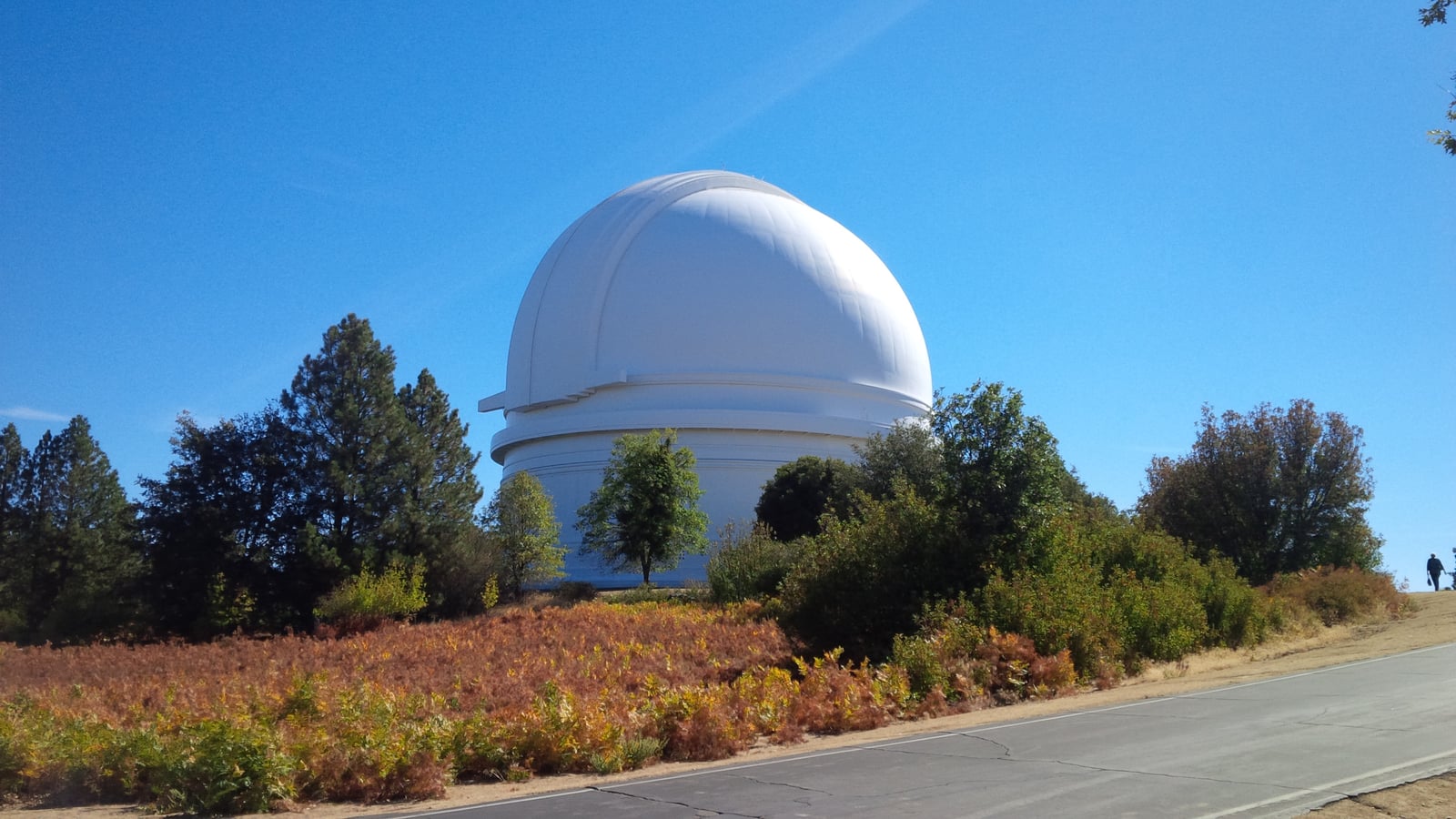
The real photograph accompanying this article shows Palomar’s site in 2014, not this binary or a stream of matter. The result is interesting without turning an artist’s impression into a photograph: a changing point of light has revealed a possible history that a single image could not tell.
Source notes: 1, 2, 3. Editorial interpretation and illustrative calculations are identified separately.
Sources & Methods
Prepared October 7, 2026. We read MIT’s October 5 institutional announcement, Nature’s October 6 publisher release, and the final study’s complete accessible abstract and metadata in MIT’s repository. The final manuscript is listed there with a request-a-copy control; it and the underlying observations were not reviewed. The distinction between the reported J0440 system and the J1444 candidate follows the final abstract. Explanatory comparisons, proposed survey questions and explicitly hypothetical observing-session calculations are original analysis, not independent experimental results. No telescope observation, model reproduction or interview was performed.
- MIT: a star gradually consumes a brown dwarf — Primary institutional announcement, October 5, 2026; full announcement read
- Nature Portfolio: dwarf stars consuming their companions — Primary publisher release, October 6, 2026; includes two distinct studies. Only the red-dwarf system is developed here
- Householder and colleagues: stable mass transfer onto an M dwarf — Primary final-paper abstract and repository metadata, issued October 5, 2026; DOI 10.1038/s41550-026-02992-6. Final full manuscript and raw data not reviewed