
A completed deal, not just a proposed acquisition
Microchip Technology announced on September 21, 2026 that it had completed its acquisition of Hailo, whose portfolio includes edge-AI accelerators, vision and robotics processors, and software. The transaction terms were not disclosed. Microchip says it plans to continue supporting Hailo's existing products, software environment and customer engagements.
That is the confirmed corporate change. It is not an announcement that every Hailo device has become faster, cheaper or compatible with a new set of models. Existing customers should distinguish the commitment to support from a detailed, product-specific roadmap.
The broader significance is how the companies fit together. Microchip brings embedded processing, connectivity, security, power and other components; Hailo brings specialised AI technology. Our reading is that the combination targets a familiar engineering problem: getting a promising demonstration to work as part of a dependable, maintainable product. Owning more of the pieces could help, but the acquisition itself does not prove that integration has been achieved.
Sources: Microchip: completed Hailo acquisition (September 21)
Why local AI is not simply a smaller cloud
Edge AI means processing near the source of the data rather than depending on a remote server for every inference. Raspberry Pi's documentation provides a concrete example: an AI HAT adds a Hailo neural processing unit to a Raspberry Pi 5, allowing supported models to run locally. Camera frameworks can use it for tasks such as object detection.
Consider a camera inspecting items on a production line. A local system could turn images into a decision without uploading every frame. That is an illustrative application, not a deployment verified for this article. Its value would depend on reliable detection, the time available to react and what happens when the model is uncertain.
Local processing can reduce the need to transmit raw data, but it is not a privacy guarantee. A device can still store sensitive recordings, expose an insecure interface or send results elsewhere. The appropriate question is what the complete application collects, retains and shares—not simply whether its AI chip sits on site.
Raspberry Pi shows why the ecosystem matters
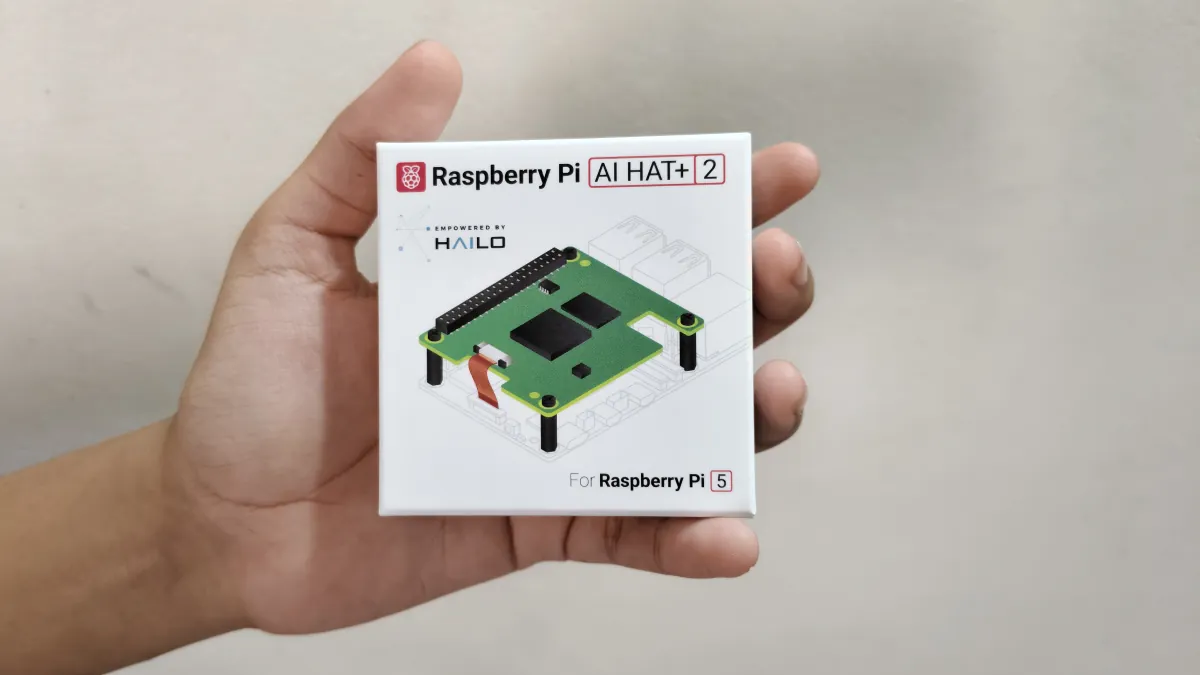
The Raspberry Pi AI HAT+ 2 is an existing example of Hailo technology reaching developers. Its official product page specifies a Hailo-10H accelerator, 8GB of onboard memory and 40 TOPS at INT4 precision. It supports local generative-AI use as well as camera-oriented work. This is not a new board launched as a consequence of the acquisition.
Raspberry Pi also makes an important qualification: computer-vision performance is comparable to the 26-TOPS AI HAT+. That alone shows why reading 40 versus 26 as a universal speed improvement would be misleading. A specification belongs to a particular numerical precision and workload; it is not a single score for everything a computer can do.
For a buyer, the better starting point is the application. Which model is supported? How much memory does it need? Can the camera, operating system and accelerator work together in the intended configuration? Those questions are more useful than choosing the largest advertised operations-per-second number and hoping the software will follow.
Sources: Raspberry Pi AI HAT+ 2: specifications; Raspberry Pi: AI HATs and local inference
The hidden product is the software path
Raspberry Pi's AI software documentation describes separate dependencies for its Hailo-8-family boards and the Hailo-10-based AI HAT+ 2. It warns that the respective package families cannot coexist. It also identifies compatibility requirements between drivers, runtimes and model-toolchain versions. These are current integration details, not changes attributed to Microchip.
For a prototype, installing the right combination may be a manageable one-off task. For an organisation maintaining many devices, the questions multiply. Can an update be tested before it reaches the fleet? Can a failed update be reversed? How long will a known-working software combination remain supported? These are practical due-diligence questions, not deficiencies we have established in either company's products.
Microchip's stated intention to maintain Hailo support is therefore relevant, but customers should look for concrete documentation and communication. A useful integration would preserve working applications while giving developers a clear path forward. A larger corporate portfolio does not automatically remove the effort needed to validate a customer's own system.
Sources: Raspberry Pi: AI software and dependency requirements; Microchip: completed Hailo acquisition (September 21)
Scientific perspective: test the whole pipeline
Lumacta's evidence-based assessment is that an edge-AI product should be evaluated from sensor input to useful output. Accelerator throughput is only one part of that journey. Image capture, preprocessing, data movement, model execution and application logic all belong in the test. A fast neural-network stage cannot compensate for an unreliable final decision.
A credible comparison would use the same task, representative inputs and an explicit accuracy target. It should report response time, power consumption at the system level and sustained behaviour under realistic operating conditions. For a camera, that might include changing light, motion and difficult examples rather than a small collection of easy scenes.
Those are proposed evaluation conditions, not benchmark results from Lumacta. We have not measured a post-acquisition performance gain. The Raspberry Pi specifications and software requirements illustrate why such testing is necessary: different accelerators and software combinations do not become interchangeable merely because they perform AI inference.
Sources: Raspberry Pi: AI HATs and local inference; Raspberry Pi AI HAT+ 2: specifications; Raspberry Pi: AI software and dependency requirements
Where the opportunity lies—and what buyers should wait to see
The potential upside is a more coherent route from a local-AI idea to a finished device. If hardware selection, support and software integration become simpler, smaller engineering teams could spend less time assembling infrastructure and more time solving their actual problem. That benefit remains an outcome to demonstrate, not a saving already measured.
There are trade-offs to watch. A tightly integrated supplier ecosystem can be convenient, but buyers should assess how difficult it would be to change a model, replace a component or move to another platform. The relevant cost is not just the initial board: it includes development, validation, maintenance and the consequences of downtime.
For existing Hailo users, the immediate step is to follow product-specific support notices rather than redesign a working system because ownership changed. For new projects, the acquisition makes the combined roadmap worth examining. The most convincing next announcement would be a well-supported, reproducible development path—not another peak-performance number without an application around it.
Sources: Microchip: completed Hailo acquisition (September 21); Raspberry Pi: AI software and dependency requirements
Sources & Methods
Checked September 22, 2026. Microchip's completion announcement is dated September 21. Raspberry Pi's product and integration documents describe existing hardware, not post-acquisition improvements. We did not benchmark devices, interview the companies or verify a customer deployment. The scientific perspective and engineering examples are labelled editorial analysis.
- Microchip: completed Hailo acquisition (September 21) — Primary acquisition announcement
- Raspberry Pi: AI HATs and local inference — Official architecture and compatibility documentation
- Raspberry Pi AI HAT+ 2: specifications — Primary hardware specification; existing product
- Raspberry Pi: AI software and dependency requirements — Official software integration documentation