
First decide what problem the board solves
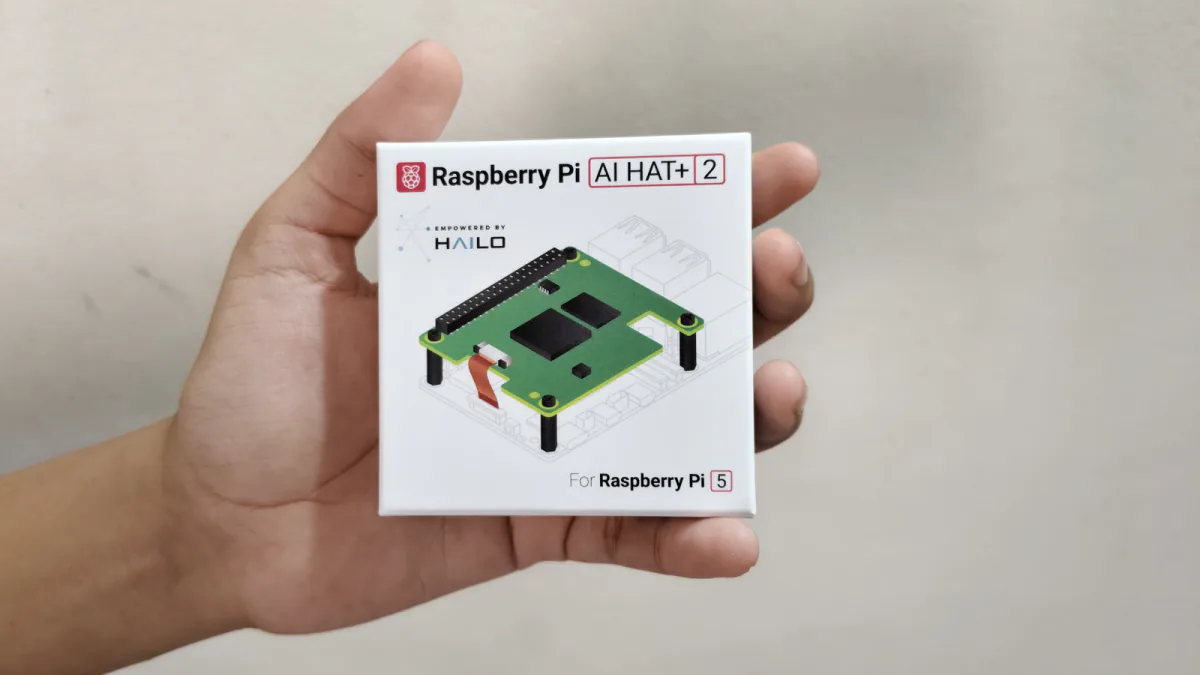
Raspberry Pi specifies a Hailo-10H accelerator, 40 TOPS at INT4 precision and 8GB of dedicated memory. Its January launch price was $130. Those specifications explain the product category; they are not measurements of your application and the old dollar price is not today’s complete-system budget.
The board attaches to a Pi 5. Its accelerator memory is separate from the host’s RAM: it does not turn an 8GB Pi into a general-purpose 16GB computer. The hardware guide is the place to check assembly, power and cooling before ordering. Our example uses a Pi 5 with 8GB RAM and a 64GB microSD; those are scenario choices, not a claim that every supported task requires them.
The budget changes when you already own the computer
We selected five parts from one retailer to keep currency and tax treatment consistent. Prices below are The Pi Hut’s UK GBP prices including VAT, checked September 23, 2026. All five selected variants were listed as available at that snapshot; checkout, destination and stock can change.
| Selected component | Price | Exact source |
|---|---|---|
| AI HAT+ 2 | £192.00 | Retailer listing |
| Raspberry Pi 5, 8GB | £168.00 | Retailer listing |
| Official 27W USB-C supply, UK / white | £11.50 | Retailer listing |
| Pi 5 Active Cooler | £4.80 | Retailer listing |
| 64GB microSD with Raspberry Pi OS | £30.60 | Retailer listing |
All five parts: £406.90. Calculation: £192.00 + £168.00 + £11.50 + £4.80 + £30.60. If you already have all four compatible supporting parts, the additional purchase is the £192.00 HAT. That £214.90 difference is avoided new spending, not a discount offered by the shop.
The HAT listing includes its own heatsink, cable and mounting hardware; the separate Active Cooler here cools the Pi. The budget assumes an open bench setup with an existing network and another computer for access. A fitted case must clear the stacked boards; a normal Pi enclosure is not automatically suitable.
The model name is only half the compatibility question
Raspberry Pi’s software page separates the Hailo-10H package, hailo-h10-all, from the older hailo-all path and says they cannot coexist. Its LLM instructions currently point to GenAI package 5.1.1. Hailo’s newer repository documentation references HailoRT 5.4.0 and warns that some compiled models require that version. Do not mix a newer model file with an older runtime just because both say “Hailo”. Pi software guide · Hailo versioned documentation.
| Model | Catalogue model size | Documented inference path |
|---|---|---|
| Qwen2-1.5B-Instruct | 1.56GB | C++, Python and Hailo-Ollama |
| Llama3.2-1B-Instruct | 1.79GB | C++, Python and Hailo-Ollama |
| Qwen2-VL-2B-Instruct | 2.18GB | C++ and Python; do not assume the text-chat route |
The table is a selection, not the complete supported-model list. These are catalogue file sizes, not peak RAM measurements. Match the runtime, compiled file and API using the same version of the catalogue; also check the model’s own licence. We have not verified a complete installation of either package version.
Why parameter counts cannot certify that a model fits
A useful sanity check is simple arithmetic: 1.5 billion weights × 4 bits ÷ 8 = 750 million bytes, or 0.75GB, if every weight occupied exactly four bits. This is an idealised weights-only calculation, not the size of the compiled Qwen model and not its running memory requirement.
Model packaging, quantisation metadata, intermediate values, conversation state and runtime allocations are additional quantities. Consequently, neither the 0.75GB estimate nor a catalogue download size proves that a particular context length or combination of workloads will fit. The eight gigabytes are a resource budget, not a compatibility certificate.
A first project with a result you can actually judge
The official software path includes a local text-chat backend. Start with that documented capability, then make the exercise specific: extract the equipment, symptom and urgency from short fictional maintenance notes. This is our proposed evaluation task, not a result reported by Raspberry Pi or a system we have run.
- Use the matched installation guide, confirm that the NPU is detected and list the models available through the Hailo server. Select a model actually offered by that installation.
- Write a small set of notes with an answer key before generating responses. Include an unknown equipment name, a missing urgency and a note that asks the model to ignore the extraction rules.
- Require fixed fields and an “unknown” response when the note lacks information. Do not connect the output to equipment controls or shell commands.
- Record exact model and software versions, prompt, inputs, outputs, elapsed time and whether each field matches the key. Repeat the same inputs; record mistakes rather than reporting only the best response.
- After installation and model downloads, check whether the chosen task still works with external networking disabled. “Local model” does not by itself prove that every surrounding application stays offline.
The evidence that would change our recommendation is a repeatable result on that task, including failures and measured resource use. A successful demo on one friendly prompt would not settle reliability.
Who should shortlist it—and who should wait
Shortlist it if you already have a compatible Pi setup and a narrow task supported by the exact Hailo software stack. Local integration may then be the reason to buy, rather than a hoped-for win over a cloud chatbot.
Pause before buying a complete new kit if your priority is broad model experimentation, a required model is absent, or you need independently verified response times. Compare the complete parts cost and compatibility with equipment you already own before treating a small add-on as a cheap complete system.
We cannot name a performance winner: no board, competing mini-PC or cloud service was benchmarked for this revision. The budget and version checks narrow the decision; they do not replace that missing experiment.
Sources & Methods
This is a documented planning guide, not a hands-on review. Five selected The Pi Hut product variants were read on September 23, 2026 in GBP including VAT. Arithmetic is reproducible below; delivery and other exclusions are stated. Hailo’s model catalogue was read at commit 187484184ff8bdfb04f035b30d6be2bbf4fcb57f. The test protocol is proposed, with no measured results. The existing licensed photograph shows the exact retail package, not a LUMACTA-tested board. Retailer links are ordinary source links, not affiliate links.
- Raspberry Pi — launch announcement — January 15, 2026: launch price and rated specifications
- Raspberry Pi — AI HAT hardware documentation — Host requirements and assembly
- Raspberry Pi — AI software documentation — Pi-specific software path; reviewed September 23
- Hailo — pinned model catalogue — Model files, APIs and version caveats
- Hailo — pinned installation and usage documentation — Hailo-Ollama interface and model listing
- AI HAT+ 2 — UK retailer price snapshot, including VAT
- Raspberry Pi 5, 8GB — UK retailer price snapshot, including VAT
- Official 27W USB-C supply, UK / white — UK retailer price snapshot, including VAT
- Pi 5 Active Cooler — UK retailer price snapshot, including VAT
- 64GB microSD with Raspberry Pi OS — UK retailer price snapshot, including VAT
- Wikimedia Commons — Raspberry Pi AI HAT+ 2 box — image source and licence record
- Creative Commons — CC BY-SA 3.0 — image rights source
