
Availability check: the range is on sale, not every configuration
Apple’s September 22 follow-up says the new Mac mini and Mac Studio have reached its online and physical stores. That moves the story beyond a pre-order announcement, but it does not certify stock or delivery for a particular configuration in your country.
| Model | US starting price | Memory ceiling in announcement | Availability boundary |
|---|---|---|---|
| Mac mini, M6 | $899 | 32GB | Range launched September 22; check the selected SKU. |
| Mac mini, M5 Pro | $1,699 | 64GB | Range launched September 22; check the selected SKU. |
| Mac Studio, M5 Max | $2,499 | 128GB | Range launched September 22; check the selected SKU. |
| Mac Studio, M5 Ultra | $5,499 | 512GB | 512GB configuration scheduled for late October, not part of immediate availability. |
Starting price and maximum memory describe different configurations. The $5,499 figure must not be read as the price of a 512GB Studio. These are Apple’s US list-price references; currency conversion alone cannot establish a Romanian or other European checkout price, tax treatment or delivery date.
For a local-AI purchase, write down the actual model, quantisation, context length and concurrent users before selecting memory. A configuration that holds the weights may still lack room for the operating system, working data and inference cache. Conversely, paying for capacity that your application cannot use is not an automatic productivity gain. We have not measured either case on these machines.
One strategy, two very different desktops
Apple's August 25 announcements make an unusually direct argument: the next desktop upgrade cycle is about keeping more AI work on the machine. The new Mac mini comes with M6 or M5 Pro, while Mac Studio moves to M5 Max or M5 Ultra. Both retain compact enclosures, but they target different limits — an accessible always-on box at one end and a high-memory workstation at the other.
The company repeatedly uses local models, coding agents, image generation and automated workflows as examples. That matters because the pitch is no longer confined to a Neural Engine score. Apple is combining GPU-based Neural Accelerators, unified memory, faster interconnects and software frameworks into a broader local-compute proposition.
Mac mini becomes Apple's entry-level AI appliance
The M6 Mac mini has a 12-core CPU, 12-core GPU with Neural Accelerators in every GPU core and what Apple calls a Dual 16-core Neural Engine. It starts with 16GB of unified memory, can be configured to 32GB and reaches up to 170GB/s of memory bandwidth. Apple says its AI performance can be up to four times faster than the M4 model, depending on the workload and comparison configuration.
The M5 Pro version raises the ceiling to an 18-core CPU, 20-core GPU, 64GB of unified memory and 307GB/s of bandwidth. It also moves from Thunderbolt 4 on the M6 model to Thunderbolt 5. Both versions add Wi-Fi 7, Bluetooth 6 and standard 2.5Gb Ethernet, with 10Gb Ethernet available as an option.
Mac Studio makes memory capacity the differentiator
Mac Studio with M5 Max reaches an 18-core CPU, a 40-core GPU, up to 128GB of unified memory and 614GB/s of memory bandwidth. The M5 Ultra configuration goes much further: up to a 36-core CPU, 80-core GPU, 512GB of unified memory and 1.2TB/s of memory bandwidth.
That 512GB ceiling is the most consequential specification for local AI users. Large models are often constrained by whether their weights and working data fit in available memory. Capacity does not guarantee fast or efficient inference, but it changes which workloads can run without splitting a model across separate memory pools or sending data to a cloud service.
Thunderbolt clustering is Apple's scale-up story
Apple says multiple Mac Studio systems can be linked through Thunderbolt 5 using RDMA, creating a shared pool for distributed inference. Its announcement claims a cluster of four systems can deliver up to three times the AI inference performance of one Mac Studio. Mac mini with M5 Pro also supports clustering through Thunderbolt 5.
The claim is interesting, but the practical questions are substantial: model support, networking overhead, scheduling, failure handling, energy use and total system cost will decide whether this is useful outside controlled demonstrations. Apple has not supplied an independent benchmark or a universal scaling figure, so the three-times result should be read as one tested configuration, not a promise for every model.
The impressive numbers still belong to Apple
Apple reports large gains across LM Studio, image generation, video tools, ray-traced graphics and scientific applications. Those results use specific prior Macs, selected software versions and Apple-run tests. They establish what the company measured under its stated conditions; they do not yet establish day-to-day performance, noise, thermals or value across the wider market.
The same caution applies to privacy. Running a model locally can reduce the need to transmit prompts or files to a remote service, but the privacy outcome still depends on the application, model, telemetry settings and network behaviour. A local-capable Mac is not automatically a private workflow.
Prices start far apart, and one configuration comes later
In the United States, Mac mini starts at $899 with M6 and $1,699 with M5 Pro. Mac Studio starts at $2,499 with M5 Max and $5,499 with M5 Ultra. Pre-orders opened August 25, and Apple says general availability begins September 22; the Mac Studio configuration with 512GB of unified memory is due in late October.
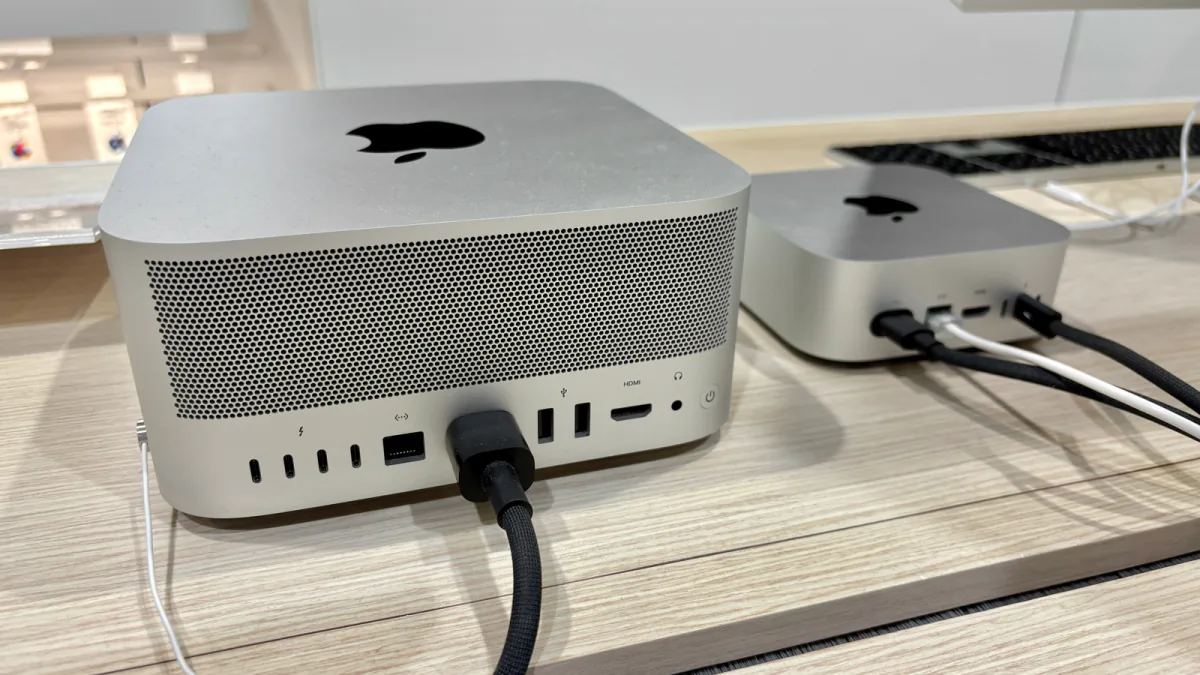
The hero photograph is deliberately not an Apple Newsroom asset. Apple's site terms do not grant general commercial republication rights for its photographs, so LUMACTA NEWS uses a CC BY-SA image of the previous-generation product families and labels that limitation directly. Before any buying recommendation, regional prices and shipping configurations should be checked again.
Sources & Methods
Published reporting and original source context are retained. September 23 revision: Added the September 22 availability announcement and separated the delayed 512GB configuration from the launch range. New explanatory examples are explicitly hypothetical; no independent hardware or model benchmark is claimed.
- Apple — Mac mini with M6 and M5 Pro — manufacturer announcement, specifications and test notes
- Apple — Mac Studio with M5 Max and M5 Ultra — manufacturer announcement, specifications and test notes
- Apple — M6 and M5 Ultra architecture overview — manufacturer chip announcement
- Wikimedia Commons — Mac mini and Mac Studio photograph — context image source and author record
- Creative Commons Attribution-ShareAlike 4.0 — image licence
- Apple — new Mac mini and Mac Studio available — Primary documentation, checked September 23, 2026
