
The news is a price and a timetable—not a delivered review unit
Microsoft opened $2,599-MSRP Surface Laptop Ultra preorders October 7, with availability scheduled October 16. The $5,999 Surface RTX Spark Dev Box is U.S.-only through Microsoft.com, shipping November. These are announced U.S.-dollar prices, not Romanian quotes.
The current U.S. laptop product page displays $2,599.99. Treat that as a published starting price, not a checkout we completed. Neither the starting figure nor a preorder button establishes the price of the highest-memory configuration, its local stock or the day it will reach your desk.
Our reading is that this is now a concrete procurement question, not only a future-PC pitch. Obtain the exact configuration, delivery estimate, tax treatment and return conditions before making a deadline-dependent purchase.
Source notes: 1, 2. Editorial interpretation and illustrative calculations are identified separately.
Two laptop configurations are not one interchangeable specification
NVIDIA’s laptop table lists RTX Spark N1X options with 5,120 GPU cores and an 18-core Grace CPU, or 6,144 GPU cores and a 20-core CPU. Their listed memory ceilings are 64 GB and 128 GB respectively. Both use a Blackwell RTX GPU and unified memory.
Compare the actual machine being quoted, not a collage of the cheapest price and largest specifications from different rows. Record processor and memory together: GPU-core arithmetic cannot make an oversized workload fit.
The 1-petaflop headline is theoretical sparse FP4 performance, as Microsoft’s announcement footnote explains. It is not a measured rate for your editor, a guarantee of model response time or a result comparable without qualification to another arithmetic format. Ask for a repeatable finished-task measurement before converting that headline into a productivity forecast.
Source notes: 1, 3. Editorial interpretation and illustrative calculations are identified separately.
A model fitting its weights is only the first memory question
Microsoft qualifies 128 GB as total system memory shared between CPU and GPU; the GPU-addressable amount is smaller and depends on configuration and workload. It should not be treated as 128 GB of dedicated graphics memory waiting unused for one application.
Consider an invented sizing exercise, not a benchmark or a claim about a particular model. Storing 120 billion numerical weights at four bits each requires 120 billion × 4 ÷ 8 = 60 billion bytes: 60 GB in decimal units. That calculation covers only the assumed weight values.
It excludes quantization metadata, working buffers, stored conversation state, the operating system and other applications. Representations may differ. A nominal 64 GB pool does not establish practical fit. Our proposed check records peak memory at the intended context length and concurrent work, including failures—not just a successful load.
Source notes: 1, 2. Editorial interpretation and illustrative calculations are identified separately.
Check the screen and media path as carefully as the AI model
Microsoft lists a 15-inch touchscreen with up-to-120-Hz refresh; its footnote says pen input is unsupported. The 2,000-nit peak HDR figure is measured on a 10% window, with lower sustained and SDR brightness. Ports include three USB-C connections, USB-A, HDMI, an SD reader and a headphone jack.
For a filmmaker, our proposed trial uses actual camera files, effects, audio interface and export destination. Test playback, scrubbing, export correctness and external-display behavior together. A model demonstration does not establish that a color-managed edit or required peripheral works.
NVIDIA describes hardware video acceleration, including 4:2:2 workflows. That is a reason to investigate the path, not assume every codec profile and application version takes it. Record the file format, software version and enabled acceleration. Also check the input device you need: a touchscreen is not automatically a replacement for a pen-based drawing workflow.
Source notes: 2, 3. Editorial interpretation and illustrative calculations are identified separately.
Local inference can change the workflow without making it free
Where a calculation runs is not necessarily where the whole job goes. An application may synchronize files, call online tools or route a later request elsewhere. Verify the complete workflow before promising a client that their material never leaves the machine.
Similarly, avoiding a metered remote inference call does not eliminate ownership costs. Budget for hardware, electricity, setup, software rights and the person who maintains the environment. Compare those costs with the work that would genuinely move off a paid service; do not count a subscription saving if you will still need that subscription.
The desktop’s separate timetable makes this a second decision, not merely a laptop without a display. Ask whether shared desk-based access or personal mobile work is the requirement. We have not measured either machine’s sustained performance, noise, power draw or unattended operation, and a shared chip name cannot supply those missing comparisons.
Source notes: 1, 3. Editorial interpretation and illustrative calculations are identified separately.
Who should investigate now—and who should wait for evidence?
Our buying view is conditional: investigate if a memory limit or remote-compute workflow is holding up valuable work, and you can validate the software before the return window closes. The useful promise is enabling that job, not winning a compute-number contest.
For ordinary browsing, document work or an occasional AI question, we see no demonstrated reason in these announcements alone to replace a functioning computer. For deadline-sensitive creative work, keep the existing setup until a representative project and recovery plan pass. This is editorial advice, not a hands-on recommendation based on tests we did not perform.
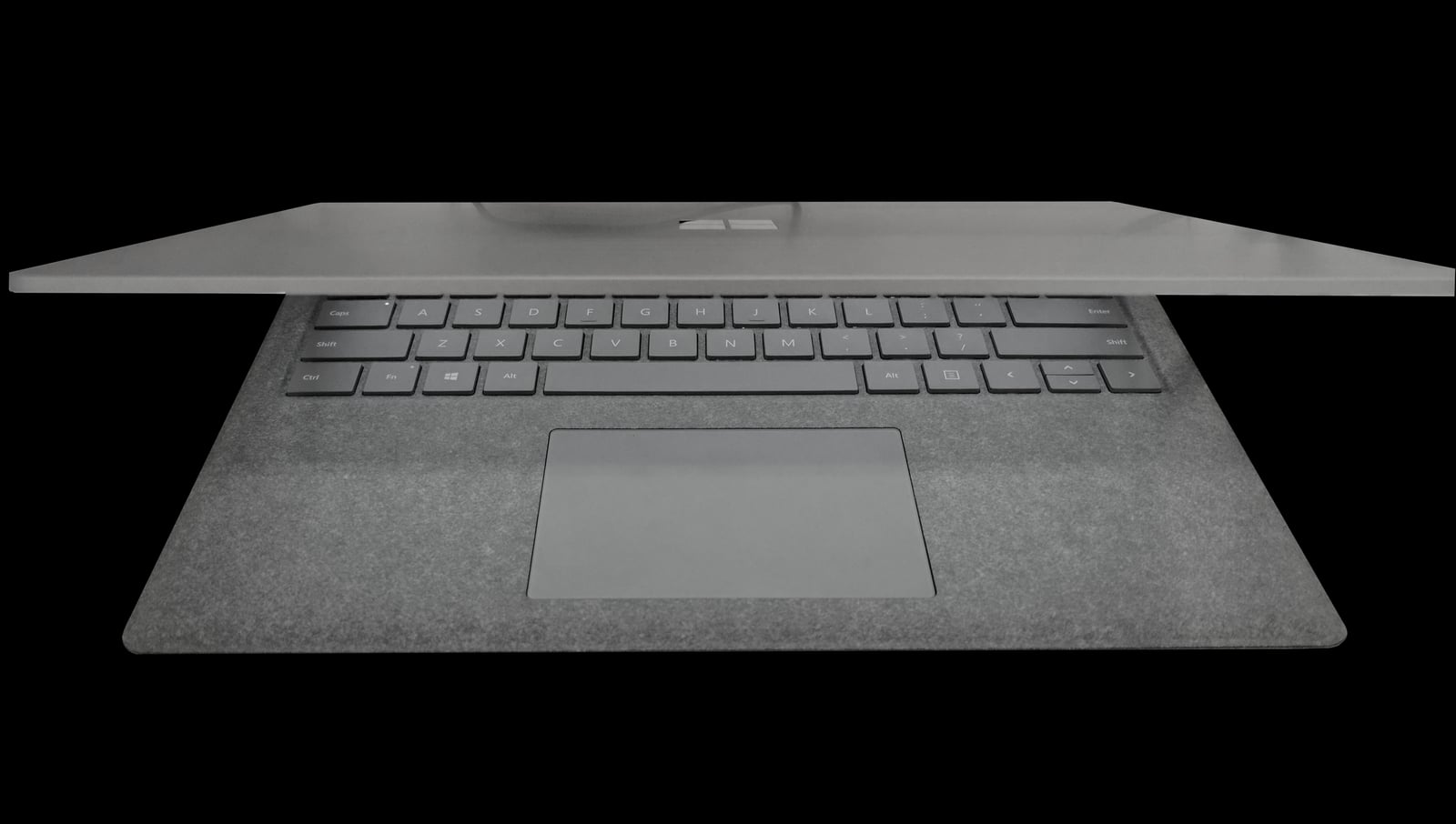
The accompanying photograph shows an older Surface Laptop in 2017, not Laptop Ultra or RTX Spark. The October news is substantial without borrowing that image as product evidence: prices and dates make the offer actionable; configuration-level measurements will determine whether it actually improves a particular reader’s work.
Source notes: 1, 2, 3. Editorial interpretation and illustrative calculations are identified separately.
Sources & Methods
Prepared October 8, 2026. We read Microsoft’s October 7 announcement including footnotes, the current U.S. laptop page and its published qualifications, and NVIDIA’s RTX Spark specification tables. Prices are announcement figures or displayed U.S. starting prices, not a completed checkout or Romanian quote. The four-bit memory calculation is an explicitly invented sizing exercise. Our proposed trials and buying view are original analysis; no hardware benchmark, delivery check, purchase, software-compatibility test or interview was performed.
- Microsoft: Surface preorders, prices and availability — Primary October 7 announcement; prices, availability, memory and sparse-FP4 qualifications, not independent benchmarks
- Microsoft: current U.S. Surface Laptop Ultra product page — Primary product information checked October 8, 2026; displayed starting price, display, ports and qualification notes. Not a checkout
- NVIDIA: RTX Spark laptop and desktop specification tables — Primary platform specifications checked October 8, 2026; configuration boundaries and video capabilities. Not independent application testing