
The pitch is a connected production workflow
ASUS's September 11 IBC announcement brings its ProArt creator hardware into a broadcast and video-production setting. The Amsterdam event runs September 11–14. The company describes on-device AI, remote workstation access and video-generation demonstrations, alongside professional monitors.
The lineup includes the ProArt P16 and P14 RTX Spark laptops and GR1X mini PC. These are not all September 11 hardware launches: ASUS had already announced those three platforms at its September 2 IFA showcase. This week's news is their presentation within a wider production workflow.
For readers, that change in setting matters. A quick demonstration answers whether something can be shown. A working studio asks whether the same operation fits a project that must be revised, checked and delivered. We have not attended the demonstration or independently benchmarked the systems.
Sources: ASUS: ProArt creator showcase at IBC 2026; ASUS: earlier ProArt IFA announcement, September 2
Local, remote and cloud are not interchangeable
ASUS's IFA announcement positioned the new platforms around AI workflows running directly on a PC. At IBC, the company also describes remote access to a workstation and a hybrid software ecosystem. These are different operating arrangements, even when they appear behind a similar interface.
A useful way to read the distinction is to ask where each job runs. Processing on the computer in front of you is local. A lightweight device controlling a workstation elsewhere is remote access. A service operated by an outside provider is a separate arrangement again. A single project may involve all three.
Our assessment is that the phrase local AI should start a question, not end it. A team should check the particular application, model and feature it uses, including whether an operation needs an external service. A hardware capability alone cannot describe the behaviour of every piece of software installed on the machine.
For an illustrative editing assignment, generating a temporary concept image and processing confidential interview footage may involve very different expectations. The right workflow follows the sensitivity and purpose of the material. It should not be chosen merely because two features carry the same AI label.
Sources: ASUS: ProArt creator showcase at IBC 2026; ASUS: earlier ProArt IFA announcement, September 2
An AI workstation still needs a trustworthy image pipeline
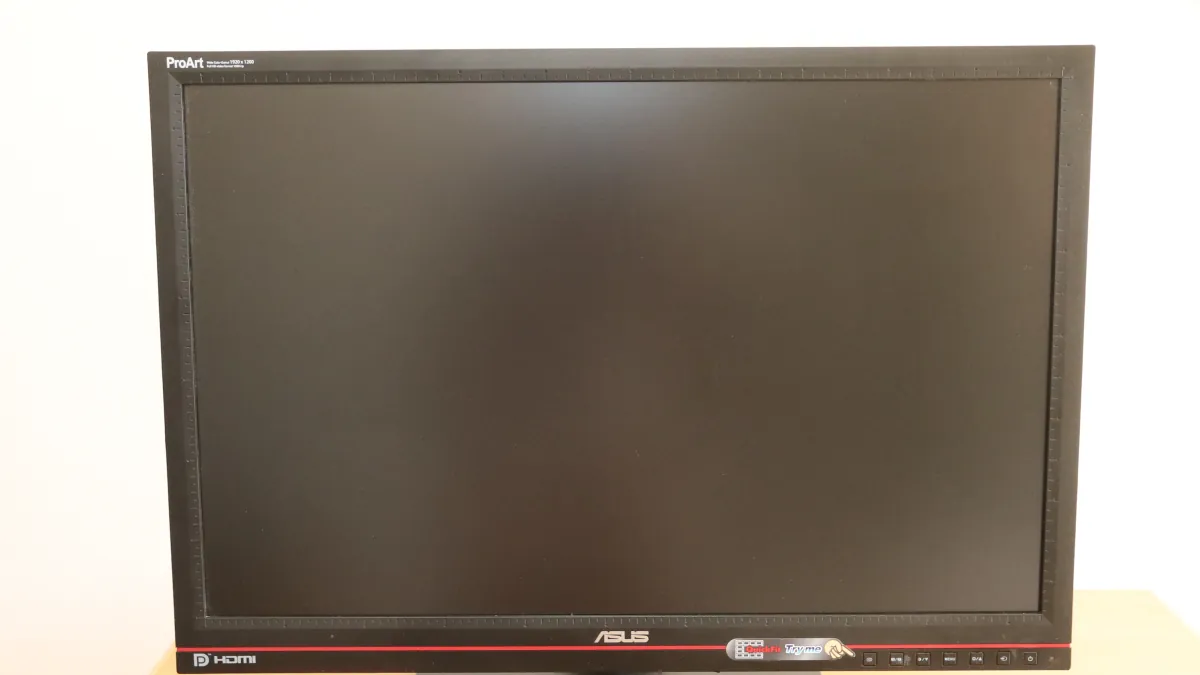
The IBC display lineup includes the PA27UCDV 4K QD-OLED monitor and SDI-equipped PA27USD and PA32USD production displays. Those are manufacturer-announced products and capabilities, not monitors tested by Lumacta. Our accompanying photograph shows an older PA246Q for brand context, not one of these new models.
Adobe's color-management documentation separates how incoming material is interpreted, the space used for processing and the output delivered. Its workflows cover different source formats and both standard- and high-dynamic-range destinations. That technical background is independent of ASUS's hardware demonstration; it is not a review of the displays.
Our interpretation is straightforward: an attractive preview does not settle whether an image is being interpreted correctly for its intended destination. The production task includes preserving the relationship between source material, working settings, display and final export. Faster generation does not remove that chain of decisions.
Sources: ASUS: ProArt creator showcase at IBC 2026; Adobe Premiere: color management explained
Missing metadata can turn a polished preview into the wrong result
Adobe also explains that some camera-specific color spaces cannot be identified automatically when necessary metadata is absent. In those cases, the source needs the appropriate manual color-space assignment. Its documentation describes how tone-mapping choices affect the conversion of material for a different output range.
For illustration, two clips can look inconsistent because they entered the project with different interpretations, not because the computer lacks AI performance. Spending less time on a generated effect will not correct that mismatch. The relevant fix begins with identifying the source and the intended pipeline.
This is why we would evaluate creative assistance inside a complete sequence. Include original footage, graphics, titles, audio, effects and the required export. A result that looks acceptable in a small preview may need further work at delivery size. That proposed check is about workflow quality; it is not a claim that the showcased hardware produces a particular defect.
Sources: Adobe Premiere: color-management options and source metadata
Scientific perspective: measure time to an accepted result
Lumacta's evidence-based assessment—not an independent hardware review—is that the most informative unit is a finished, acceptable task. A peak AI-compute figure cannot by itself tell a filmmaker how quickly an edit will be approved. The test needs both a quality requirement and a complete start-to-finish boundary.
We would compare the same source files, application versions, settings and output requirements across systems. Count setup, processing, corrections and export, then repeat the work long enough to expose variability. Record failed runs as well as the best demonstration. These are our proposed evaluation criteria, not measurements supplied by ASUS.
For a generated shot, that might mean judging whether a chosen character remains consistent, whether motion remains plausible and how many revisions are required before the shot belongs in the edit. A faster first attempt could be genuinely useful—or could transfer time into checking and repair. Only the complete task distinguishes those outcomes.
The same reasoning applies to economics. A studio should compare the resources consumed by an accepted deliverable, including staff effort, rather than treating an isolated speed claim as a guaranteed saving. This article provides a way to interpret demonstrations, not a recommendation to buy a particular configuration.
Sources: ASUS: ProArt creator showcase at IBC 2026; Adobe Premiere: color management explained; Adobe Premiere: color-management options and source metadata
The next useful evidence comes from real projects
Our conclusion is that ASUS is addressing a relevant problem: creative computing does not happen in one application or on one component. The combination of local processing, remote access and production displays is worth following because it connects several stages that creators already have to manage.
The remaining question is how consistently those stages work together outside a curated demonstration. Independent tests should include compatibility with the tools a studio already relies on, the handling of large projects and the behaviour of repeated jobs. Availability and configuration also need checking in the market where the equipment would actually be used.
The most promising outcome is not an AI label on every box. It is less friction between an idea and a reliable finished piece of work. IBC offers a view of the direction manufacturers want to take. Evidence from complete, repeatable production tasks will show how far they have travelled.
Sources: ASUS: ProArt creator showcase at IBC 2026; ASUS: earlier ProArt IFA announcement, September 2
Sources & Methods
Checked September 14, 2026. News peg: ASUS's September 11 IBC announcement; P16/P14 RTX Spark and GR1X were previously announced September 2. Product details are manufacturer claims. Adobe pages supply separate technical background, not validation of ASUS products. We did not attend IBC, test the hardware or measure customer workflows. The scientific perspective and practical examples are Lumacta's analysis.
- ASUS: ProArt creator showcase at IBC 2026 — Manufacturer announcement
- ASUS: earlier ProArt IFA announcement, September 2 — Manufacturer announcement and chronology
- Adobe Premiere: color management explained — Technical documentation
- Adobe Premiere: color-management options and source metadata — Technical documentation