
An open question, with dates attached
NASA’s October 30 account says it issued the information request on October 29 and expects any intervention by 2032. Its current analysis places likely atmospheric re-entry in 2033–2034 without intervention. These are planning estimates, not an announced launch or a countdown to an imminent loss.
The original SAM.gov record is a Sources Sought notice, published October 29 at 2:48 p.m. EDT. Responses are due November 30 at 3 p.m. EST. It expressly excludes proposals and a government commitment. A response would help the agency understand capabilities; it would not be a contract award.
This explanation covers an active request announced three days before our November 2 edition, outside our preferred 48-hour news window. We retain the original event and announcement dates. The subject remains useful because readers can assess the alternatives while the response period is open; we are not presenting it as a new November 2 decision.
Source notes: 1, 2. Original editorial examples and interpretations are identified separately.
Compare the outcome before comparing the vehicle
The notice describes three options: capture and raise Hubble to at least 600 kilometres; service it to improve performance or resilience; or conduct a controlled re-entry. NASA requires a boost or servicing attempt to avoid harming the telescope. The listed options do not identify a chosen supplier or vehicle.
Our comparison starts with the outcome rather than an attractive spacecraft illustration. Keeping an observatory aloft can preserve an opportunity to work. Repairing an instrument can change the work it can do. Bringing a mission to a managed end addresses a different responsibility. A credible assessment should say which objective leads and how success would be measured for that objective.
Those aims can also compete. A more ambitious intervention might promise more capability while introducing more steps that must succeed. A narrower intervention might reduce scope but leave important limitations untouched. Neither becomes preferable simply because its description contains fewer words or a larger projected number of years. The comparison needs a stated scientific objective and a defensible account of risk.
Source notes: 2. Original editorial examples and interpretations are identified separately.
Extra time in orbit is one part of usable science
NASA’s current account explains that Hubble has no propulsion system for maintaining its own orbit. An earlier, explicitly historical NASA–SpaceX study examined whether Dragon could rendezvous, dock and move it. That 2022 study was unfunded and non-exclusive; its existence is not a selection under the 2026 request.
Our reading is that altitude and observing usefulness should occupy separate columns in any future assessment. A higher orbit is a physical outcome. Additional useful observations require the rest of the observatory and its operating arrangements to support them. A proposal should explain how its added time becomes a deliverable that astronomers can actually use, rather than making the age of the spacecraft the sole measure of value.
It would also be misleading to carry the funding terms of the older study into the new process. A historical agreement can establish that an idea was explored. It cannot establish today’s price, the willingness of a partner to provide a service or the conditions of a future agreement. Readers should ask which dated document supports each commercial claim.
Source notes: 1, 3. Original editorial examples and interpretations are identified separately.
Past servicing proves particular work, not every future approach
NASA’s Servicing Mission 4 history records the installation of new instruments and replacement hardware in 2009, alongside repairs to two failed instruments. It also describes specialised tools and extensive procedure development. The last shuttle visit provides evidence of those accomplished tasks, not validation of an unspecified commercial successor.
That distinction matters for any technology advertised as repairable. Replaceable hardware is valuable only when someone can reach it, identify the right fault and carry out an intervention without unacceptable damage. The useful follow-up to a proposed repair is therefore a description of the actual task and its verification, including what the approach cannot repair.
A mature evaluation should preserve the difference between a demonstrated component and a demonstrated mission. A capture mechanism working in a relevant test can reduce one uncertainty. It does not, by itself, settle the behaviour of the entire operation. Conversely, a lack of flight evidence for the combined mission does not make every supporting component unproven. Naming the level of evidence makes the argument more informative.
Source notes: 4. Original editorial examples and interpretations are identified separately.
What would make the next announcement more useful?
The RFI asks for objective experience, component readiness, rendezvous and capture approaches, combined-vehicle control, risks, timing and cost assumptions. It also asks what resources respondents would need from NASA. These are requested inputs, not performance results published with the notice.
For readers, we propose following three records: the proposed scope, the evidence supporting that scope and the decision actually made. Keep a dependency visible when it remains unresolved. If a later announcement reports a test, identify which part of the proposed operation it tests. If it reports a procurement step, identify what that step commits the parties to do.
Commercial value would need similarly clear boundaries. A demonstration for one observatory could teach useful lessons, but this review cannot price a broader servicing market or infer that other spacecraft share the same interfaces and operational constraints. Any wider claim should identify the assumptions that travel from the demonstration to the next customer.
Source notes: 2. Original editorial examples and interpretations are identified separately.
The evidence available today
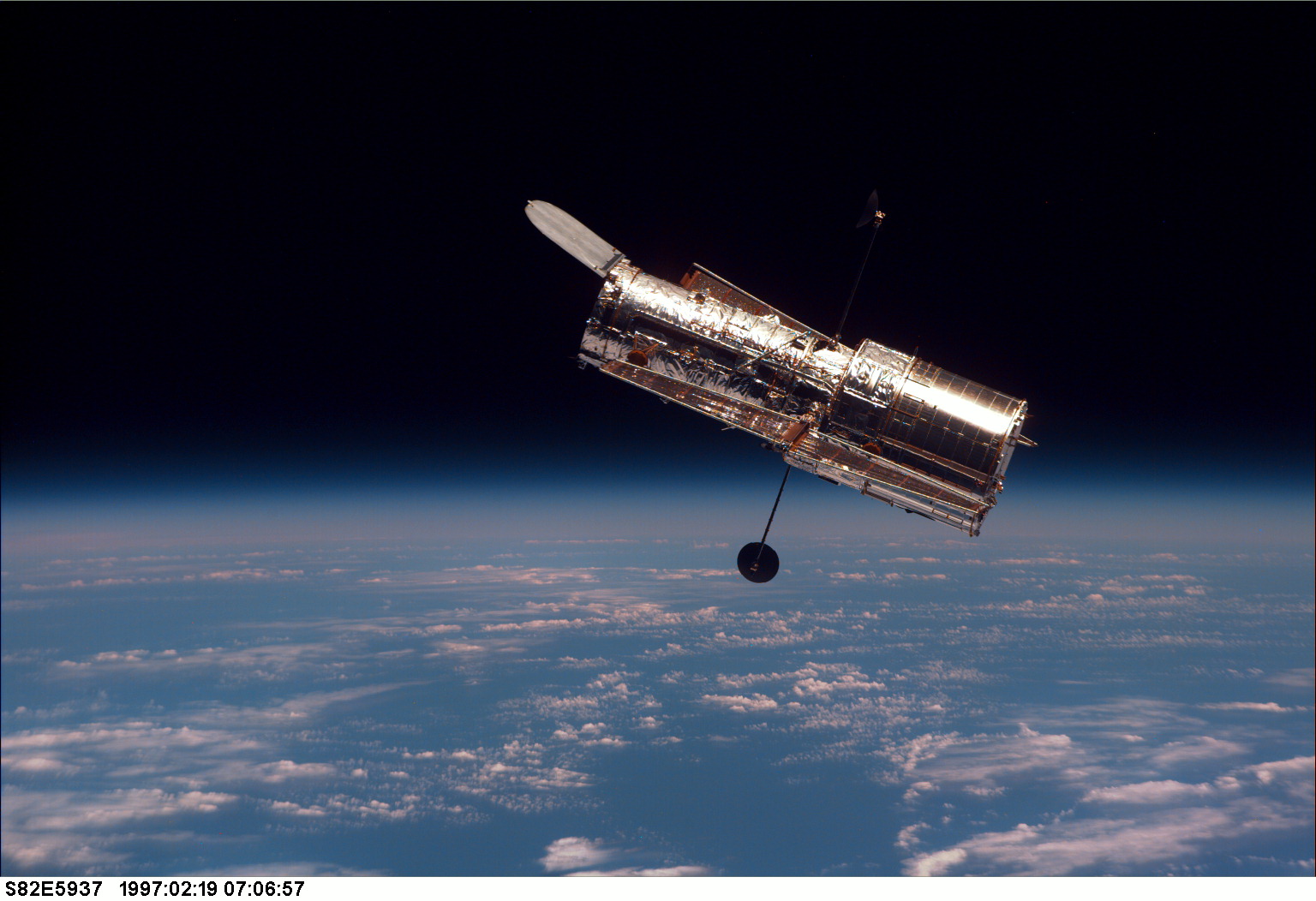
We read the agency documents and historical records, not a selected contractor’s validated mission design. We ran no orbital model, spacecraft inspection or independent cost analysis. Our proposed comparison is editorial analysis. The archive photograph records a 1997 servicing-era view; it does not depict a future intervention or supply evidence that one is ready.
Source notes: 1. Original editorial examples and interpretations are identified separately.
Sources & Methods
We read the current public SAM.gov notice through its normal browser interface, NASA’s October 30 announcement and two historical NASA records. The Verge’s November 1 report was read independently; it refers to the same NASA account and is not separate engineering validation. Dates remain explicit, including the exception to the preferred 48-hour window. The comparison is original editorial analysis, with no mission modelling or firsthand testing.
- NASA: current Hubble request — Primary announcement, October 30, 2026; event October 29
- SAM.gov: HST servicing notice — Primary notice 80GSFC27RFIHSTS, October 29, 2026; browser read November 2
- NASA: historical reboost study — Historical primary record, updated December 22, 2022; not current selection
- NASA: Servicing Mission 4 — Primary mission history; May 2009 intervention, read November 2
- The Verge: Hubble request coverage — Independent publication by Terrence O’Brien, November 1, 2026; same-source report, not technical replication