
The new result is science, not a rescue
The Swift team’s September 21 notice reports that the Burst Alert Telescope (BAT) detected GRB 260921A. It was the first BAT-triggered gamma-ray burst since GRB 260127A—not necessarily the instrument’s first activity since restart. The distinction matters: an alert establishes a scientific detection, not the date every subsystem returned to service.
The same notice says automatic slews were disabled. Swift did not automatically turn towards this burst, and its direction was too close to the Sun for follow-up with the observatory’s X-ray and ultraviolet/optical instruments. That limitation concerns this event; it is not a statement that those instruments were globally out of operation.
Four milestones that should not be conflated
| Report | Established at that time | Not established |
|---|---|---|
| August 19 · NASA | Capture and orbit raising cancelled after LINK attitude-control problems. | A successful rescue or a completed docking. |
| August 28 · NASA | XRT and UVOT restarted on August 26. | A restored orbit or a new propulsion capability for Swift. |
| September 4 · NASA | LINK tested arms and thrusters, with a reported closest separation of 12–15 km. | Contact, capture, or transfer of thrust to Swift. |
| September 21 · Swift team | A new BAT-triggered burst was reported. | A return to unrestricted automatic follow-up. |
What LINK demonstrated—and what it did not
NASA’s August decision changed the purpose of the flight. A spacecraft built to lift Swift into a higher orbit would instead test capabilities relevant to later servicing missions. The observatory’s continuing science did not reverse that decision.
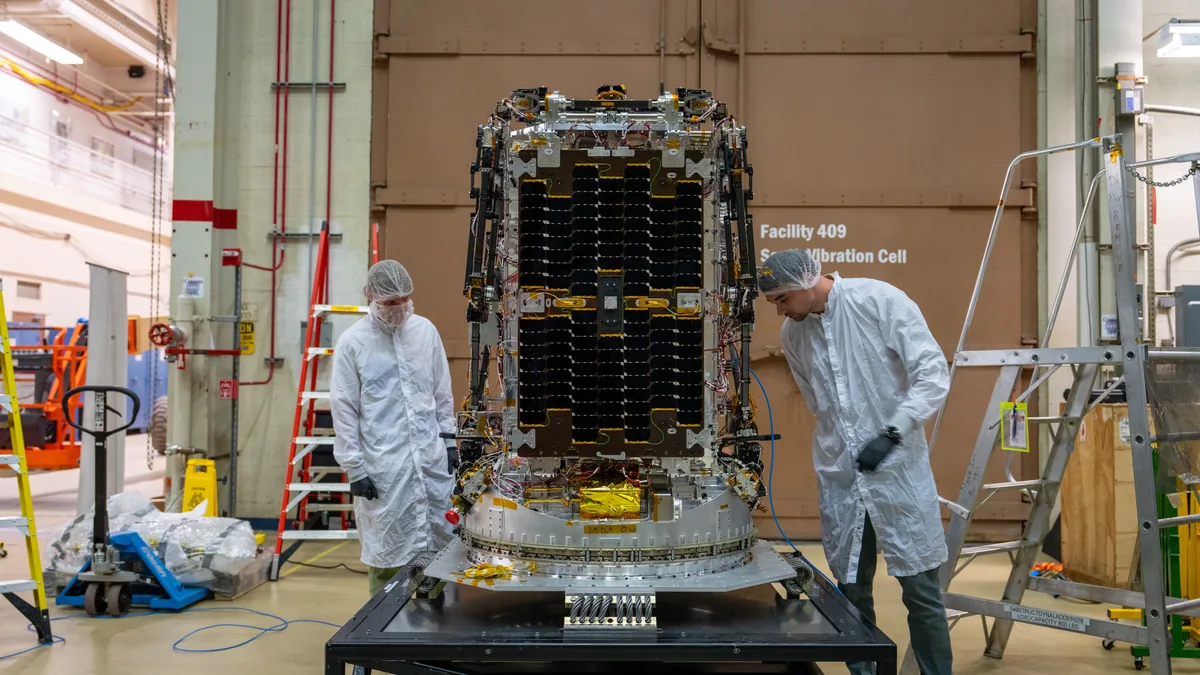
The September 4 update describes LINK raising its own orbit, aligning with Swift, deploying three robotic arms and firing three electric xenon thrusters together. NASA said no closer approach was planned after the reported 12–15 km separation. These were tests of LINK’s equipment and operations, not a physical connection to the telescope.
Engineering interpretation: a servicing chain has several distinct links: navigation, safe approach, contact, a stable mechanical connection and controlled force transfer. Evidence for the first steps cannot certify the later ones. Calling the flight a total technical success or a completely useless exercise would erase that distinction. The useful question is which capability was actually demonstrated, under which conditions.
An old deorbit estimate is not a reentry confirmation
On September 4, NASA relayed Katalyst’s estimate that LINK would deorbit in roughly two to three weeks. That was a forward-looking estimate made on that date. The passage of those weeks does not turn it into an observed event.
At the September 23 check, the NASA Swift blog and Katalyst news index did not provide a newer confirmation of LINK’s reentry. This is a limited finding about the pages checked, not proof that LINK is still in orbit. Nor does a later Katalyst announcement about a different project answer the LINK question.
A reliable status update would require an explicit operator or agency statement, or appropriately interpreted tracking evidence. This article has neither for LINK’s final descent, so it does not supply a definitive reentry date.
Why working instruments cannot solve orbital decay
NASA’s August science restart account explains that Swift has no propulsion system for raising its orbit. Its earlier low-drag operating strategy helped preserve altitude but involved suspending observations. Returning to science and preserving orbital lifetime were therefore connected operational choices, not independent switches.
Lumacta’s assessment: the meaningful positive result is that an ageing observatory can still make observations worth reporting. The unresolved cost is remaining observing time. A burst detection cannot tell us how much of that time remains, and the sources here do not support a freshly calculated lifetime. Keeping those two conclusions separate makes the story more useful than either a rescue headline or a premature obituary.
Sources & Methods
Documentary update checked September 23, 2026. NASA supplies mission decisions; GCN circular 45676 is the Swift team’s observation report. The blog and company news index are a bounded status check, not an orbital-tracking dataset. No telemetry, independent orbit propagation or new operator interview was obtained.
- Swift team: GCN circular 45676 — September 21 observation and operational limitations.
- NASA: revised servicing mission — August 19 decision not to capture or boost Swift.
- NASA: science observations restart — August 28 report of the August 26 instrument restart.
- NASA: LINK technology demonstration — September 4 manoeuvres, separation and then-estimated deorbit timing.
- NASA Swift mission blog — Index inspected September 23; absence of a newer entry is not proof of an orbital state.
- Katalyst news index — Company updates inspected September 23; no confirmation of LINK reentry identified here.