
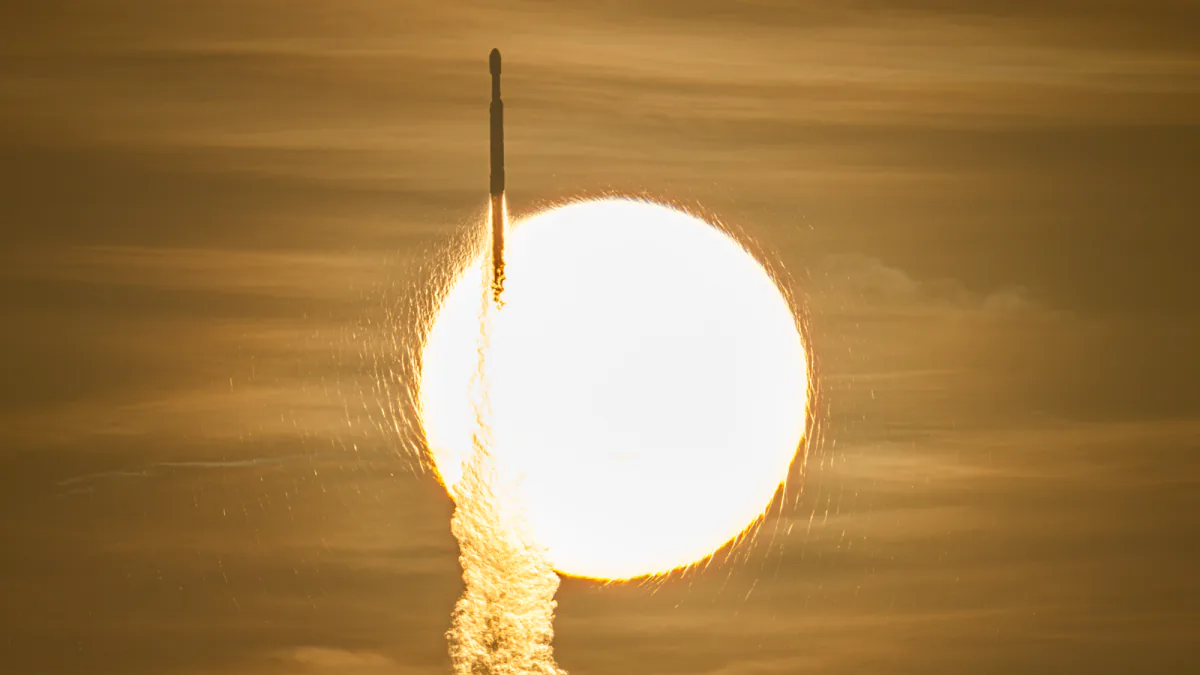
Roman leaves the launch vehicle
NASA's Nancy Grace Roman Space Telescope lifted off at 7:26 a.m. EDT, or 11:26 UTC, on August 30 aboard a SpaceX Falcon Heavy from Launch Complex 39A at Kennedy Space Center in Florida. NASA's public update identifies the vehicle, time, payload and pad; it does not support the second-level liftoff precision used in the earlier reporting version.
NASA reported that Roman established communications through a Tracking and Data Relay Satellite at 7:33 a.m. EDT. The observatory then separated from Falcon Heavy's second stage at 7:57 a.m. and began flying independently toward the Sun–Earth L2 region, roughly one million miles from Earth.
The agency ended live coverage at 8:09 a.m. after confirming launch and separation. Those milestones do not by themselves prove that every deployment, checkout or instrument function has succeeded.
Why Roman's camera matters
The Nancy Grace Roman Space Telescope carries a 300-megapixel Wide Field Instrument that observes infrared light. NASA says it is designed to deliver angular resolution comparable to Hubble's across a field of view at least 100 times larger.
The comparison is about survey scale, not simply a ‘better Hubble.’ A wider, consistent view can let astronomers study far larger populations of galaxies, stars and transient events. Roman's planned work includes investigations of dark energy and dark matter, a statistical census of exoplanets and broader infrared astrophysics.
Roman also carries a Coronagraph Instrument as a technology demonstration. Its role and performance should be reported separately from the Wide Field Instrument rather than compressed into a single camera claim.
The next milestones remain separate
NASA's commissioning page says Roman's solar arrays and sunshade deployed 1 hour 23 minutes after launch, providing power and shading the observatory. NASA also reported that Roman completed its first mid-course correction on August 31; the approximately three-minute burn began at 12:02 p.m. EDT.
NASA described that burn as the first of two planned trajectory adjustments, with the second to be performed only if necessary. The journey to L2 and commissioning remain in progress, and launch-day photographs cannot establish the outcome of later deployments, instrument checkout or first science images.
What the photograph shows
The hero is a real photograph of the Falcon Heavy carrying Roman as the rocket crosses the Sun during launch. NASA's image record identifies the event, location, date and photographer, John Kraus.
The photograph documents liftoff, not spacecraft separation, communications, deployment or observatory health. The exact NASA asset and final crop were checked against the agency's media guidance for this publication.
Sources & Methods
This post-launch report was checked against NASA's August 30 launch updates, its August 31 mid-course correction update, the current Roman commissioning page and the image-library record. It confirms only the milestones NASA explicitly reports and keeps later deployments, commissioning, instrument performance and first science images on hold.
- NASA Roman launch blog — liftoff — primary source
- NASA Roman launch blog — communications and separation — primary source
- NASA Roman launch blog — coverage concludes — primary source
- NASA Roman launch blog — first mid-course correction burn — primary source
- NASA Roman commissioning status — primary source
- NASA Science — Nine Things to Know About Roman — primary source
- NASA Image and Video Library — NHQ20260830_admin_0002 — image source
- NASA Images and Media Usage Guidelines — rights source