
A launch agreement, with a date that matters
NASA selected SpaceX to provide launch services for StarBurst, the agency announced on September 17, 2026. The plan is a Bandwagon rideshare flight on a Falcon 9 from Cape Canaveral in Florida, no earlier than 2028. The spacecraft is a small gamma-ray observatory intended to investigate short, energetic flashes associated with neutron-star mergers.
The timing deserves attention. An older NASA mission-description page still refers to a 2027 start. For the current launch plan, this article uses the newer, explicitly dated contract announcement. Neither date should be read as a claim that the satellite has already reached orbit.
Securing a ride is an important project milestone, but it is not a scientific result. StarBurst will still have to complete the remaining steps toward flight and work as intended in space. The reason this contract is interesting is the kind of observation it could make possible, rather than the procurement announcement alone.
Sources: NASA: StarBurst launch-services contract (September 17); NASA: StarBurst science goals and detector architecture
One cosmic collision can produce different kinds of evidence
Multimessenger astronomy studies an event through more than one kind of signal. Light—including gamma rays—is one messenger. Gravitational waves are another. Combining them can reveal more than observing either alone because the signals carry different information about the physical process that produced them.
NASA's account highlights the August 17, 2017, neutron-star merger, known as GW170817, as a landmark joint observation involving gravitational waves and light. StarBurst is intended to help extend that approach with further events. It is not the first instrument to look for gamma-ray bursts, and it does not itself detect gravitational waves.
An everyday analogy is investigating a distant event using both a recording and a separate physical measurement. Agreement between independent types of evidence can strengthen an explanation, while differences may expose something the explanation missed. The astronomy is much more demanding, but the logic is familiar: a second messenger is valuable because it is not simply a duplicate of the first.
How a gamma-ray flash becomes a measurement
The mission description lists 12 scintillation detectors, using cesium iodide crystals, oriented to monitor the sky that Earth does not block. When a gamma ray interacts in a crystal, the interaction produces light that a silicon photomultiplier converts into an electrical signal. The electronics use that response to estimate the incoming photon's energy.
Timing is essential. The design uses a GPS-synchronized clock to record when gamma rays arrive, while differences between detector responses help estimate where a source is located. This is a detector system, not an ordinary camera taking a detailed visible-light photograph of two stars colliding.
The instrument's role is to supply usable evidence to a wider observing network. A short flash may be scientifically valuable precisely because its timing and likely direction can be compared with other measurements. Clear uncertainty estimates matter here: a location estimate is an area to investigate, not necessarily an exact point already resolved by the detector.
Sources: NASA: StarBurst science goals and detector architecture
The hardware is real, but the contract is not a billion-dollar price tag
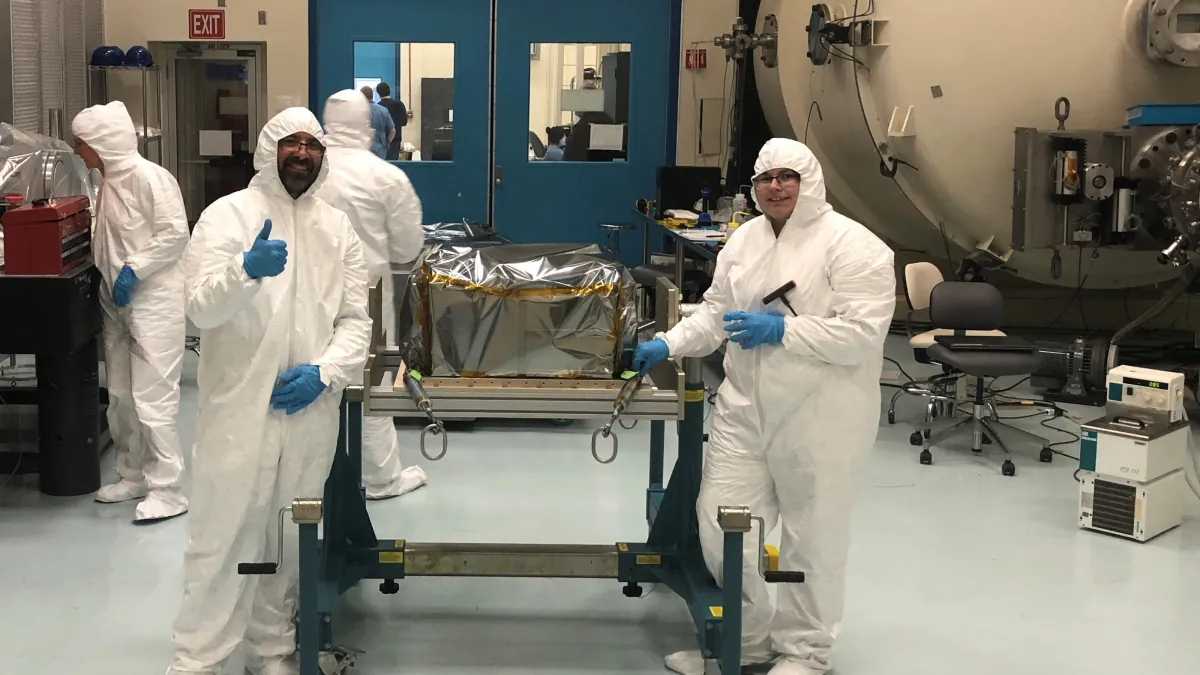
A March 27, 2025, NASA report documented the instrument's arrival at Marshall Space Flight Center for environmental testing and integration. It described planned vibration and thermal-vacuum tests, the kinds of checks needed before sensitive hardware can face launch and space conditions. The photograph above comes from that earlier report and shows StarBurst in the cleanroom, not a completed launch.
The launch selection uses NASA's VADR contracting framework. Its stated one-billion-dollar maximum covers the framework across contracts; it is not the price of this individual mission's launch. The September announcement does not disclose the StarBurst task-order amount.
StarBurst also belongs to the Astrophysics Pioneers programme, which supports smaller-scale investigations. Our interpretation is that this makes the project an example of targeted instrumentation complementing larger facilities. It does not establish that every small satellite is inexpensive or that a single compact detector can replace the breadth of a major observatory.
Sources: NASA: StarBurst launch-services contract (September 17); NASA: StarBurst arrives for testing (March 27, 2025); NASA: Astrophysics programmes and Pioneers
Scientific perspective: success means useful coincidences
Lumacta's evidence-based assessment is that the crucial outcome will be well-characterized observations that can be connected credibly to other messengers. A large number of alerts would not, by itself, prove that the mission has answered questions about neutron-star matter or the physics of a merger.
Evaluating that outcome should include sensitivity, observing coverage, background events, timing accuracy and uncertainty in source location. Researchers also need to show why signals recorded by different instruments plausibly came from the same event rather than unrelated activity. These are criteria for reading future results, not performance figures measured by Lumacta.
There is a wider systems lesson. Science depends on the ability to combine instruments, data and follow-up observations, not only on making each device impressive in isolation. The value of StarBurst could therefore be larger than its physical footprint, but only if its measurements are reliable and usable by that network. This is editorial scientific analysis, not an independent mission review.
Sources: NASA: StarBurst science goals and detector architecture; NASA: multimessenger astronomy explained
Why looking at extreme physics is worth following
NASA's mission goals include studying the origins of short gamma-ray bursts, the remnants of neutron-star mergers and the behavior of extraordinarily dense matter. These are questions about how the universe works under conditions that ordinary terrestrial experiments cannot reproduce in the same way.
For readers outside astronomy, the practical lesson is about patient technological capability. Designing a sensitive instrument, validating it and making its data useful are distinct achievements. A launch contract funds access to the next stage; it does not guarantee the final discovery. Treating those steps honestly makes progress easier to understand without reducing it to hype.
The next milestones to watch are confirmed launch preparation, successful deployment and published observational results with clear methods. For now, a small observatory has a planned route toward a large scientific question. That is meaningful progress, provided the promise is described in the future tense and the evidence remains open to examination.
Sources: NASA: StarBurst science goals and detector architecture; NASA: multimessenger astronomy explained
Sources & Methods
Checked September 20, 2026. News event: NASA contract release of September 17. Its no-earlier-than-2028 launch plan takes precedence over an older mission page's 2027 reference. Hardware descriptions and the 2025 photograph are background, not evidence that launch or on-orbit validation has occurred. Scientific perspective is editorial analysis.
- NASA: StarBurst launch-services contract (September 17) — Primary contract announcement and current launch plan
- NASA: StarBurst science goals and detector architecture — Technical mission description; older schedule superseded
- NASA: multimessenger astronomy explained — Scientific background
- NASA: StarBurst arrives for testing (March 27, 2025) — Hardware milestone and original photograph
- NASA: Astrophysics programmes and Pioneers — Programme context