
The important change is the question we can test
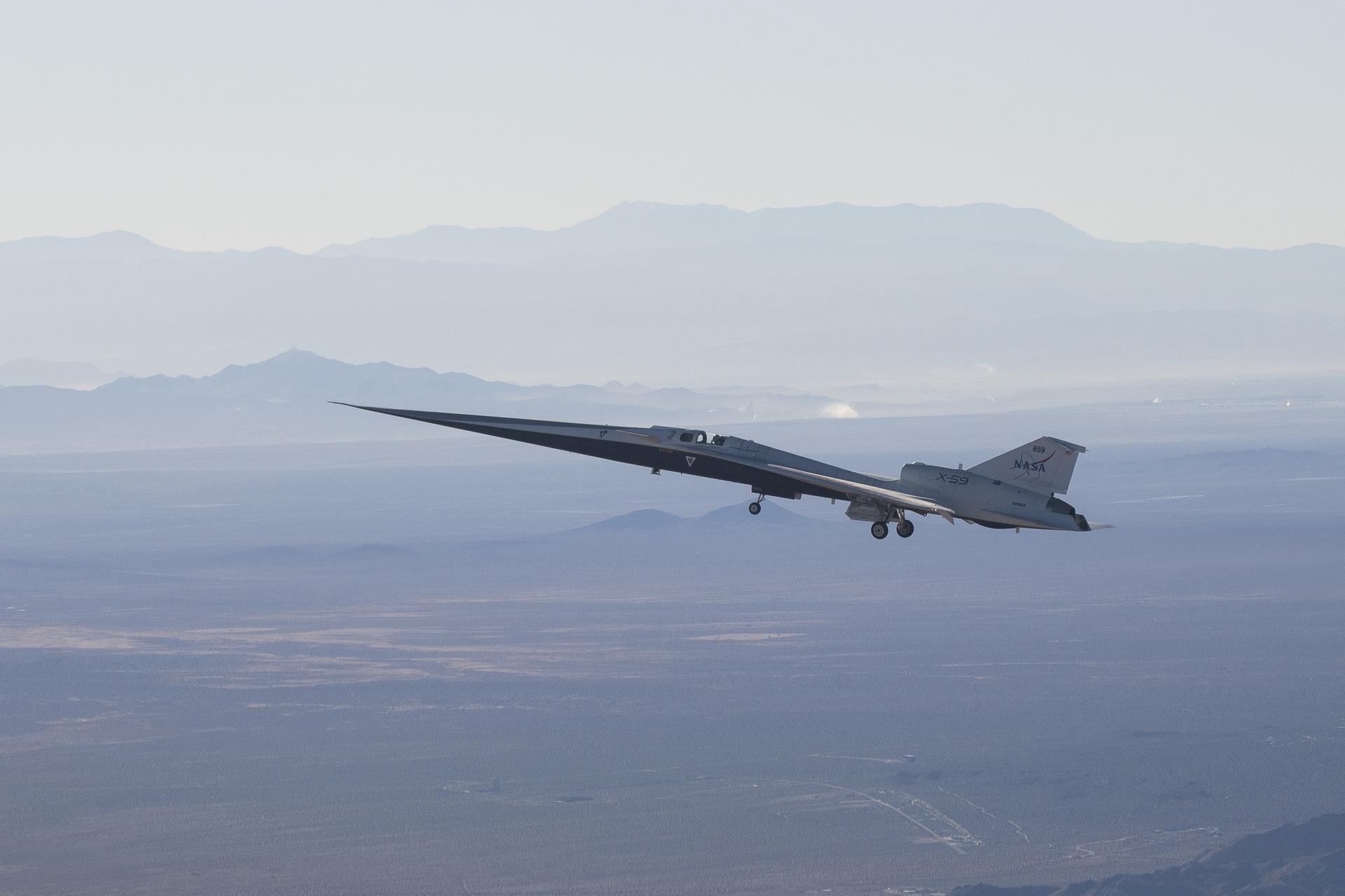
NASA’s X-59 asks whether an aircraft can make supersonic flight over land less disruptive. Its broader importance lies in connecting aerodynamic design, measurements in real air and people’s experience. A useful outcome would make that connection more predictable, so designers and regulators can evaluate an operation against evidence rather than a dramatic fly-past.
Acoustic validation remains ahead in the October 28 update. Our earlier X-59 report covers that programme milestone; this review examines the studies and decisions behind the next steps.
The commercial question is larger: can a future passenger aircraft meet noise requirements while carrying a useful payload, operating an acceptable mission and sustaining an airline business? X-59 research can inform that question without answering every part. The most credible interpretation keeps those contributions identifiable.
Source notes: 1. Comparisons and implications are Lumacta’s evidence synthesis; no flight, acoustic experiment or community study was performed.
How we assembled this evidence review
We selected primary technical papers, current regulatory material and two environmental and economic analyses, reading their substantive methods, results and limitations on November 1, 2026. We included work that could clarify a specific decision: acoustic prediction, atmospheric variability, community response, system integration, operating permission or commercial consequences. This is a targeted narrative synthesis, not an exhaustive systematic search.
We did not pool effect sizes or calculate an overall success probability. The sources describe different objects: simulations, an earlier community campaign, an engineering system, legal requirements and hypothetical future fleets. Averaging them would conceal their different denominators. Papers using related programme data also do not become independent replications simply because they have different titles.
For each source, we ask what was observed or assumed, what outcome was evaluated and what would be needed to transfer the conclusion. That method supports a comparison of evidence strength without inventing a single score. We performed no flight, acoustic measurement, atmospheric simulation, participant survey or airline-cost study.
Source notes: 2, 3, 4, 5, 6, 7, 8, 9, 10. Comparisons and implications are Lumacta’s evidence synthesis; no flight, acoustic experiment or community study was performed.
Read the acoustic target with its measurement context
Doebler and Loubeau’s 2023 study predicts the range of X-59 sound exposures relevant to planning community testing. It uses propagated acoustic predictions and a perceived-level metric, PLdB. The exercise is a planning calculation, not a report of measured X-59 community outcomes.
NASA’s physics explanation describes shock waves produced continuously during supersonic flight. The aircraft’s components, flight path and atmosphere influence what reaches the ground. X-59 shaping seeks to change that pressure signature. The mechanism concerns how disturbances combine and propagate; it does not remove the need to measure their effect.
That distinction makes the unit part of the claim. Perceived loudness, pressure amplitude and the number of events are different descriptions. A numerical value should travel with its metric, location, operating condition and measurement or modelling method. We should not turn a favourable number into a universal promise that every listener will hear the same thing.
Anderson and colleagues’ 2023 measurement paper explains why quiet signatures demand care in recording and processing. Ground reflections, turbulence, calibration and ambient noise can affect the result. Their methods discussion supports attention to the measurement chain; it is not a completed X-59 community trial.
For a future result, the useful comparison is a documented operating envelope: where the signature was measured, how it varied, which observations were excluded and how prediction error was assessed. A single well-explained passage would be meaningful progress. Extending it to repeated operations requires evidence for the additional conditions, rather than a stronger adjective.
Source notes: 2, 13, 14. Comparisons and implications are Lumacta’s evidence synthesis; no flight, acoustic experiment or community study was performed.
The atmosphere belongs inside the design problem
Nemec, Bedonian and Aftosmis studied atmospheric uncertainty using 620 historical atmospheric profiles around Edwards. Their 2024 computational study holds aircraft weight, shape and trim fixed and excludes clouds, wind and turbulence. Its reported 92% outcome below 75 PLdB is conditional on that modelling setup; it is not an observed flight-test success rate.
This creates an important engineering opportunity. A design process that can predict sensitivity, document its assumptions and compare predictions with measurements could help engineers make more robust choices. Our inference concerns the value of the method, not a demonstrated transfer to another aircraft. A larger passenger design would need its own validation.
The next persuasive evidence would pair measured signatures with recorded atmospheric conditions and prediction errors. We would look for performance across the stated conditions, including uncomfortable cases, rather than only a best example. Uncertainty can then become a design input and an operational boundary instead of disappearing inside an average.
Source notes: 3. Comparisons and implications are Lumacta’s evidence synthesis; no flight, acoustic experiment or community study was performed.
Community response is an outcome of its own
Lee, Rathsam and Wilson’s 2020 analysis uses data from the earlier QSF18 community campaign to examine annoyance models. The relationship depends on the response definition and statistical model. This is empirical community evidence, but it is not a survey of X-59 overflights and does not supply a completed X-59 acceptance threshold.
A physical signature and a person’s experience answer related questions. For future community work, we would examine participant selection, exposure estimates, survey timing, missing responses and uncertainty around the reported relationship. Those details determine which population and operating pattern the conclusion can reasonably describe.
Acceptance also needs a stated decision. A response to an individual event cannot automatically establish willingness to live under a regular service. The point is not to discount people’s reports; it is to match them to the question actually asked. Publicly usable results would let both supportive and concerned readers inspect that match.
Source notes: 4. Comparisons and implications are Lumacta’s evidence synthesis; no flight, acoustic experiment or community study was performed.
The technological legacy includes system integration
NASA’s June 2026 eXternal Vision System presentation describes camera and synthetic imagery, a 4K display and parallel processing with failover. It also identifies continuing work on issues including parallax, workload, reliability and window-equivalence testing. The presentation documents an engineering programme; it does not grant civil certification for a passenger aircraft.
The wider lesson is that an aerodynamic choice creates work elsewhere in a system. A feature that helps one objective must remain compatible with how a pilot sees, interprets and acts. An attractive airframe therefore needs a complete chain of supporting functions, with failures and degraded conditions considered explicitly.
Potential reuse should be assessed function by function. A display technique, validation procedure or uncertainty-analysis tool might prove valuable even if a future aircraft has a different shape. We would ask what evidence transfers with the method, what assumptions change and which tests must be repeated. This is a route for evaluating future applications, not a claim that a particular spinoff has already been certified.
Source notes: 5. Comparisons and implications are Lumacta’s evidence synthesis; no flight, acoustic experiment or community study was performed.
Operating permission and airport noise are separate gates
The eCFR display, current through October 29, retains the US rule that civil operation above Mach 1 requires the conditions of a section 91.818 authorization. That is jurisdiction-specific regulatory context, not a judgment about every national airspace or permission for a particular flight.
The FAA’s July 2, 2026 proposal would introduce an interim surface-overpressure criterion of 0.11 pounds per square foot with approved compliance demonstrations. It remains a proposal. Pressure amplitude is not interchangeable with a PLdB target, and the proposal separates landing-and-takeoff noise from the overland question. A quiet-aircraft claim alone therefore cannot establish compliance.
ICAO announced adopted standards on March 27, 2026 under which supersonic aircraft will need to meet noise limits applicable to today’s subsonic aircraft from 2029. The full technical annex was not reviewed here. The announcement is relevant to the airport-noise pathway; it is not approval of a particular commercial route.
For readers, the practical question is which decision a milestone supports. Research evidence, an adopted standard, a national authorization and certification of an aircraft each have a role. Keeping their scope visible makes progress easier to understand without presenting a future framework as an already operating airline.
Source notes: 6, 7, 8. Comparisons and implications are Lumacta’s evidence synthesis; no flight, acoustic experiment or community study was performed.
The climate question needs a different model
A 2025 Atmospheric Chemistry and Physics study compares four atmospheric models and three hypothetical supersonic fleet scenarios in a 2050 background. Under the studied scenarios, it finds additional non-CO2 warming and generally ozone loss, with results sensitive to cruise conditions and emissions assumptions. Its specified non-CO2 comparison excludes changes in contrails and CO2.
These are modelled fleet scenarios, not measured climate effects of X-59. The authors’ differences across models are part of the evidence, rather than a reason to select the most convenient result. We do not turn a conditional comparison into a universal emissions multiplier for every possible supersonic aircraft.
The implication for technology is to keep acoustic and environmental objectives separate during evaluation. A quieter signature does not supply the missing emissions inventory, fuel pathway or atmospheric assessment. A credible future proposal would publish its mission assumptions and show how alternative design choices change several outcomes together. An improvement in one column should remain an improvement in that column until the others are evaluated.
Source notes: 9. Comparisons and implications are Lumacta’s evidence synthesis; no flight, acoustic experiment or community study was performed.
A viable aircraft needs a viable mission
Dela Peña’s October 2026 lifecycle and commercial assessment combines document-based evidence and scenario assumptions. Economic outcomes change between reference, favourable and adverse cases. The paper explicitly lacks proprietary design, engine, flight and airline-operational data, as well as a new primary community survey. It is a framework for examining dependencies, not a verified airline forecast.
Its useful lesson for a reader is to request the inputs behind a commercial promise: the proposed mission, usable seats, loading, fuel assumptions, maintenance needs and the revenue case. We would then ask which inputs are measured, which are supplier claims and which are modelling choices. A precise output can still depend on uncertain inputs.
X-59’s research value should not be judged only by a hypothetical ticket price. Nor should the value of the research be converted into an assured ticket market. A future operator would need to connect a specific aircraft and service to costs, permissions and passengers willing to use it. That connection has to be demonstrated at the commercial system’s scale.
Source notes: 10. Comparisons and implications are Lumacta’s evidence synthesis; no flight, acoustic experiment or community study was performed.
Translate a speed advantage into a complete journey
A simple example shows why cruise performance and passenger value need different accounting. Suppose an illustrative journey includes six hours of cruise and two hours of other fixed time. If a hypothetical technology halves only the cruise portion, the total falls from eight hours to five: a 37.5% reduction, rather than a 50% reduction in the whole journey.
Those numbers are chosen for arithmetic. They are not X-59 performance data, a route simulation or a forecast of a commercial service. The example tells us to state which part of the journey a claimed saving concerns. It also gives a comparison a clear boundary: the same starting point, destination and definition of total time.
For an actual proposal, we would replace every assumption with the operator’s evidence and include the conditions that affect the passenger’s choice. A benefit can be substantial without applying to every journey. Showing its applicable mission is more useful than treating an aircraft’s maximum speed as a complete travel product.
Lumacta analysis. Comparisons and implications are Lumacta’s evidence synthesis; no flight, acoustic experiment or community study was performed.
A decision table for following the next results
Our proposed table below is an editorial reading tool. It contains questions to update when new evidence appears, not pass marks that Lumacta has assigned to X-59. Each row has a different completion condition. Success in one row can justify the next investigation while leaving another row unresolved.
For a future announcement, record the aircraft or model version, the stated conditions, the measured or assumed outcome and the remaining uncertainty. Then identify which row the new evidence actually changes. This makes a sequence of results cumulative without quietly expanding the scope of an earlier success.
The method is also useful for comparing alternatives. Ask a low-boom proposal, another supersonic approach and a subsonic service to disclose the evidence relevant to their own missions. They need not solve an identical engineering problem to be compared on outcomes. They do need a consistent definition of what the traveller and the affected community receive.
| Decision | Useful next evidence | Conclusion to keep separate |
|---|---|---|
| Sound | Predictions compared with documented measurements | Performance outside the tested conditions |
| People | Defined exposures, participant selection and responses | Acceptance of a different operating pattern |
| Rules | The applicable jurisdiction, standard and authorization | Approval of another aircraft or route |
| Climate | Mission inventory and explicit scenario assumptions | An environmental benefit inferred from quietness |
| Market | Aircraft-specific costs, seats and passenger assumptions | Commercial viability inferred from a research milestone |
Source notes: 2, 3, 4, 6, 7, 8, 9, 10. Comparisons and implications are Lumacta’s evidence synthesis; no flight, acoustic experiment or community study was performed.
What would make the next milestone convincing
The strongest next step would make predictions, aircraft conditions, atmospheric observations and measured ground signatures traceable to the same tests. Community evidence would then describe the people and exposures studied, with uncertainty that readers can inspect. Those results could inform a regulatory decision while preserving the distinction between research and approval.
For technology more broadly, the promising legacy is a better way to connect design intent with evidence outside the laboratory. If validated, methods for robust acoustic design, measurement and integrated pilot vision could remain useful beyond one experimental aircraft. Their value should be argued through the function they improve and the tests supporting that improvement.
X-59 can make an ambitious problem more testable. The next chapter will be strongest when it explains exactly which uncertainty has been reduced and what remains to be done. That gives the research a durable meaning, whether the eventual passenger market is broad, specialised or slower to develop than its advocates hope.
Source notes: 1, 2, 3, 4, 5. Comparisons and implications are Lumacta’s evidence synthesis; no flight, acoustic experiment or community study was performed.
Sources & Methods
Targeted narrative evidence synthesis, read November 1, 2026; not a formal statistical meta-analysis or exhaustive literature search. Simulations, prior community data, engineering material and scenario models are compared by scope, not pooled. No flight, acoustic experiment, survey, independent model run or commercial validation performed. Related NASA work is not counted as independent replication. Full ICAO technical annex not reviewed. NASA did not review or endorse this article.
- NASA: X-59 programme status — Primary mission update; October 28, 2026
- Doebler and Loubeau: predicted X-59 exposure range — Primary acoustic modelling study; 2023
- Nemec, Bedonian and Aftosmis: atmospheric uncertainty — Primary computational study; AIAA 2024-4671, 2024
- Lee, Rathsam and Wilson: community annoyance models — Primary analysis of QSF18 community data; 2020
- NASA: X-59 eXternal Vision System — Primary engineering presentation; June 2026
- eCFR: 14 CFR 91.817 — Current US regulatory text; displayed currency October 29, 2026
- FAA: Enabling Supersonic Overland Flight — Proposed rule; July 2, 2026; not a final operating approval
- ICAO: adopted environmental standards — Primary announcement; March 27, 2026; future applicability
- van ’t Hoff and colleagues: atmospheric fleet scenarios — Peer-reviewed four-model climate study; February 27, 2025
- Dela Peña: sustainability and commercial scenarios — Document-based lifecycle and economic framework; October 6, 2026
- NASA: archive photograph AFRC2025-0168-019 — Image record; October 28, 2025; NASA/Jim Ross
- NASA: editorial media guidelines — Reuse conditions read November 1, 2026; no endorsement
- NASA: the science of sonic booms — Primary physics explanation; August 10, 2026; updated October 14
- Anderson and colleagues: recording sonic thumps — Primary measurement-methods paper; Noise-Con 2023