
A progress report, rather than a new first flight
NASA’s October 28 update marks one year since the X-59’s first flight on October 28, 2025. It reports 40 additional flights, an altitude above 56,000 feet and speeds up to Mach 1.53. Those are cumulative programme milestones, not achievements all made on the report’s publication day. The agency says flight-envelope work will continue while testing moves toward acoustic validation.
The change in question is useful. First ask whether an experimental aircraft can reach and operate within the conditions needed for its research. Then ask what evidence establishes the effect it is intended to have. A photograph of a flying aircraft helps document the machine; it cannot tell us what a person beneath its path heard.
This article offers a way to read that next evidence. We have not flown the aircraft, inspected its telemetry or conducted a noise experiment.
Source notes: 1. Original editorial examples and interpretations are identified separately.
A sonic boom is a travelling effect
NASA’s separate August explanation describes shock waves forming throughout supersonic flight, rather than a single noise when an aircraft first exceeds the speed of sound. Its account says the aircraft’s shape, path and atmospheric conditions influence what reaches the ground. That makes the listener’s location and the conditions of a flight important to interpretation.
For readers, the practical consequence is to distrust a comparison that changes several things at once. Two impressive recordings would not make a controlled comparison if they represented different locations, aircraft configurations or recording arrangements. Our proposed reading rule is to establish what was held comparable before judging which sound was preferable.
A headline speed is therefore an incomplete description of an acoustic experiment. It gives one part of the operating context, while leaving the measurement question open.
Source notes: 2. Original editorial examples and interpretations are identified separately.
Connect the aircraft state to the measurement
The intended quiet-supersonic operating point is Mach 1.4 at 55,000 feet. The report’s car-door sound analogy remains a projection. It is not a result of completed acoustic validation.
A useful future report would connect a specific flight to its ground observations. We would look for the aircraft state, the measurement locations, the recording method and an account of the conditions. We would then ask which conclusion those observations support, rather than expecting every test to answer the whole programme’s question.
For example, a result that explains one carefully documented passage could be valuable even if it does not establish how every future route would sound. Stating that boundary makes the result easier to use and easier to compare later.
Source notes: 1. Original editorial examples and interpretations are identified separately.
Ask about repetition and missing observations
Our proposed evidence checklist has three further parts. First, ask whether the published result represents a selected example or a documented series. Second, ask how unsuccessful or unusable observations were handled. Third, look for an explanation of uncertainty that fits the claim being made.
These questions do not presume that the programme has omitted anything. They explain what we would want to see before turning an individual success into a broader conclusion. A transparent limitation is useful information; its absence should not be replaced with our own reassuring assumption.
The same discipline applies to a dramatic audio clip. A recording can illustrate an experience, but readers still need to know what it represents. We would treat the clip and the supporting measurement record as complementary material with different jobs.
Source notes: 1, 2. Original editorial examples and interpretations are identified separately.
People’s responses require their own evidence
An independent stakeholder supplies a useful counterweight. In its summary of an August public comment, the Aviation-Impacted Communities Alliance argues that the FAA’s proposed overland-supersonic framework lacks enough noise, vibration, operational, community-response and environmental evidence for authorizations of unspecified scope and duration. It calls for monitoring and reporting. That is the organization’s position, not our finding about X-59 performance.
The broader editorial question is how a measured sound relates to an acceptable experience. A technical description and an account of people’s responses should not be substituted for one another. When response evidence arrives, we would examine who participated, what exposure they experienced and how the result was summarized.
We would also distinguish a participant’s reported experience from a policy decision. The former contributes evidence; the latter involves choosing how evidence should guide action. Reporting the distinction lets readers understand disagreement without inventing either unanimous enthusiasm or unanimous opposition.
Source notes: 4. Original editorial examples and interpretations are identified separately.
Research progress does not itself grant permission
The FAA’s July 2 notice proposed replacing the longstanding US overland-supersonic prohibition with a framework based on surface sonic-boom overpressure and approved demonstrations. Its text also separated landing and takeoff noise standards from that proposal. This is regulatory context from a proposed rule, not an announcement that X-59 has certified an airline or secured commercial operating permission.
For anyone assessing a commercial claim, our suggested question is concrete: which aircraft, which operation and which authorization does it describe? Research that informs a decision has value without being described as the decision itself. Equally, a proposed framework should retain its proposal label when cited as background.
Source notes: 3. Original editorial examples and interpretations are identified separately.
What our archive photograph documents
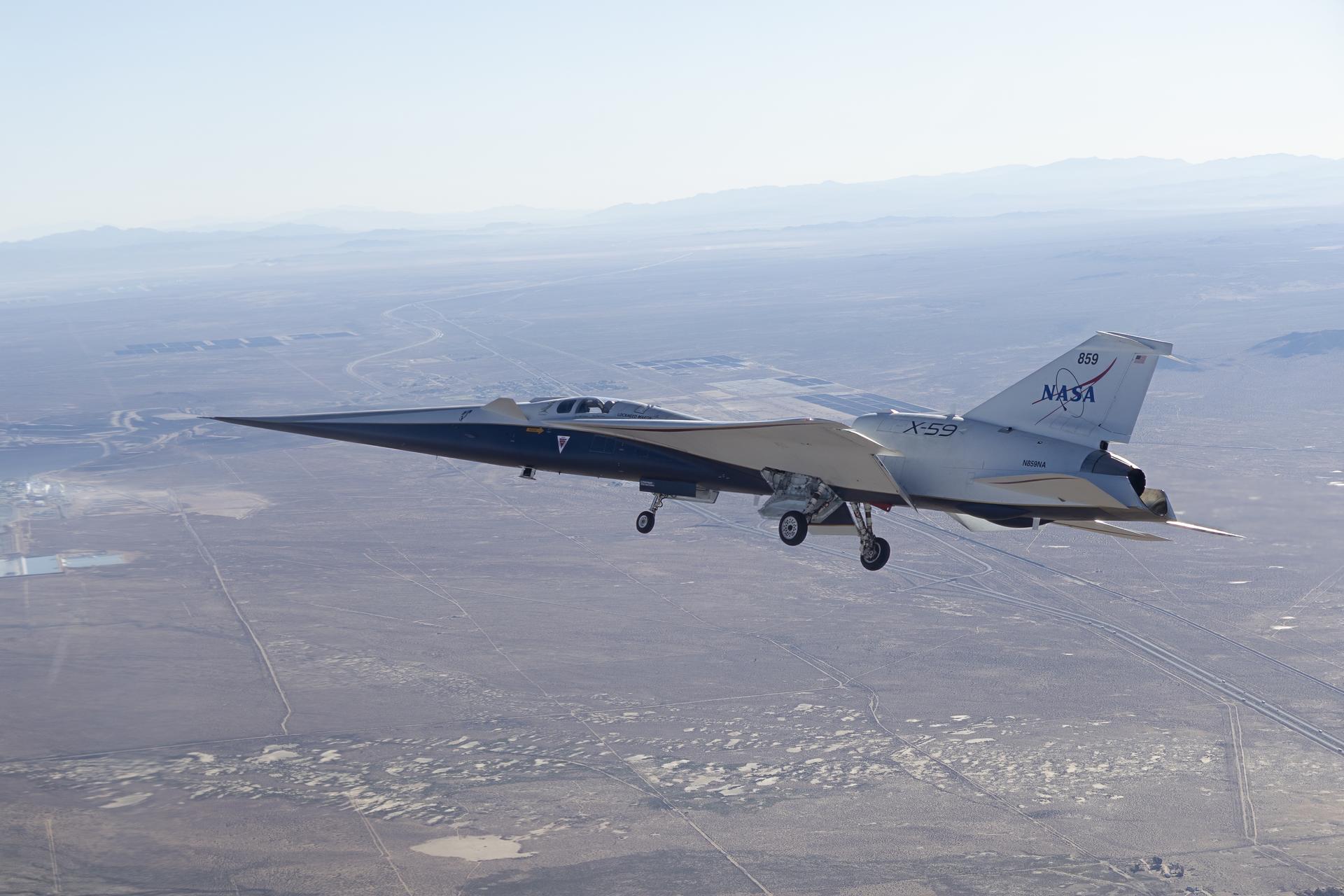
The photograph shows X-59 above Palmdale and Edwards during its first flight on October 28, 2025. NASA’s library credits Lori Losey and supplies that date. It is an archive photograph, not an image of a 2026 speed record or evidence of sound measured on the ground.
That provenance is part of the explanation. The visible machine can help readers understand the subject while the caption prevents an older image from standing in for a newer experiment. Our next update will follow the acoustic evidence at the level actually demonstrated.
Source notes: 5. Original editorial examples and interpretations are identified separately.
Sources & Methods
Prepared October 29, 2026 from the October 28 X-59 progress report and separate physics, proposed-rule and community-position sources. Programme figures remain attributed claims, not independently reproduced measurements. Our comparison checklist is an editorial proposal. No flight, telemetry inspection, acoustic test, community survey or interview performed. NASA did not review or endorse this article. Archive image date and creator checked against the NASA image API; actual pixels inspected.
- NASA: X-59 one-year progress report — Primary programme report; October 28, 2026; cumulative flight results and future acoustic work
- NASA: science of sonic booms — Primary physics explanation; August 10, 2026; read October 29
- FAA: Enabling Supersonic Overland Flight proposal — Separate primary regulatory context; July 2, 2026; proposed rule, not commercial approval
- Aviation-Impacted Communities Alliance: its public-comment position — Independent stakeholder’s own position, August 2026 comment summary; read October 29
- NASA: X-59 photograph AFRC2025-0168-038 — Primary image record and API; photograph October 28, 2025; NASA/Lori Losey
- NASA: images and media guidelines — Primary reuse conditions; read October 29, 2026; factual editorial use, attribution and no endorsement