
The milestone is integration, not arrival
NASA’s October 23 report describes Dragonfly completing a real-time first-flight simulation on flight-like avionics at Johns Hopkins Applied Physics Laboratory. Simulated camera, inertial and lidar inputs were combined with flight software. This was not physical flight on Titan, and the report does not specify the test’s calendar date.
The interesting engineering claim is that the pieces operated together. A successful component test answers a limited question about that component. An integrated rehearsal asks whether the relationships between components behave as intended when events occur in sequence. Those are different kinds of evidence, and both can be necessary.
Think of a musician who can play every phrase correctly but has not yet rehearsed with the orchestra. The analogy is imperfect: flight software is not interpreting a conductor. It does expose the distinction between individual capability and coordinated performance. The significance lies in the additional question being tested, not in pretending that the rehearsal has removed every remaining uncertainty.
Source notes: 1. Original editorial examples and interpretations are identified separately.
An accurate answer can still arrive too late
The report describes graphics processors producing camera scenes on a 20–70-millisecond exposure timescale. This lets the rehearsal examine more than whether a navigation answer eventually appears. Timing becomes part of the interaction. An image delivered at the wrong point can describe a world that the controller no longer occupies.
Here is an original teaching example, not Dragonfly telemetry. Imagine a vehicle moving at 5 metres per second. A 100-millisecond delay corresponds to half a metre of travel; a one-second delay corresponds to five metres. The calculation is distance equals speed multiplied by time. It illustrates why response time belongs in a navigation discussion.
Those invented numbers cannot establish an acceptable Dragonfly delay, safe landing distance or actual flight speed. Such a conclusion would require its control design, uncertainty estimates and operating conditions. The narrower lesson is transferable: evaluating the eventual answer alone can miss a failure caused by when that answer becomes available.
Source notes: 1. Original editorial examples and interpretations are identified separately.
The environment is not interchangeable with Earth
NASA’s spacecraft description identifies Titan’s dense atmosphere and low gravity as reasons to use aerial mobility. It also lists a battery and radioisotope power system, rather than treating the rotorcraft as a solar-powered consumer drone. These are environmental design choices, not proof that the assembled vehicle can fly reliably.
A simulation needs assumptions about the world it represents. Change the assumed environment and the same command may have a different consequence. That is why a convincing visual scene and a faithful engineering model are not synonymous. The image shown to an observer can look realistic while a relevant physical assumption remains uncertain.
There are two separate risks to investigate: the implementation can behave differently from its design, or the design can be evaluated against an incomplete account of the world. Passing a computer rehearsal helps address the conditions actually represented. It cannot, by itself, demonstrate that every assumption about a distant environment is correct. Confidence needs a connection between the model, measured behavior and the intended operating conditions. That is our engineering interpretation, not an allegation that this particular test used a faulty model.
Source notes: 2. Original editorial examples and interpretations are identified separately.
The useful next question is how the system fails
The October report identifies tests on the actual flight system, other flight profiles and deliberately introduced faults as further work. These future steps must not be described as already completed. The distinction matters because an expected sequence is only one part of the operating problem.
For an autonomous vehicle, a useful question is not merely whether it can select an action when every input agrees. What should happen when information is incomplete, inconsistent or late? There may be several reasonable responses depending on the vehicle’s state and available options. Inventing a universal fallback would be as misleading as assuming nothing can go wrong.
A meaningful fault campaign therefore needs defined conditions and observable outcomes, not simply a video of an apparently successful ending. For readers following later announcements, look for which cases were exercised, what constituted success, and what evidence connects those tests to the flight configuration. We have no access to those procedures and do not assign a reliability percentage to the present rehearsal.
Source notes: 1. Original editorial examples and interpretations are identified separately.
Reaching different sites changes the scientific question
The current mission overview targets launch no earlier than July 2028 and arrival in late 2034. Those remain plans. NASA frames the investigation around chemistry relevant to the steps before biology, not a promise that Dragonfly will discover life. That boundary should survive even an exciting engineering update.
The science description connects surface sampling and molecular analysis with elemental measurements, environmental observations and imaging at different scales. These observations answer different questions. A striking landscape picture can locate a sample, but cannot replace a chemical measurement; a composition result needs its surroundings to be interpreted responsibly.
Moving between sites makes comparison possible. Consider two hypothetical samples with a similar chemical component but different geological surroundings. The shared component alone does not show that both places followed the same history. Repeated measurements, contextual observations and competing explanations can make the distinction testable. This is an explanatory example, not a forecast of an actual Dragonfly result.
That is the connection between navigation and discovery: arrival enables evidence collection, but does not predetermine its interpretation. A mission can overturn an attractive explanation rather than confirm it and still deliver valuable science.
Source notes: 3, 4. Original editorial examples and interpretations are identified separately.
Our assessment: progress is a chain of different evidence
The right response is neither to dismiss simulation as imaginary nor to mistake it for a completed mission. A controlled rehearsal can reveal important interactions precisely because its inputs can be defined. Its conclusion must stay attached to that configuration and those conditions. Progress comes from connecting different kinds of evidence without pretending they are interchangeable.
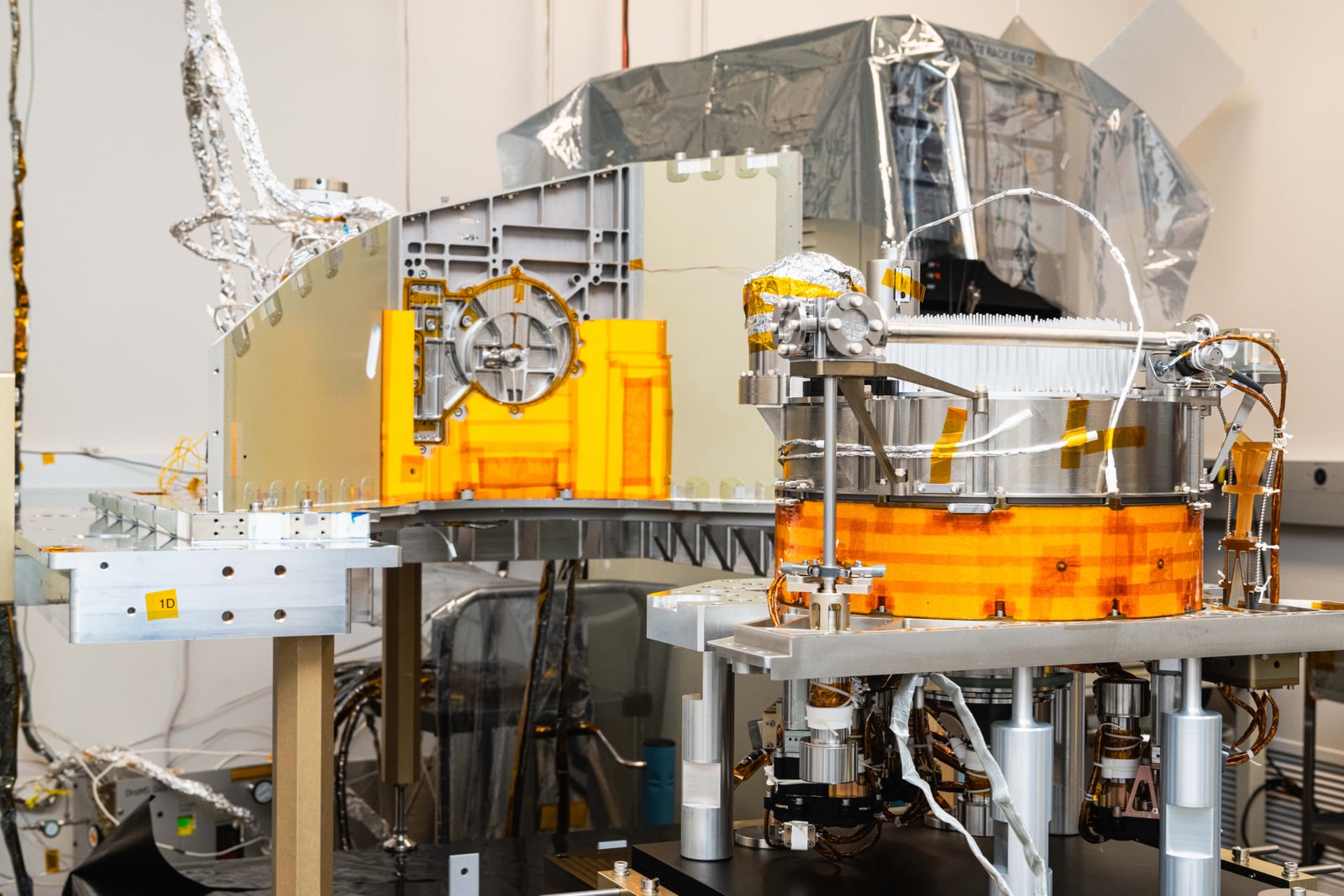
The accompanying real photograph is archive context: science hardware at NASA Goddard on March 5, 2026. It does not show the October simulation, a flying vehicle or Titan. Keeping those distinctions visible is part of reporting the milestone accurately, not a qualification hidden after a dramatic image.
Our assessment rests on primary project descriptions, not firsthand observation, an interview, software inspection or flight-data analysis. The most useful next announcement will explain what new uncertainty has been reduced and what remains to be tested. For an autonomous explorer, the quality of that chain matters more than how close a computer image looks to the imagined destination.
Source notes: 1, 2, 3, 4. Original editorial examples and interpretations are identified separately.
Sources & Methods
Prepared October 24, 2026 from four complete NASA primary project pages and the exact NASA SVS photography record. Publication date and unreported test date are distinguished. This is independent editorial interpretation of project descriptions, not independent verification of testing. The 5m/s delay example is an original calculation with invented inputs, not a Dragonfly specification. The March5 photograph date follows SVS15003 and its dated filename; a general mission multimedia page labels the corresponding imageMarch2, a discrepancy not silently adopted. No hands-on test, interview, software audit, telemetry review or reliability estimate was performed. No NASA review or endorsement of this article is implied.
- NASA: October 23 integrated simulation report — Primary project report; complete body and captions read; test date not stated
- NASA: Dragonfly spacecraft and instruments — Primary technical description; complete body read; configuration descriptions are not test results
- NASA: current Dragonfly mission overview — Primary schedule and scope; complete mission body read; future dates remain targets
- NASA: Dragonfly science objectives — Primary investigation description; complete body read; no life discovery claimed