
A team, not simply a smarter rover
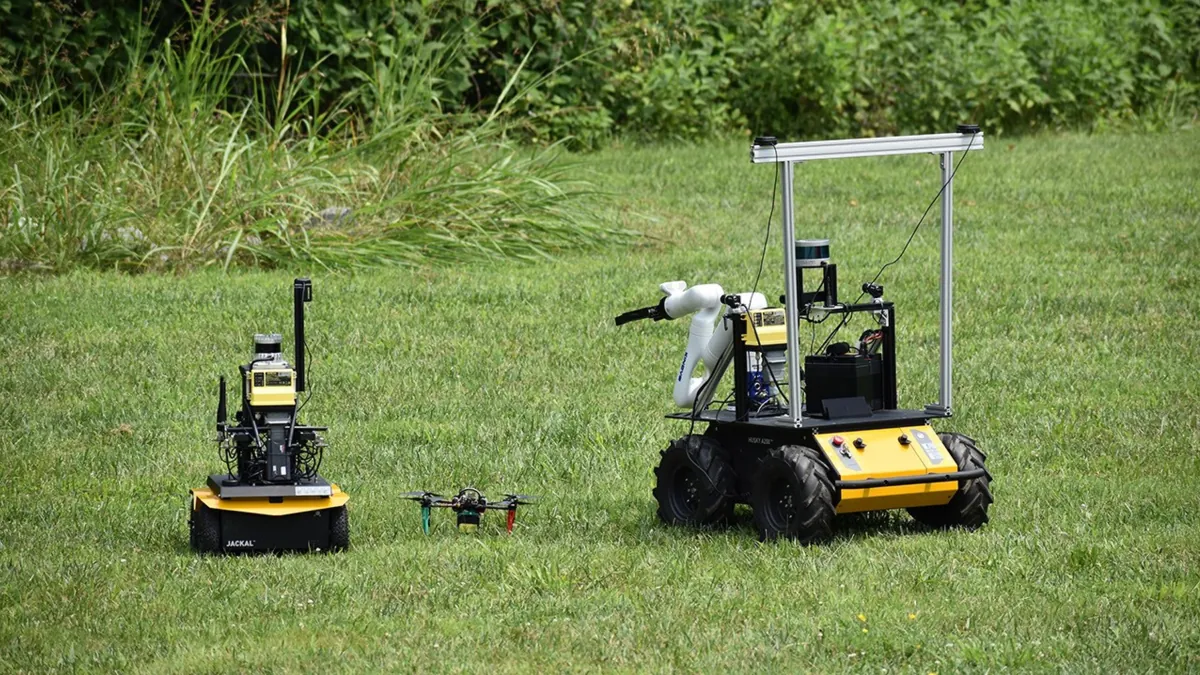
NASA's ASTRA project tested a drone and two rovers at Virginia Tech's transportation institute in July, the agency reported on September 15. Humans supplied science goals; the machines allocated work and reconsidered opportunities. NASA describes a drone retaining its existing task while recruiting another robot to investigate a new target.
The fleet combined aerial scouting, lidar mapping and a sampling arm. This was an Earth-based trial—not a deployed planetary mission. The interesting question is what such coordination should accomplish, and how anyone would establish that it is dependable.
When a question takes minutes to reach Earth
NASA's Mars mission-planning material illustrates one-way communication delays reaching about 22 minutes on a representative trajectory. The exact delay changes with geometry. The implication is straightforward: even a perfectly functioning radio cannot turn a distant rover into a machine that a person drives through every obstacle in real time.
A decision made locally can therefore have value without matching a human scientist's general abilities. If a system can safely complete a bounded task while its next instructions are in transit, the mission may spend less time waiting. That is an operational argument for autonomy, not evidence that more autonomy is always better.
Consider an illustrative choice: a robot sees a potentially useful outcrop while its battery is falling. Waiting may lose the opportunity; approaching may compromise its return. The right action depends on the mission's priorities, remaining resources and uncertainty—not merely on whether a camera labels the rock as interesting. A useful assistant must sometimes decline the opportunity.
Three machines create a coordination problem
NASA's separate CADRE research provides a concrete example of how a robotic team can divide responsibilities. JPL describes capabilities including selecting a leader, assigning work, constructing maps and coordinating measurements. Its ground-penetrating-radar concept depends on multiple robots collecting measurements together. CADRE is background here, not another name for ASTRA or evidence that the Virginia fleet passed lunar qualification.
The distinction matters because a team is not automatically three times as capable as one robot. In our illustrative scenario, the scout may identify ten locations, but a sampling rover can visit only two. A useful plan must decide which observations complement one another and which merely repeat work.
Coordination also creates dependencies. A failed message, an outdated map or an unavailable teammate may change what the remaining machines can safely do. Our reading is that the valuable outcome is not constant activity. It is a system that understands which actions remain justified when part of its original plan is no longer possible.
Sources: JPL: CADRE strategic planner
Why a grassy field is useful—and insufficient
NASA's planetary-analog programme explains why studying Earth supports exploration elsewhere. Remote sensing supplies the broad view; observations made on the ground help researchers interpret what distant instruments are seeing. Terrestrial fieldwork lets teams compare those perspectives and rehearse methods before committing them to much less accessible environments.
That connection makes mixed robotic teams scientifically interesting. Aerial observations and close measurements answer different questions. In an illustrative geological survey, an overhead pattern might suggest a promising area, while a nearby measurement reveals that the apparent pattern has a different cause. Good exploration needs a way to update the interpretation, not merely collect another photograph.
An analog remains a selective test, however. We would not interpret successful coordination on Earth as a substitute for evaluating destination-specific hardware, environmental conditions and operational constraints. The same algorithm can face a very different problem when the cost of a stalled wheel or an incorrect assumption becomes much higher.
Sources: NASA: planetary analogs and ground-truth observations
Scientific perspective: measure useful decisions
Lumacta's evidence-based assessment is that this kind of autonomy should be evaluated by decision quality, not by how independent the robots look in a demonstration. This is an editorial assessment and a proposed test framework, not an independent peer review or a reproduction of ASTRA's experiments.
We would compare a cooperative fleet with simpler alternatives under the same resource limits: a fixed schedule, independent robots and human-directed operation with realistic communication delays. Relevant outcomes would include completed scientific objectives, duplicated measurements, time lost, energy used and interventions needed. A system should not receive a better score merely because it makes more decisions.
The difficult cases deserve explicit attention: a teammate becoming unavailable, ambiguous observations, inconsistent information and opportunities that should be ignored. We would also want records explaining why priorities changed. For a scientist, a defensible decision can matter as much as a successful drive, because the resulting data must still support an interpretable scientific argument.
Sources: NASA: ASTRA field-test report, September 15; NASA: Mars communication disruption and delay; JPL: CADRE strategic planner; NASA: planetary analogs and ground-truth observations
The opportunity is better science between instructions
Our conclusion is that cooperative autonomy deserves attention because it addresses a practical limitation of remote exploration. The prospect is not a replacement for the people choosing scientific questions. It is a better way to carry out their intentions when continuous supervision is impossible or inefficient.
There is a potential economic benefit if missions obtain more useful information from equipment they already paid to transport. There is also a cost: additional software, testing, coordination hardware and operational complexity. These are conditional trade-offs, not savings demonstrated by the announcement.
The next milestone worth watching is evidence that the approach improves a defined scientific task while retaining understandable failure behaviour. A robot team that knows when to pause, preserve resources and ask for help may prove more valuable than one that always finds a reason to keep moving.
Sources: NASA: ASTRA field-test report, September 15; NASA: Mars communication disruption and delay; JPL: CADRE strategic planner
Sources & Methods
Checked September 16, 2026. NASA supplies the field-test account; the other sources provide background. Examples, comparisons and proposed evaluation criteria are Lumacta's analysis. We did not attend or reproduce the trials.
- NASA: ASTRA field-test report, September 15 — Primary agency report
- NASA: Mars communication disruption and delay — Mission-planning background
- JPL: CADRE strategic planner — Separate project's technical documentation
- NASA: planetary analogs and ground-truth observations — Scientific-method background