
A dated commitment, with observations still ahead
NASA announced on October 27 that UVEX, the UltraViolet EXplorer, had passed its technical and programmatic confirmation review, Key Decision Point C. The agency committed to launch by January 2031 and a total lifecycle cost of $590 million. The statement does not identify the review’s exact completion day.
That distinction matters when reading a mission headline. An announced commitment is substantial progress, but it is not the same evidence as a completed observatory or a returned dataset. We should judge the decision at the level it describes, then identify which later milestones would answer the remaining questions.
Our reading is therefore forward-looking: what must happen between permission to proceed and observations that other researchers can use? The questions below are an editorial framework for following that work. They are not a report of Lumacta testing a detector, auditing the budget or reproducing a mission simulation.
Source notes: 1. Original editorial examples and interpretations are identified separately.
A different wavelength changes the observing question
Caltech describes an observatory designed to make deep ultraviolet maps and obtain spectra, separating light into wavelengths that reveal physical characteristics. Its team highlights small nearby galaxies, stripped stars and stellar explosions. These are planned investigations, rather than discoveries already delivered by UVEX.
A useful comparison begins with the scientific question, not the most impressive-looking image. Ask what information is sought, which observation can constrain it and what remains ambiguous afterward. Different instruments can contribute complementary evidence; one attractive picture should not silently stand in for that entire process.
For this mission, the meaningful future result will be usable measurements accompanied by enough information to interpret them. We would look for the observation method, its limitations and the evidence behind the conclusion. A design goal establishes what a team intends to attempt; it cannot, by itself, establish success.
Source notes: 3. Original editorial examples and interpretations are identified separately.
A map and a rapid response solve different problems
The University of Maryland’s announcement describes both an all-sky survey and follow-up of transient events within hours. Its account explains that early ultraviolet measurements can help distinguish models of kilonova emission, while supernovae can be especially informative in ultraviolet light during their early evolution.
The editorial distinction is between building a comparison record and catching a changing event at the useful moment. For a future transient result, we would ask when an alert arrived, when the observation began and which part of the event was actually measured. A broad responsiveness goal does not answer those questions for an individual event.
Nor should the existence of several complementary observatories be mistaken for an automatically coordinated observation. The practical evidence would be a documented sequence of alerts and measurements. This is a suggested way to assess future reporting, not a claim that we have evaluated UVEX’s scheduling system or reproduced a follow-up exercise.
Source notes: 4. Original editorial examples and interpretations are identified separately.
Read sensitivity claims with their comparison attached
The institutional accounts use different headline comparisons: Maryland describes fifty times GALEX’s sensitivity, while Caltech says up to one hundred times. Neither figure is an independent on-orbit measurement. We do not combine them into a single verified performance claim or assume they describe an identical comparison.
Instead, a useful specification would state the wavelength band, exposure, observing conditions and detection criterion behind a number. Without an aligned baseline, a larger multiplier can conceal a different question. Those are our proposed comparison checks, not additional mission requirements obtained from an unpublished engineering document.
The distinction also protects the eventual science story. A successful observation should be evaluated with its own evidence and uncertainties. It need not inherit every optimistic headline from development, and a design estimate should not be rewritten as a measured result merely because the programme has advanced.
Source notes: 3, 4. Original editorial examples and interpretations are identified separately.
Calibration is part of the observing system
Berkeley’s Space Sciences Laboratory describes specialized ultraviolet CMOS detectors and electronics designed to limit contamination from outgassing. It is constructing a custom calibration facility with a thermal-vacuum chamber, ultraviolet illumination and mechanisms for checking alignment and sensor response under the intended conditions.
That account gives readers a more useful next question than whether the spacecraft looks finished. What configuration was calibrated, what conditions were represented, and what uncertainty remains when the instrument is integrated with the rest of the observatory? A component result can be valuable without being treated as an end-to-end demonstration.
We have not inspected that facility or verified its measurements. Our interpretation is that a trustworthy progress report should connect the reported test to the capability it supports. The strongest evidence will identify both the boundary tested and the boundaries still waiting for their own checks.
Source notes: 5. Original editorial examples and interpretations are identified separately.
The archive image records GALEX, not UVEX
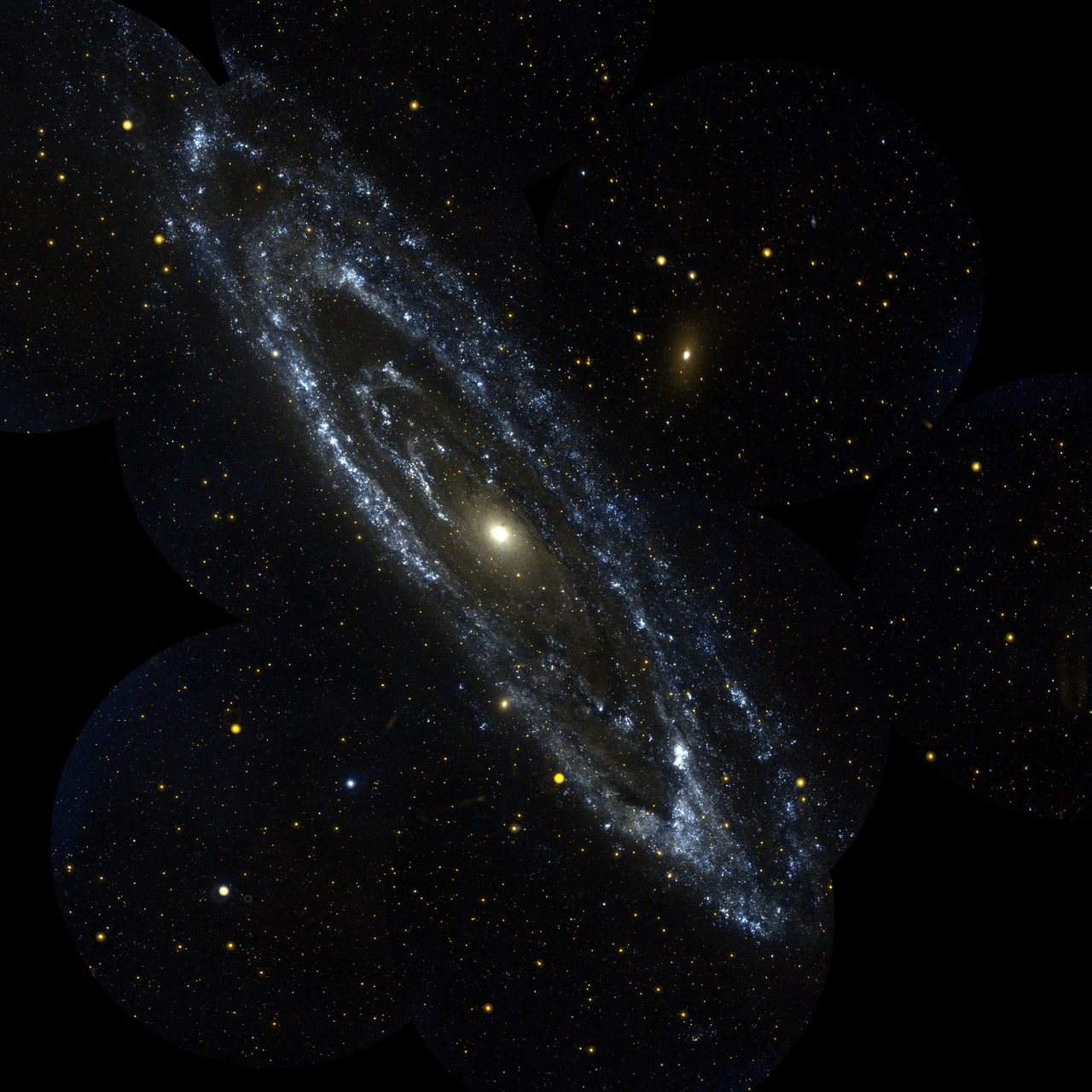
The image here is a GALEX ultraviolet mosaic of Andromeda, observed in September 2003 and released that December. Ultraviolet bands are mapped to visible colors. These are archival observations, not UVEX data.
Its role here is context: it lets readers see what a documented ultraviolet data product looks like while keeping the provenance visible. The archive label is essential. Reusing an older observation does not make it a new discovery, and changing a caption cannot turn it into evidence from a mission still under development.
Individual exposure dates are not specified; the published colors map ultraviolet bands.
Source notes: 6. Original editorial examples and interpretations are identified separately.
What the next engineering stage actually opens
NASA’s separate systems-engineering handbook describes Phase C as final design and fabrication. Its lifecycle places assembly, integration, testing and launch in Phase D, followed by operations. This general process reference explains why a confirmation milestone is not equivalent to launch clearance or completed scientific commissioning.
The practical reading rule is to match a claim to its stage. Approval to proceed, an environmental test and a calibrated observation answer different questions. Treating them as interchangeable makes progress harder to assess, because the reader loses track of what was demonstrated and what remains prospective.
This framework is deliberately modest. It does not predict a delay or certify that the current plan will hold. It provides a consistent way to read later evidence without changing the standard whenever a more dramatic headline becomes available.
Source notes: 2. Original editorial examples and interpretations are identified separately.
Our checklist for the next UVEX update
First, identify the actual change: a decision, a finished design, delivered hardware, a test or an observation. Second, ask for the scope and conditions of the evidence. Third, keep the stated comparison baseline beside any performance number. These checks are our editorial proposal; they are not a completed mission assessment.
Then follow the connection to a scientific question. What would the measurement help distinguish, what alternatives remain and what independent information would strengthen the inference? Keeping those questions explicit makes a programme update useful even before a public science dataset exists.
UVEX’s confirmation is worth reporting because it moves the project forward. The next useful stories will show how the planned observing capability becomes demonstrated capability. Readers should be able to follow that progression without confusing an approved ambition, an archival observation and a measured result.
Source notes: 1, 2, 5. Original editorial examples and interpretations are identified separately.
Sources & Methods
Prepared October 28, 2026 from the October 27 NASA confirmation announcement and participating Caltech, Maryland and Berkeley accounts, with separate NASA lifecycle context. These programme sources are not independent flight validation. Different sensitivity comparisons remain attributed and unresolved. No spacecraft test, calibration measurement, budget audit, simulation or interview performed. GALEX archival observations are distinguished from future UVEX data.
- NASA: UVEX confirmation announcement — Primary programme statement; October 27, 2026; read October 28
- NASA: programme and project lifecycle — Separate primary process reference; read October 28, 2026
- Caltech: ultraviolet survey and instrument goals — Participating institution; October 27, 2026; design goals, not measured flight results
- Maryland: survey, sensitivity and transient science — Participating institution; October 27, 2026; targets and scientific rationale
- Berkeley SSL: UVEX engineering and calibration — Participating institution; October 27, 2026; complete article read October 28
- JPL: GALEX Andromeda image PIA04921 — Primary archive image record; released December 10, 2003; observations September 2003
- JPL image-use policy — Primary reuse conditions; credit and no endorsement; read October 28, 2026