
An October update contains a longer hardware history
NASA’s October 26 report says NEO Surveyor’s sunshade has received solar cells, sensors and functional and performance checks. Its chronology places cell installation in January, thermal-vacuum testing in March, delivery in May and the pictured inspections in July. The precise date of the later completed checks is not given.
Read that as a new public status account of ongoing work. It would be misleading to move every milestone onto the publication date or treat the update as a launch announcement. A dated article, an assembly milestone and a completed flight system are three different claims, each requiring its own evidence.
Our assessment is that the useful story is the chain the hardware must eventually support. Following that chain helps a reader understand why an unglamorous component can matter, while keeping a component-level success in proportion to the larger mission.
Source notes: 1. Original editorial examples and interpretations are identified separately.
The sunshade joins thermal design to power supply
The six-metre sunshade blocks sunlight from the infrared telescope and carries 864 solar cells, rated up to two kilowatts. These are reported specifications; we did not test them.
As an engineering reading question, ask what has been tested at each boundary. An array’s electrical performance, a structure’s behaviour in an environmental test and the observatory’s ability to obtain usable measurements are related questions, but they are not interchangeable. A clear update should let readers keep those levels separate.
The next useful evidence to seek is therefore the scope of a test: the assembled hardware involved, the environment represented and the success criteria used. We do not infer undocumented test temperatures, margins or failure rates from the published status account.
Source notes: 1. Original editorial examples and interpretations are identified separately.
Search coverage depends on more than visible brightness
The mission overview explains that dark asteroids may reflect little visible light while still emitting infrared radiation after sunlight heats them. NEO Surveyor is designed to improve searches in viewing directions where solar glare makes ground-based optical observations difficult. Its launch is listed as no earlier than September 2027, rather than a guaranteed departure date.
The important comparison is therefore a search method and its observing geometry, not a competition to build the most impressive camera specification. A reader should ask which population is hard to observe using an existing approach and how the new observing method addresses that particular gap.
That is a rationale for the planned mission, not a measured discovery yield. We have not evaluated its eventual on-orbit completeness or compared it with operating observatories using a common dataset. Those would be different analyses, requiring observations and a defined method.
Source notes: 2. Original editorial examples and interpretations are identified separately.
A detected object still needs a constrained trajectory
CNEOS’s Sentry introduction explains why a newly discovered asteroid can initially have a range of possible paths consistent with limited observations. Additional observations can narrow that range and remove an object from the risk list. CNEOS describes that removal as normal refinement, not proof that the earlier assessment was erroneous.
Our practical reading sequence has four questions: what was observed, which observations support the fitted orbit, how uncertain is that orbit, and what consequence follows from it? Keeping those questions apart avoids turning the first detection into a prediction of impact.
A hardware progress report answers none of those questions for an individual asteroid. Nor does an attractive picture of a space telescope establish a current threat. This article concerns the planned measurement chain; it does not report a new hazardous object or advise readers about one.
Source notes: 3. Original editorial examples and interpretations are identified separately.
A category label is not an appointment with Earth
CNEOS defines potentially hazardous asteroids using orbital proximity and an absolute-brightness threshold. Its definition uses an Earth minimum orbit intersection distance of 0.05 astronomical units or less and an absolute magnitude of 22 or brighter. The approximate size interpretation depends on an assumed reflectivity.
That distinction is useful when a future discovery appears in a headline. A classification describes screening criteria; an impact prediction requires a trajectory and an assessment of uncertainty. Treating the two as synonyms removes the very information that makes a warning meaningful.
For the same reason, we do not translate a discovery count into a count of incoming impacts. A programme can improve knowledge by finding objects and then showing more precisely where they will travel. Better information can remove possibilities as well as reveal them.
Source notes: 4. Original editorial examples and interpretations are identified separately.
The accompanying spacecraft is WISE, not NEO Surveyor
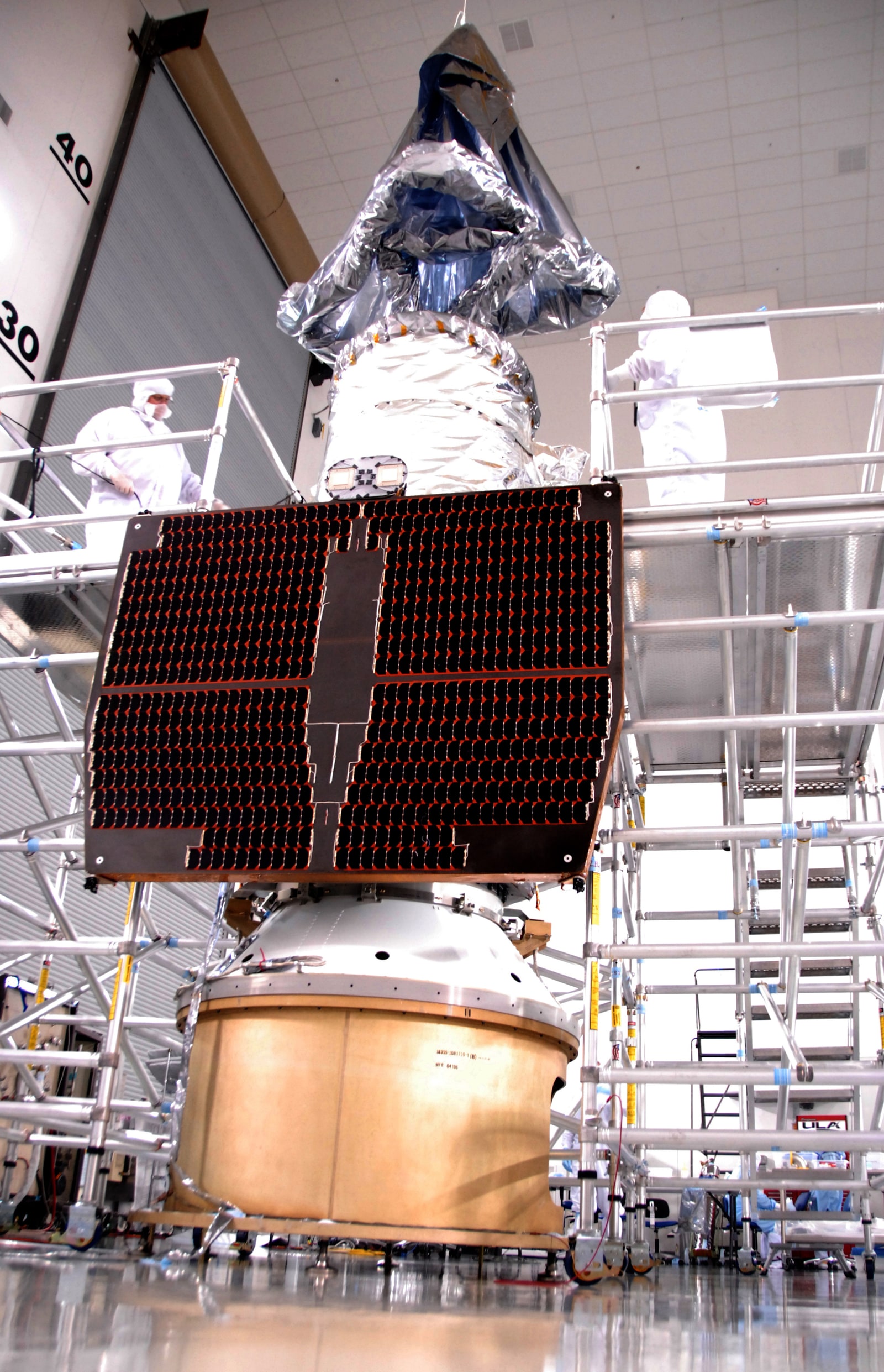
The mission overview identifies NEOWISE as a predecessor whose infrared work NEO Surveyor builds on. The photograph here shows WISE being prepared for protected transport in 2009. It is historical hardware context, not a picture of the new sunshade, the July inspection or a newly detected asteroid.
That separation also applies when reading official imagery. A clean-room photograph records what the camera saw at a stated place and time. It cannot independently certify the performance of unseen subsystems. A rendering can explain a design, but should never silently replace documentary evidence.
Here the archive label is part of the information, not a decorative credit. We have chosen an actual photograph with an identified source and reuse basis, rather than imply access to a current assembly session or present a simulated spacecraft as a photograph.
Source notes: 2. Original editorial examples and interpretations are identified separately.
Our checklist for the next readiness report
For subsequent updates, we would look first for a specific change in verified capability: component checks, integrated observatory tests, commissioning or demonstrated survey operations. Each is valuable on its own terms; none should borrow the evidential weight of a later milestone.
Then ask whether the public account distinguishes a design objective, a test result and a measured scientific outcome. For an individual object, follow the orbit evidence and its uncertainty rather than substitute a mission target or an alarming classification.
The October update is useful because it makes part of the engineering work visible. Its importance is prospective: helping a future observing system reach the point where it can produce better information. The remaining steps, and the evidence needed to assess them, still matter.
Source notes: 1, 2, 3. Original editorial examples and interpretations are identified separately.
Sources & Methods
Prepared October 27,2026 from the complete October26 NASA status report, the current mission overview and separately maintained CNEOS definitions and Sentry methodology. Earlier hardware months are retained; the exact later test-completion date is unknown. These official references explain programme status and methods, not independent validation of flight performance. No hardware test, mission simulation, asteroid orbit calculation, interview or hands-on assessment performed. WISE archive imagery is clearly distinguished from NEO Surveyor and current assembly work.
- NASA: NEO Surveyor sunshade status report — Primary programme update published October26,2026; complete report read October27
- NASA: NEO Surveyor mission overview — Primary mission objectives and schedule; read October27,2026; no flight performance validation
- CNEOS: Sentry impact-monitoring introduction — Separate primary technical methodology; introduction and orbit-update explanation read October27
- CNEOS: near-Earth object groups — Separate primary classification reference; read October27,2026