
An October update about a phase already underway
NASA’s October 22 update says Psyche began near-continuous electric propulsion on September 28. The team plans nearly 90% thruster operation during the remaining cruise toward a summer 2029 rendezvous. This is a reported transition and a future duty target, not arrival at the asteroid.
For readers following the mission, the significant change is the emphasis on sustained operation. A spectacular engine ignition is an easy event to picture; years of mostly uneventful running are harder to visualize. Yet that repeated, managed work is precisely what makes this approach useful.
The date distinction matters. We are reporting the October 22 account in our October 23 edition, not claiming that the engines started today. Nor does a successful cruise update certify every remaining stage. Reaching the neighborhood of an asteroid and entering useful science orbits will require further achievements.
Source notes: 1. Original editorial examples and interpretations are identified separately.
Why a gentle push is not an ineffective engine
Psyche’s technical description lists four Hall-effect thrusters, with only one used at a time. Electromagnetic fields accelerate charged xenon atoms out of the engine. Solar arrays provide electrical power; xenon is still consumed as propellant. JPL’s propulsion background distinguishes this cruise system from the chemical launch vehicle that originally lifted the spacecraft from Earth.
The useful physical distinction is between how hard an engine pushes and how long that push can act. Thrust changes momentum. A small force maintained for a long interval can produce a substantial change, while an efficient exhaust can reduce the propellant needed to supply it. This does not make the spacecraft fuel-free or remove the need for electrical energy.
Here is an original scale calculation, deliberately not a Psyche performance estimate. For an imagined 2,000-kilogram spacecraft under a constant 0.20-newton force, acceleration is 0.0001 metres per second squared. Over 24 hours, that adds 8.64 metres per second in the force direction. At an illustrative 90% operating fraction, it adds 7.776 metres per second.
That arithmetic assumes fixed mass, fixed force and fixed direction. It omits gravity, navigation corrections and changing power, so it cannot predict a destination or arrival date. Its value is narrower: a force that sounds negligible becomes meaningful when the engineering problem permits it to act repeatedly.
Source notes: 2, 4. Original editorial examples and interpretations are identified separately.
Ninety percent describes time, not ninety percent power
NASA reports pauses for communications and engineering. Swirling expelled ions also produce a small torque. Reaction wheels absorb angular momentum; reorientation and a different low-power thruster firing unload the buildup. This is a management procedure, not evidence of four engines firing together.
An operating fraction answers how much of a period an engine is active. It does not, by itself, specify the engine setting, its direction or the resulting acceleration. Two systems can have the same duty cycle and deliver different changes in velocity. A long-duration headline therefore needs the surrounding control story.
The reaction-wheel detail is especially revealing. Turning a wheel redistributes angular momentum within a spacecraft; it does not give the wheel unlimited capacity to absorb an ongoing disturbance. A propulsion plan must provide a way to manage that accumulation while preserving the orientation required for power, communications and navigation.
Our reading is that the interesting achievement is coordinated endurance. Scheduling a pause can be what permits a high overall operating fraction, rather than a contradiction of it. We have not inspected the actual wheel speeds, commands or operational logs, and cannot independently calculate their margins.
Source notes: 1. Original editorial examples and interpretations are identified separately.
The power supply travels through a changing environment
NASA’s technical page gives solar-array output of 21 kilowatts near departure from Earth, versus 2.3–3.4 kilowatts during asteroid operations. The October update says the current full-power phase will eventually give way to reduced propulsion power as sunlight declines. A long push is therefore not a promise of constant acceleration.
The general geometric reason is straightforward: light spreads over a larger sphere as distance increases. In an idealized comparison, doubling distance from a light source leaves one quarter of the incident intensity per unit area. That is an explanatory inverse-square relationship, not a reconstruction of Psyche’s present power supply.
A real power budget also needs to support the rest of the spacecraft. For a fixed available supply, allocating more to one subsystem leaves less for others. The practical engineering question is not simply whether sunlight reaches the panels, but whether usable electrical power supports the required activities at the same time.
That makes the journey a linked design problem. Engine capability, array output and operational scheduling cannot be judged in isolation. Our idealized geometry does not account for panel temperature, conversion efficiency, degradation or changing pointing, and it should not be used as a substitute for the mission’s engineering model.
Source notes: 1, 2. Original editorial examples and interpretations are identified separately.
Getting there enables a test, not a guaranteed origin story
NASA’s science objectives include determining whether Psyche is a remnant core or material that never melted. The spacecraft carries an imager, a gamma-ray and neutron spectrometer, and a magnetometer; radio tracking also supports gravity measurements. These are complementary investigations, not four interchangeable ways of taking a photograph.
The scientific attraction is a chance to confront an origin explanation with several kinds of evidence. A surface can look suggestive without establishing the history of the entire body. Measurements of composition, magnetic properties and the gravity field can constrain different parts of that argument.
This is why we avoid calling the destination a confirmed exposed planetary core. The possibility motivates the journey; it is not an outcome the spacecraft has already delivered. A mission can be scientifically successful by finding that a favored account is incomplete, provided the measurements can genuinely distinguish alternatives.
The propulsion update therefore matters because it supports access to the evidence. It does not settle the scientific interpretation in advance. The engineering and the eventual discovery are connected, but they should not be collapsed into one claim.
Source notes: 2, 3. Original editorial examples and interpretations are identified separately.
Our assessment: watch the coordinated system, not the glow
For future updates, useful questions include whether planned operating periods are being achieved, how the available power changes, and what new navigation information permits. Those questions follow from the linked engineering problem; they are not a claim that a particular fault exists or that we have access to internal performance data.
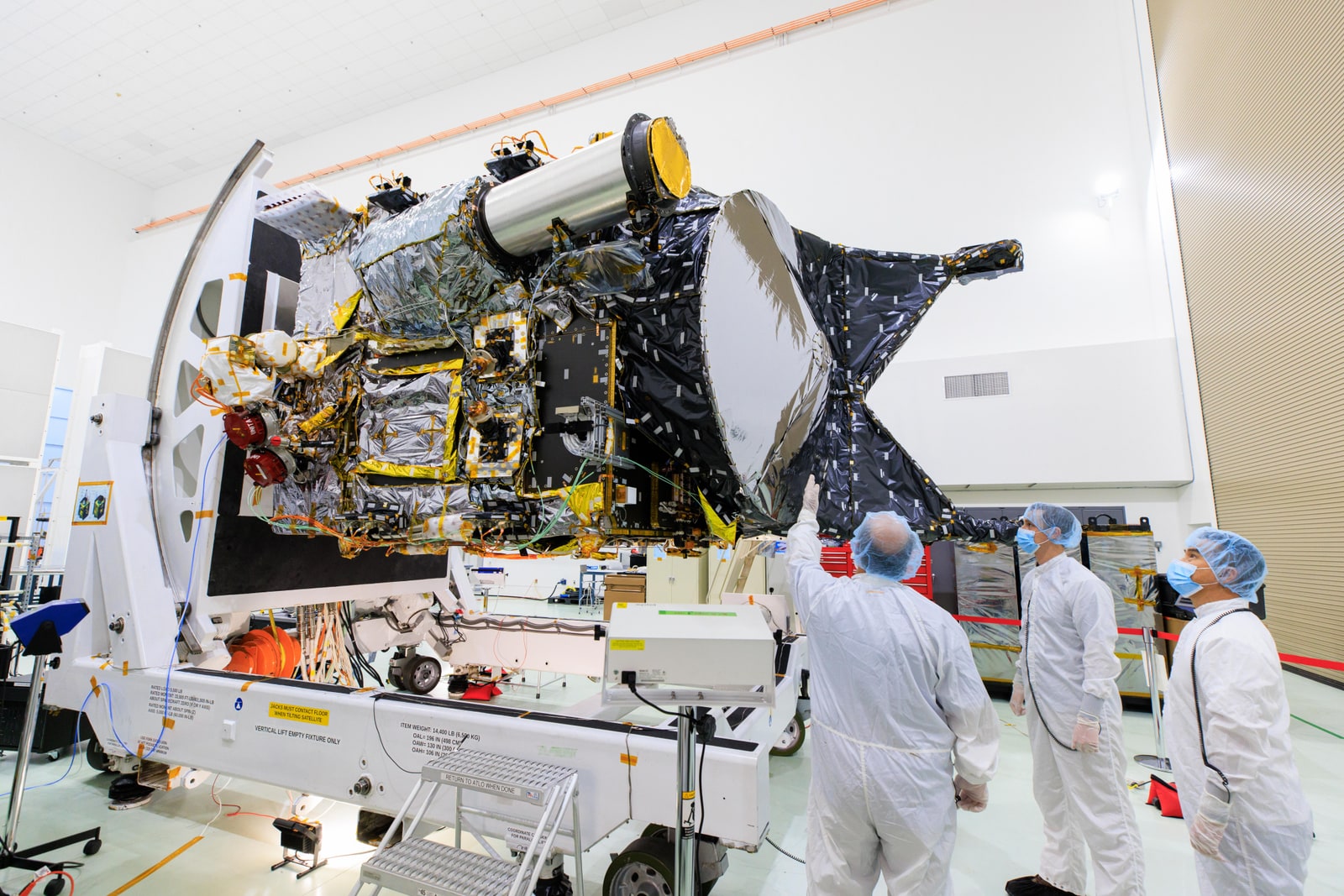
The accompanying photograph records the real spacecraft in a clean room on June 26, 2023. It illustrates ground hardware, not its present condition in space. A prelaunch image cannot demonstrate years of reliability. We distinguish that archive context from a current measurement and from an artist’s impression.
The central lesson is larger than a single engine: modest thrust becomes useful when power, control, time and propellant are designed together. Today’s report is based on primary mission accounts and technical descriptions, not a firsthand inspection, test run, trajectory simulation or interview. The long push is underway; its final scientific destination is still ahead.
Source notes: 1, 2, 3. Original editorial examples and interpretations are identified separately.
Sources & Methods
Prepared October 23, 2026. NASA’s complete October 22 mission update, spacecraft technical description and science objectives were read, together with JPL’s 2021 propulsion background and image-use conditions. Historical planning dates in the 2021 article were not reused as current milestones. The current technical page states240mN whereas the October22 report states250mN; neither is silently reconciled here, and no actual Psyche thrust value is used in the calculation. The 0.20N/2,000kg example and inverse-square illustration are original teaching calculations, not measured mission results. No telemetry, underlying power model, navigation simulation, hardware test or interview was conducted.
- NASA: October 22 cruise update — Primary operations report; complete article and captions read
- NASA: spacecraft technical description — Primary technical overview; complete page read
- NASA: science objectives — Primary scientific objectives; complete page read
- JPL: propulsion background — Primary2021 engineering background; complete article read, superseded planning details excluded