
What has actually happened: launch and separation
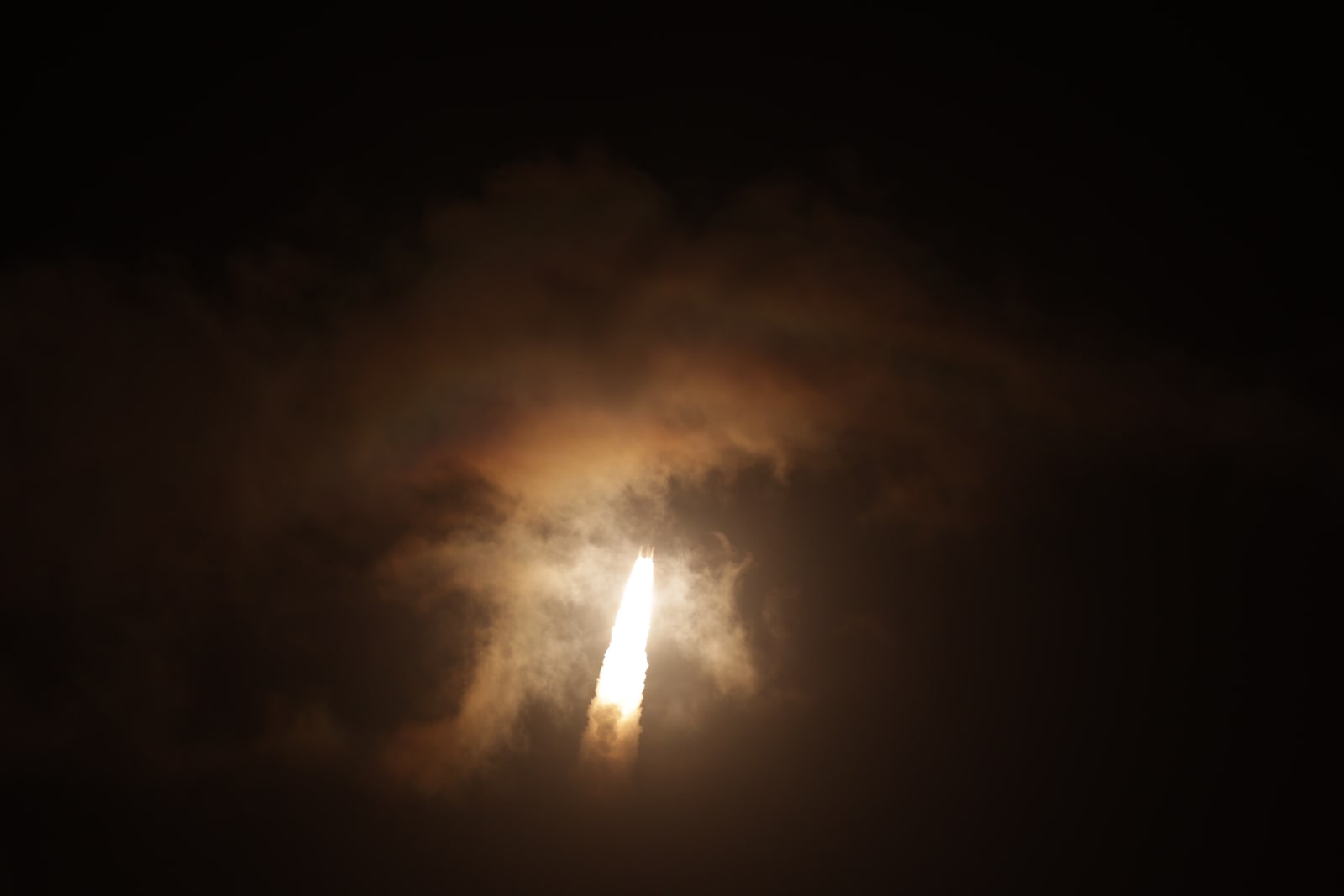
JAXA reports that H3 Flight No. 10 launched MMX from Tanegashima at 04:41:03 JST on October 20—19:41:03 UTC on October 19. Spacecraft separation was confirmed about 71 minutes and 13 seconds later, after the rocket flew as planned and delivered MMX to its predetermined orbit.
The two calendar dates describe the same departure, not conflicting launches. More importantly, the confirmed achievement is getting the spacecraft on its journey. It is not arrival at Phobos, a successful landing or the recovery of extraterrestrial material on Earth.
That distinction does not diminish the event. A mission with several difficult stages must clear its first one before any later science becomes possible. It does mean that descriptions of what MMX could become the first to accomplish should remain ambitions until those operations happen.
Our reading of today’s news is therefore a change in status: a scientific plan has entered flight. The interesting question now is how its different observations could turn a returned handful of material into an argument about an entire moon.
Source notes: 1. Original editorial examples and interpretations are identified separately.
The origin debate needs evidence that discriminates, not simply resembles
JAXA describes two principal explanations for the Martian moons: capture of asteroids formed elsewhere, or formation from debris after a giant impact on Mars. Phobos may also contain material ejected from the planet by later impacts. The mission seeks to investigate both the moon’s origin and the wider history of the Mars system.
These are questions about a history, not just a present-day appearance. A useful result should help distinguish explanations that can otherwise accommodate the same observation. Calling a surface asteroid-like is a starting point; the stronger question is what combination of evidence would be difficult for an alternative explanation to reproduce.
Our scientific perspective is to keep provenance and appearance separate. In an invented museum analogy, two objects can have the same dark finish yet come from different workshops. Inspecting their material adds information, but an origin claim becomes more persuasive when that material fits other evidence about how each object was made.
The analogy is not a model of moon formation. It explains why a successful photograph, an interesting composition and a convincing historical reconstruction are different achievements. MMX’s scientific value depends on connecting them rather than treating one as a substitute for the others.
Source notes: 2. Original editorial examples and interpretations are identified separately.
Why bring back material if instruments can study it remotely?
JAXA’s mission overview sets a minimum sample goal of 10 grams. Its science page assigns cameras and a laser rangefinder to terrain and shape measurements, spectroscopy to composition, and the IDEFIX rover to surface investigation before the main spacecraft lands. Those are planned activities, not observations already returned from Phobos.
NASA describes MEGANE as measuring gamma rays and neutrons to infer elemental composition. Its pneumatic sampler is designed to loft surface material using nitrogen gas, complementing JAXA’s corer, which accesses material below the immediate surface.
The explanatory advantage is a connection across scales. A sample can be examined closely, but the surrounding map helps ask whether its collection site is typical, unusual or close to a boundary. Conversely, physical material can help assess what a remote signature means. Neither kind of evidence automatically replaces the other.
An original sampling thought experiment makes the limitation clear: ten grams from one uniform patch and ten grams from several contrasting patches have equal mass but not necessarily equal descriptive coverage. This is not an MMX sampling simulation. It shows why reaching a mass target alone cannot establish how completely a sample represents a landscape.
Source notes: 2, 3, 4. Original editorial examples and interpretations are identified separately.
A detector must be understood before its counts become a composition
The October 2025 MEGANE calibration paper reports ground measurements and radiation-transport modeling. The authors could not reproduce the complete flight radiation environment in the laboratory. They describe temperature corrections, background rejection and detector-response modeling needed to interpret future observations. The work is calibration evidence, not a new measurement of Phobos.
Here is our own simplified counting example, not instrument data: a counter records 40 events during ten elapsed seconds but is receptive for only eight. That is four events per elapsed second and five per receptive second. Choosing the denominator changes the rate before anyone interprets what produced the events.
The example deliberately omits real detector physics. Its purpose is to explain why a number displayed by an instrument is not yet a material identification. The assumptions and corrections connecting those steps belong to the evidence, rather than being administrative detail added after the discovery.
We read the paper’s methods and limitations, not the underlying calibration measurements or executable simulations. We therefore do not independently certify its performance or convert a laboratory calibration result into a claim about accuracy achieved near Phobos.
Source notes: 5. Original editorial examples and interpretations are identified separately.
What to watch between departure and a sample on Earth
NASA’s October 15 briefing article gives August 2027 as the planned Mars arrival, sample collection no earlier than December 2028, and delivery to Earth in 2031. JAXA’s mission sequence includes close observations, landing-site assessment, surface operations and a return journey. These dates and operations remain targets, not guaranteed appointments.
Our proposed way to follow progress is to ask what each update establishes. Successful arrival would not establish that a sampling location is suitable. A good survey would not establish that the collection mechanism has acquired material. Acquiring material would not establish that it has survived the journey and been recovered for analysis.
Those are different dependencies, not reasons to withhold interest until the final capsule returns. Intermediate observations can already sharpen the scientific questions and inform later decisions. Readers should nevertheless resist allowing one successful stage to silently certify the next.
Schedule changes should be reported against the latest mission information. An older technical paper can remain valuable for understanding a sensor while no longer being the authority for operational dates. Here, the calibration study is background; the current launch result establishes that departure happened.
Source notes: 3, 4. Original editorial examples and interpretations are identified separately.
Our assessment: the strongest return would be material with a defensible context
The most compelling outcome would connect the local properties of returned grains with independently interpretable measurements of their surroundings. That would allow researchers to test whether an origin explanation fits several kinds of evidence, rather than celebrating a single suggestive resemblance.
A grain associated with Mars would also pose a different question from a grain establishing how Phobos formed. Finding material relevant to habitability is not automatically finding evidence that life existed. Our assessment is to preserve those distinctions as the mission moves from objectives to actual results.
The accompanying photograph records the real Tanegashima launch on October 20 in Japan; it is not an illustration of future sampling. No firsthand launch attendance, telemetry audit, hardware test, data replication or mission-team interview was performed for this report. Today’s achievement is substantial. The longer scientific argument is still ahead.
Source notes: 1, 2, 5. Original editorial examples and interpretations are identified separately.
Sources & Methods
Prepared October 20, 2026. The complete JAXA launch result, science page and mission overview, and NASA’s October 15 contribution report were read. The 2025 MEGANE paper’s main narrative, methods, figure captions and appendix descriptions were read; separate expanded numerical tables, underlying calibration data and simulation code were not analyzed. The museum, sampling and counting examples are original editorial teaching, not mission results. The real launch photograph’s exact archive record and complete Digital Archives reuse rules were checked. No test, interview or replication was performed.
- JAXA: launch result — Primary launch confirmation; complete release read
- JAXA: MMX science — Primary science and instrument descriptions; complete page read
- JAXA: mission overview — Primary mission sequence; complete overview read
- NASA: mission contributions — Primary October 15 instrument and planning report; complete article read
- Peplowski and colleagues: MEGANE calibration — Primary 2025 study; main narrative, captions and appendix descriptions read, not underlying data