
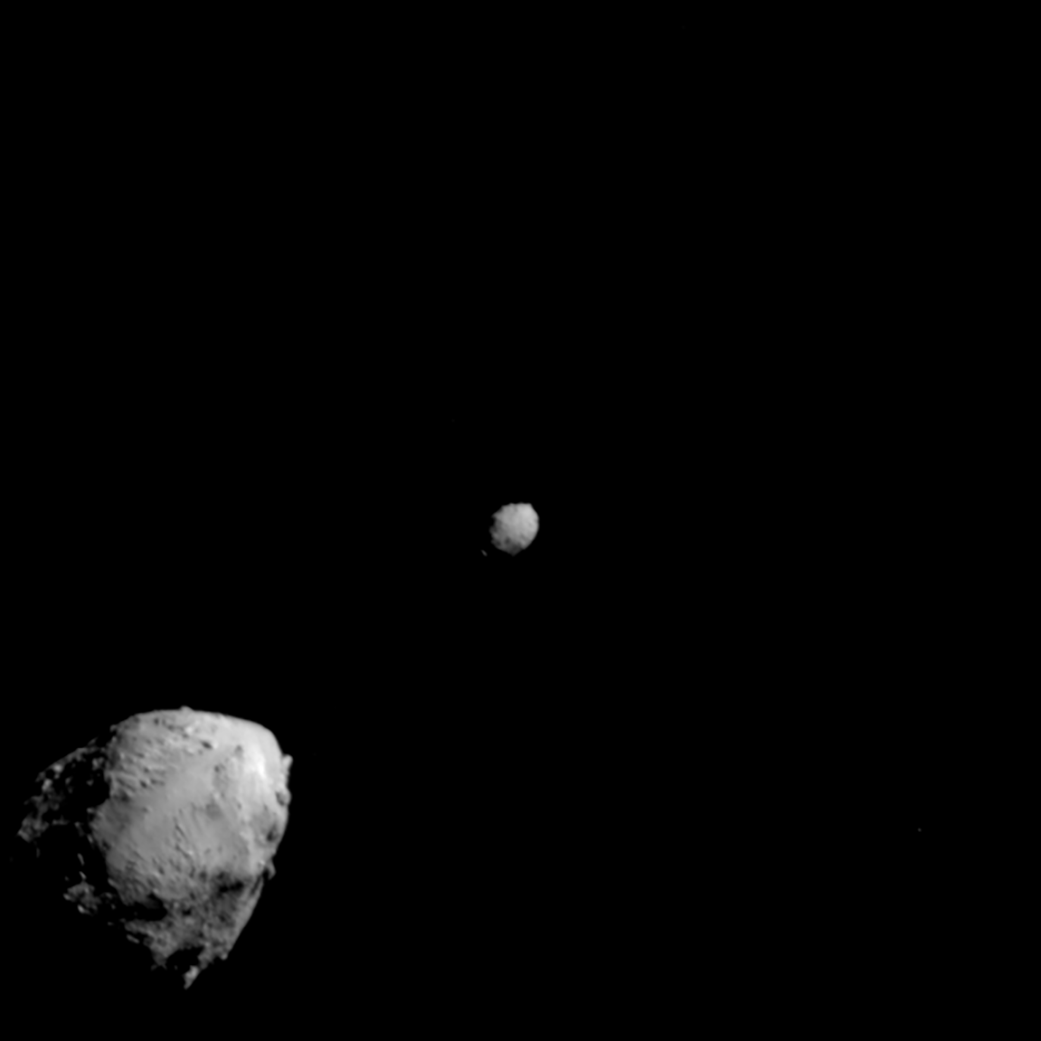
The new event is an approaching investigation—not another impact
Hera is heading towards a place humanity has already changed. In a September 23, 2026 update, ESA says the spacecraft is due to reach the Didymos–Dimorphos system this November. NASA’s DART struck the smaller body in September 2022; Hera’s role is to examine the consequences at close range.
The pair is a test site, not an asteroid threat that these missions are currently trying to avert. DART demonstrated a controlled change in Dimorphos’s motion around Didymos. Hera is designed to help explain that result well enough to improve predictions for a different object, should a future defence mission ever be needed.
That makes the coming observations more than a return visit for better photographs. A successful intervention and an understood intervention are different achievements. The first shows that a technique can work in one setting. The second helps identify the conditions under which it can be relied upon.
Source notes: 1, 2. Analysis and proposed examples are identified in the text.
What has already been measured from Earth
NASA’s March 2024 account of a JPL-led study reported that Dimorphos’s orbital period had shortened by 33 minutes and 15 seconds after the impact and subsequent evolution. The analysis combined DART’s approach images, radar and changes in the system’s brightness as seen by telescopes. This is an earlier result, not a new measurement announced this week.
The researchers also inferred a change in shape. That distinction matters: the study used observations and modelling to work backwards from the available signals. Hera will be able to examine the body close up. Those are complementary approaches, rather than grounds for dismissing either the existing analysis or the need for the new mission.
Think of observing a distant moving object through the shadow it casts. The timing can tell you a great deal about its motion, but not every detail of what is inside it. The analogy is imperfect, yet it captures why a precisely measured effect does not automatically settle every physical explanation.
Source notes: 3. Analysis and proposed examples are identified in the text.
The escaping debris supplied part of the push
An impact transfers momentum directly, but it can also throw material away from the target. That escaping material produces an additional recoil. NASA’s early DART results estimated a momentum enhancement of about 3.6 under the assumption that Didymos and Dimorphos have equal densities. It is an assumption-dependent estimate, not a universal multiplier for hitting any asteroid.
ESA identifies mass, composition and internal structure among the missing information needed to interpret the impact. If mass remains uncertain, a measured change in motion does not uniquely specify the transferred momentum. Characterising the target is therefore part of evaluating the technique, not an optional geological extra.
This is also why “hit it harder” is an incomplete explanation. The arrangement and behaviour of the target material help determine how the impact unfolds. Our interpretation is that the most useful mission result will connect the visible aftermath with the physical properties that produced it, rather than reduce the experiment to one impressive number.
Source notes: 4, 5. Analysis and proposed examples are identified in the text.
Different instruments answer different parts of the question
Hera’s radio-science measurements and tracking of motion are intended to constrain the system’s gravity and mass. Its imaging and ranging instruments can build a more detailed picture of the surface. A photograph is informative, but combining it with measurements sensitive to gravity addresses questions that appearance alone cannot settle.
The mission also carries two smaller spacecraft. ESA describes Milani’s spectral measurements as a way to investigate surface materials and its dust instrument as a way to examine the surrounding particles. Juventas carries radar intended to probe the interior and a gravimeter for measurements after landing. These are planned investigations, not results already obtained at Dimorphos.
The scientific advantage is that the instruments need not all share the same ambiguity. An apparent surface feature, a signal from beneath it and a constraint on mass can be tested against one another. Agreement would strengthen an interpretation; disagreement would identify a model or measurement that needs further investigation.
Source notes: 5, 6. Analysis and proposed examples are identified in the text.
Do not assume the before-impact landscape survived
ESA’s new guide stresses that the impact may have substantially reshaped Dimorphos. DART’s approach images showed a boulder-rich surface, but they are not photographs of what Hera will find in November. The guide’s imagined astronaut journey is a way of explaining the environment, not a crewed mission plan or a report from the surface.
The weak gravity also makes proximity operations unusual. ESA’s operations description sets out separate spacecraft and CubeSat investigations, with communications relayed through Hera. The small companions can approach differently and take measurements unavailable from a single distant viewpoint, but doing so requires navigation and communications to work together.
For readers following arrival coverage, the image date will matter. Archive DART frames, simulations, artists’ impressions and new Hera observations answer different questions. Our lead image is explicitly labelled as a pre-impact DART photograph. It should not be read as proof of the current surface condition.
Source notes: 1, 7. Analysis and proposed examples are identified in the text.
Scientific perspective: use Hera to test predictions, not just illustrate them
Lumacta’s scientific assessment is methodological: the strongest use of Hera’s data would be to compare the new observations with clearly stated predictions from impact models. Which predictions concern the overall shape? Which concern the interior? Which depend most strongly on uncertain mass or density? Separating those questions makes a disagreement informative.
A model adjusted after every new image may describe the final dataset well without having predicted it well. A useful account of progress should therefore distinguish what was expected beforehand from what was learned afterwards, and state uncertainty rather than present a single exact-looking answer. This is our analytical perspective, not a new experiment or an independent peer review.
Hera cannot demonstrate that every hazardous asteroid would respond like Dimorphos. It can make one unusually valuable experiment much more useful by reducing the unknowns around it. For planetary defence, that is a substantial contribution: better evidence for choosing and planning an intervention, rather than a promise that the problem has been solved forever.
Source notes: 3, 4, 5, 6. Analysis and proposed examples are identified in the text.
Sources & Methods
Checked September 24, 2026. The news hook is ESA’s September 23 update and stated November arrival; 2022–2024 DART findings are explicitly historical. This article compares agency accounts and instrument documentation, not raw mission data or a newly reproduced simulation. The scientific perspective is Lumacta editorial analysis, not an interview or independent peer review.
- ESA: a guide to Hera’s target asteroids (September 23, 2026) — Current mission update; expected arrival and terrain uncertainty
- NASA: DART at the Didymos system (2022) — Historical mission context; the test pair is not an Earth threat
- NASA: orbit and shape after DART (March 19, 2024) — Agency account of published research; no new 2026 result claimed
- NASA: early DART results (December 2022) — Historical assumption-dependent momentum estimate
- ESA: Hera frequently asked questions — Mass, instruments and remaining science questions; not every older numerical estimate is adopted
- ESA: Hera’s CubeSats and their instruments — Planned investigations, not completed measurements
- ESA: Hera operations — Mission operations and communications architecture