
A new feature is not the date the research began
MIT’s October 26 feature introduces Lumina to a broader audience as a simulation of the early universe’s first two billion years. This is a research-news explanation, not an announcement that an astronomical event happened today.
The reference paper’s public history starts on May 14, with a revised version dated August 3. That version states that it was accepted by Monthly Notices of the Royal Astronomical Society. MIT describes a paper appearing today; we have not independently established a final publisher record, so do not present today as the first disclosure of the work.
Those distinctions matter when evaluating novelty. A public feature can make an existing result newly accessible without making it a newly performed experiment. Readers should be able to tell whether the new item is an observation, a model, a publication milestone or a clearer account of research already available.
Source notes: 1, 2. Original editorial examples and interpretations are identified separately.
The contribution is a connected model, not a cosmic photograph
The project describes a cube 500 comoving megaparsecs on each side, evolved using gas and dark-matter resolution elements alongside radiation transport. The reference paper couples the IllustrisTNG galaxy-formation model with radiative transfer and follows hydrogen and helium reionization. Reionization means stripping electrons from atoms or ions; hydrogen and helium require different radiation energies.
The useful conceptual change is the connection between processes. In our reading, asking how sources and their surroundings evolve together is different from adding a dramatic light effect after a galaxy calculation. The scientific claim lives in the modeled relationships and outputs, not in the attractiveness of a rendered flight through them.
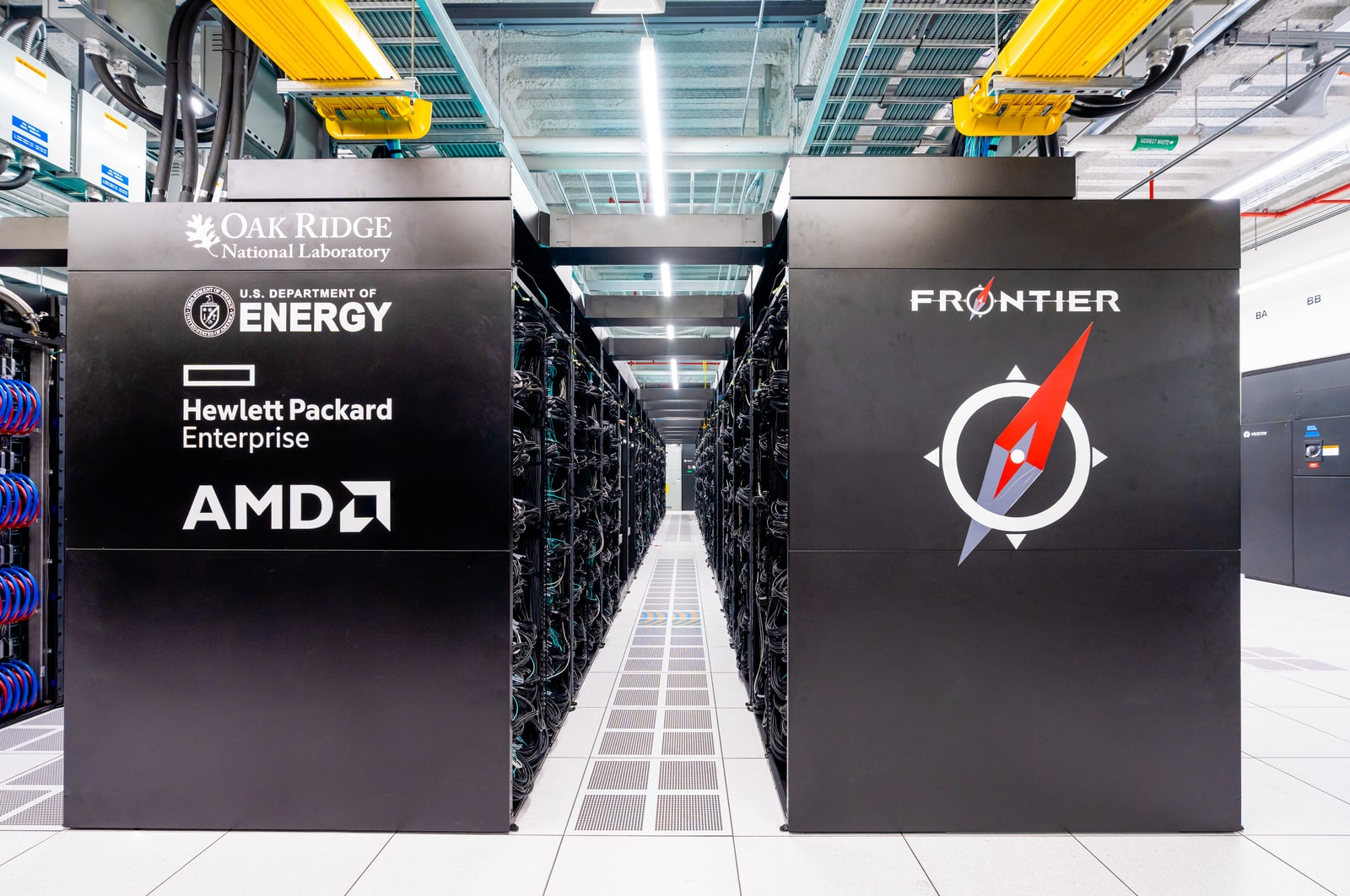
A visualisation is therefore a guide to a calculation, not a telescope exposure. Its colours, viewpoint and layers can help explain what is being represented, but do not supply an independent measurement of the early universe. We use a real, clearly dated computer photograph instead of presenting a simulation rendering as documentary imagery.
Source notes: 2, 3. Original editorial examples and interpretations are identified separately.
A large box and fine detail solve different problems
Lumina’s project documentation lists two sets of 6000 cubed resolution elements and identifies Frontier at Oak Ridge as the computing system used. These are the project’s specifications, not a performance benchmark or an independent count made by Lumacta.
Our assessment is that scale and detail should be read as separate axes. A larger modeled region offers a broader population and environment to examine. Finer detail changes which structures the calculation can represent directly. Advertising one number without asking about the other makes two different scientific capabilities look interchangeable.
For a reader, a useful comparison question is: what conclusion becomes possible at this combination of volume and resolution? That is more informative than assuming the biggest run must settle every disputed physical question. Computing capacity can expand the experiment while leaving the need to test its assumptions intact.
Source notes: 3. Original editorial examples and interpretations are identified separately.
One approximation shows why the methods section matters
The paper uses a radiation-transport approximation with light propagated at one fifth of its physical speed. The authors explicitly caution that this can delay irradiation of remote voids and affect the interpretation of small residual neutral regions. The calculation also uses subgrid modeling rather than directly resolving every small-scale process.
This is not a reason to dismiss the work. It is a reason to match a conclusion to the method that supports it. An approximation can make a demanding calculation feasible while being more consequential for one observable than another. A general claim that the model is either perfect or useless would discard that distinction.
Our proposed reading habit is to pair each striking result with its relevant caveat. Ask whether a predicted feature depends on an approximation, whether that dependence has been assessed and what comparison could expose it. We have not performed a sensitivity study or measured the size of these effects ourselves.
Source notes: 2. Original editorial examples and interpretations are identified separately.
A prediction becomes useful when the comparison is explicit
The project identifies galaxy surveys, quasar absorption spectra and other probes as intended routes for comparing the calculation with the universe. The paper reports comparisons with observational constraints; those are the authors’ results, not an independent validation conducted for this article.
For our original evaluation checklist, start with the quantity being compared. Is it a count, a distribution, a temperature-related signature or a time-dependent history? Then ask which observational selection and uncertainty apply. A model can agree with one summary while leaving a different feature unresolved; a single reassuring plot should not become a blanket certificate.
Also distinguish a comparison that helped choose a model setting from a genuinely additional test. That question does not allege misconduct or invalidate a calibration. It asks what evidential job each comparison performs. Explaining that job is more useful to readers than repeating that a picture looks realistic.
Source notes: 2, 3. Original editorial examples and interpretations are identified separately.
Availability needs a more precise description than a public webpage
The current project data page says simulation data are not publicly available and describes requesting access through the team. It separately lists global-statistics text files and documentation for larger products, including snapshots and lightcones. A public catalogue of products is not the same as unrestricted access to every dataset.
Our practical recommendation is to identify the exact product needed before promising that anyone can reproduce a result. Record its version, access conditions and processing requirements. A paper, a visualisation, a small summary table and a full snapshot can support different kinds of inspection, even when they describe the same research project.
We have not requested access, downloaded those scientific products or tested a reproduction workflow. The point is not to judge the team’s access policy from a distance. It is to preserve the distinction between an invitation to collaborate and a dataset that a reader can immediately retrieve and analyse.
Source notes: 4. Original editorial examples and interpretations are identified separately.
Frontier supplies the computing context, not the scientific verdict
Oak Ridge’s independent system reference identifies Frontier as an HPE Cray EX machine using AMD processors and accelerators. That corroborates the hardware context separately from the Lumina team’s account. It does not independently confirm the simulation’s astrophysical conclusions.
This distinction matters in a technology publication. A machine can be technically impressive without making every model run on it correct. Conversely, a scientific limitation does not mean the computing achievement is unimportant. The relevant assessment connects the computing capability to a defined research question and the evidence used to assess the answer.
The photograph accompanying this explanation shows Frontier in June 2022. It is an archive hardware image, not a photograph of the Lumina run, its researchers or a newly observed cosmic event. The source names the institutional creator; no individual photographer or endorsement is invented.
Source notes: 3, 5. Original editorial examples and interpretations are identified separately.
Our assessment: judge the questions the model lets researchers ask
Lumina’s strongest public value is not a claim that a computer has photographed the past. It is the opportunity to connect a model, a prediction and a specified observational comparison. Clear methods and access descriptions make that opportunity easier to assess; spectacular visuals cannot replace either.
A reader following the next result can use three questions: what changed in the model or evidence, which observable is being tested, and what remains dependent on assumptions or unavailable data? This is our editorial checklist, not a scientific result or a quality score assigned to the collaboration.
The October feature is a useful starting point. The more meaningful next milestone will be an identifiable analysis whose methods, comparisons and limits readers can inspect at the appropriate level. We will not turn an author-reported agreement, an acceptance notice or an appealing fly-through into a claim of independent replication.
Source notes: 2, 3, 4. Original editorial examples and interpretations are identified separately.
Sources & Methods
Prepared October 26, 2026 from MIT’s complete feature, the arXiv v2 version history, abstract, selected simulation-method and radiation caveat sections, current Lumina project and data documentation, and Oak Ridge’s separate hardware reference. The paper was first submitted May14 and revised August3; no final journal publication date independently verified. The paper and project pages share research authorship and are not independent replication; the Oak Ridge source independently checks hardware context only. No simulation run, dataset analysis, sensitivity test, interview or hands-on benchmark performed. Dates and scientific-model claims are distinguished from direct observations. Real archive photograph, attribution and licence reviewed separately.
- MIT: Lumina research feature — Primary institutional feature dated October26,2026; complete body read
- Lumina paper and version history — Primary research; v2 dated August3,2026; linked HTML methods and caveats read, not independent replication
- Lumina project specifications and context — Primary project documentation; read October26,2026
- Lumina data-access documentation — Primary access documentation; read October26,2026; no dataset retrieval tested
- Oak Ridge Leadership Computing Facility: Frontier — Independent primary hardware reference; not validation of Lumina results