
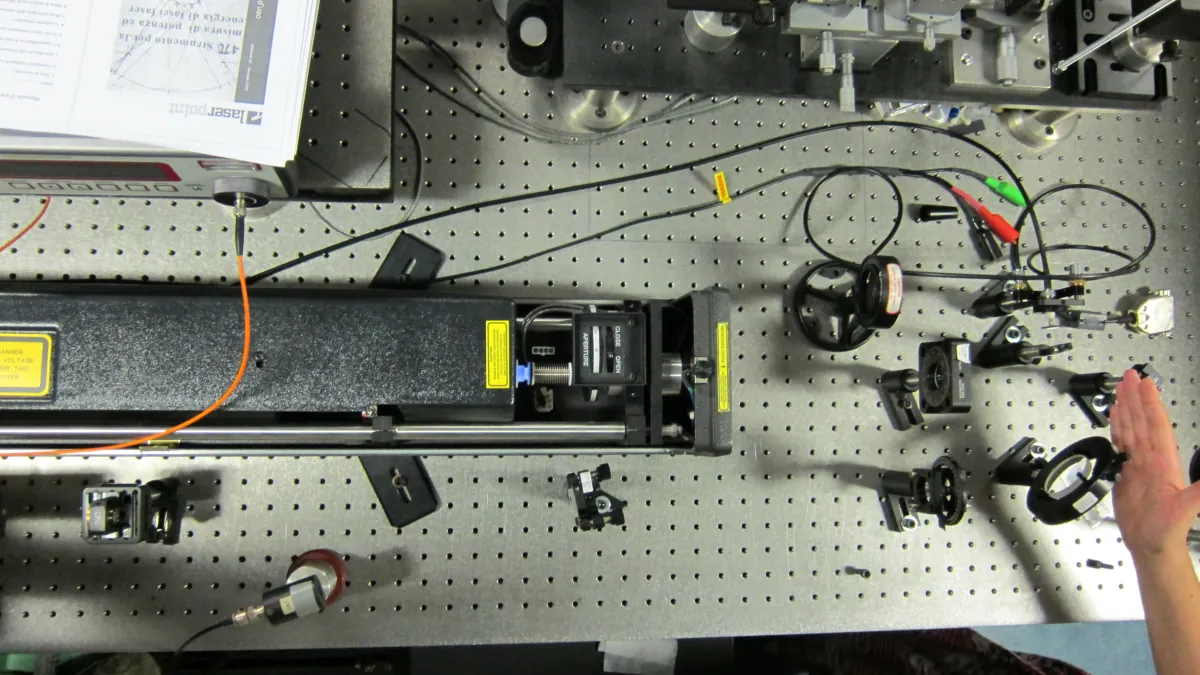
An experiment that can put itself back together
An optical experiment can fail without anything dramatic happening. A component moves slightly, the useful signal disappears, and a researcher must work out what changed. MIT's September 17 announcement describes a robot designed to take over part of that painstaking work: assembling a tabletop laser experiment, aligning its components and recovering after a disturbance.
According to MIT, a demonstration involved 50 maneuvers over about 30 minutes. That is an account of a particular experiment, not a promise that arbitrary laboratory work now takes half an hour. The underlying research was submitted to arXiv on March 23, 2026. This week's news is the institutional presentation of that work, not evidence that the research first appeared in September.
The distinction matters because laboratory automation is easily mistaken for autonomous discovery. Making an apparatus function is valuable. Choosing an important question, deciding whether a measurement answers it and challenging an unexpected conclusion remain separate scientific tasks.
Sources: MIT News: robotic lab runs optics experiments on demand (September 17); Choi et al.: robotic optical assembly, alignment and self-recovery (preprint)
The important ingredient is feedback
The platform combines a robot arm, cameras, specially prepared component holders and a motorized fine-adjustment tool. It measures the optical result after making a change, then uses that result to decide the next correction. The paper describes both geometric corrections and Bayesian optimization. Agentic AI is discussed as a possible future addition, not the demonstrated system's defining mechanism.
Think of the difference between placing a picture frame where a plan says it belongs and checking whether it actually hangs straight. A laboratory needs the second kind of behavior, often with much stricter tolerances. A recorded movement is not sufficient evidence that an experiment has returned to a useful state.
This also explains why the achievement is more interesting than a video of a robot moving mirrors. The scientific instrument becomes part of the control loop. Success is judged against a physical observation, rather than inferred from the fact that the arm reached a coordinate.
Sources: Choi et al.: robotic optical assembly, alignment and self-recovery (preprint)
Recovery worked—but not in every trial
The paper reports successful recovery in 10 of 10 lens-displacement trials, with an average recovery time of 2.83 minutes. A separate test of mirror-adjustment disturbances restored operation in nine of 10 trials, averaging 3.05 minutes. These are two different experiments; combining them into a claim of perfect reliability would be misleading.
Those small samples are useful evidence of feasibility, not a guarantee of unattended operation over weeks. The missing trial matters just as much as the successful ones when a future user is deciding whether equipment can safely run without someone beside it.
Automation in optics also predates this platform. The peer-reviewed Interferobot work at NeurIPS 2020 trained a controller in simulation and transferred it to a physical interferometer for alignment. That earlier study addressed a narrower task. Taken together, the research illustrates a progression from controlling a particular instrument toward coordinating several stages of an experimental workflow; it does not establish a universal robot scientist.
Sources: Choi et al.: robotic optical assembly, alignment and self-recovery (preprint); NeurIPS 2020: Interferobot
A remote laboratory still needs local safeguards
Safety does not disappear when a person leaves the room. MIT's laser-safety program requires hazard assessment, appropriate training and approved procedures for laser systems. Its guidance also addresses access controls for higher-hazard laboratories. These are institutional safety requirements, not a certification of the new robot or evidence that it can be deployed anywhere without additional review.
Our practical reading is that a remotely operated instrument needs an explicit boundary between correcting a routine problem and stopping an unsafe or unexplained experiment. A robot should not keep optimizing simply because a numerical score has fallen. Unexpected behavior can require a person to investigate.
A prospective operator would therefore need answers that a successful demonstration alone cannot supply: who can interrupt the apparatus, what happens when a camera loses its view, how interventions are recorded and who is responsible when a component is damaged. Those questions are part of making automation dependable, not objections to doing the research.
Sources: MIT EHS: laser safety
Scientific perspective: measure repeatability, not just autonomy
Lumacta's evidence-based assessment is that the strongest claim here is an engineering one: assembly and correction can be organized around observable results. The next convincing evidence would be independent repetition across unfamiliar layouts, with complete logs of failures and human interventions. This is our editorial assessment, not an expert interview, a reproduced experiment or an independent peer review.
A useful evaluation would compare time to a valid measurement, time spent recovering and how much preparation a specialist must do before the robot starts. It should also check whether the automated workflow produces the same scientific result when operators, components or environmental conditions change. A fast but systematically biased measurement is not a productivity gain.
Earlier alignment research provides a reason to take this direction seriously, while the current paper's incomplete recovery result provides a reason to keep the claims bounded. A shared benchmark with disclosed starting conditions would be more informative than another montage of successful runs.
Sources: Choi et al.: robotic optical assembly, alignment and self-recovery (preprint); NeurIPS 2020: Interferobot
The economic opportunity is useful instrument time
For a university or small research company, the relevant question is not whether a machine can replace a researcher. It is whether a limited budget buys more trustworthy measurements. If a platform reduces repeated setup work, it could let an existing instrument serve more projects. If it requires extensive customization and constant specialist support, those gains may be smaller than the demonstration suggests.
Shared remote access could eventually help teams that cannot afford a complete laboratory, an ambition discussed by the researchers. But that model would also need fair scheduling, secure access, understandable failure reports and a way for users to inspect how their measurements were obtained. None of those services should be assumed to exist simply because remote control is technically possible.
The bottom line: this is a credible step toward more reproducible laboratory work, with specific tests readers can examine. The next milestone is broader, independently demonstrated reliability—not a headline declaring that the scientist has become optional.
Sources: MIT News: robotic lab runs optics experiments on demand (September 17); Choi et al.: robotic optical assembly, alignment and self-recovery (preprint)
Sources & Methods
Checked September 19, 2026. Reporting distinguishes MIT's September announcement from the March preprint, attributes experimental results to its authors and uses earlier peer-reviewed work and institutional safety guidance as context. No experiment or interview was conducted by Lumacta.
- MIT News: robotic lab runs optics experiments on demand (September 17) — Primary institutional announcement
- Choi et al.: robotic optical assembly, alignment and self-recovery (preprint) — Original research preprint and dated submission record
- NeurIPS 2020: Interferobot — Earlier peer-reviewed research
- MIT EHS: laser safety — Institutional safety context