
What can actually be priced today?
| Product | Price and timing in the checked release | Memory or buying caveat |
|---|---|---|
| Yoga Pro 9n 15-inch, Gen 11 | Laptop price and availability still to be announced. | Up to 128GB in the stated configuration range. |
| Yoga 9n 2-in-1 16-inch, Gen 11 | Laptop price and availability still to be announced. | Use the 64GB limit in the specification row and prose; confirm the exact SKU. |
| Yoga Tab, Gen 2 | Estimated September availability, from €649 including tax in the announcement. | Tablet pricing cannot be used as the laptop price. |
| Yoga Tab Plus, Gen 2 | Estimated September availability, from €849 including tax in the announcement. | Local configuration, final price and delivery still need a local offer. |
Lenovo’s release contains an inconsistency: one thermal-description row refers to 128GB for the convertible, while its dedicated memory row and product prose say up to 64GB. We use the latter rather than quietly promoting the larger number. A purchase should be based on the seller’s exact part number and specification, not an ambiguous launch table.
“Not established here” is the correct boundary for current regional laptop pricing. It does not mean no retailer anywhere can have an offer; it means the primary release we rechecked does not provide one and this update has no verified regional quote. Until price, configuration and delivered software are known, a value ranking would be premature. The AI-compute positioning below remains a manufacturer proposition, not our measured result.
Two machines, two priorities
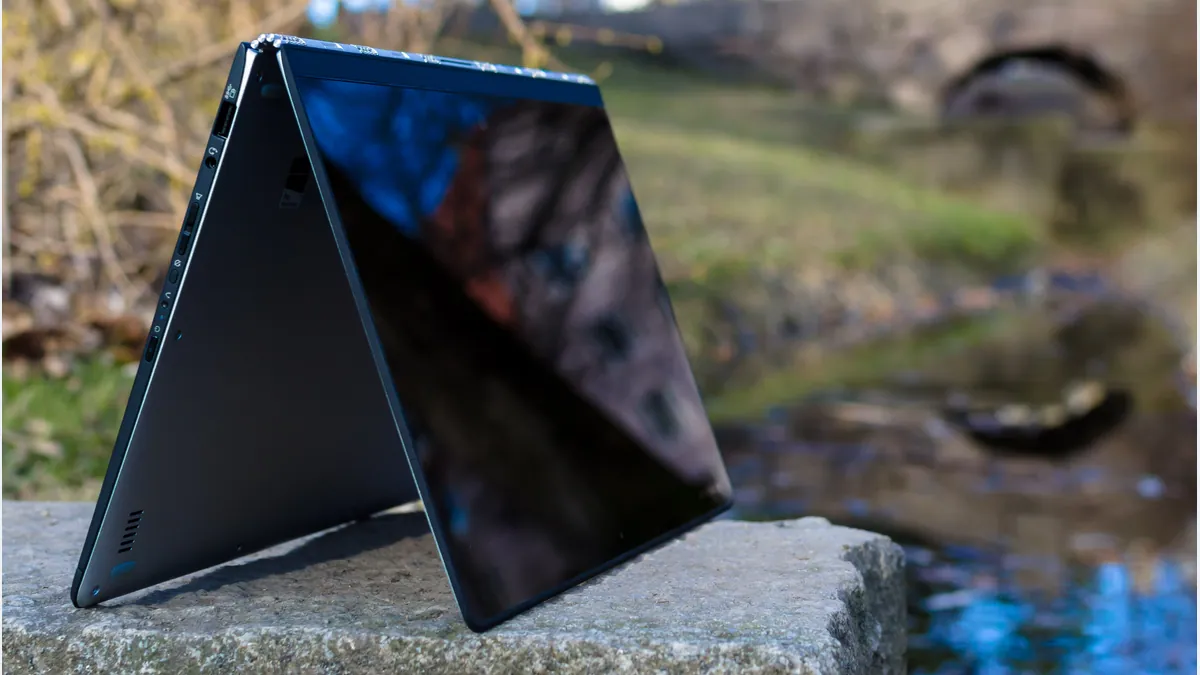
Lenovo specifies up to 128GB of unified memory for the Yoga Pro 9n, versus up to 64GB for the Yoga 9n 2-in-1. Both use NVIDIA RTX Spark. The convertible adds a 360-degree hinge and pen input on both its display and haptic touchpad. Laptop prices and availability will follow later, according to the announcement.
Those differences suggest two distinct shopping lists. Someone carrying large local models may start with memory capacity; someone annotating designs with a client may value the convertible shape. Neither use case is answered by the phrase AI PC alone. Start with the task you cannot comfortably complete on your current machine.
Capacity is not a speed result
A useful evaluation needs to separate what fits from what finishes quickly. Ask for results using a named model, its precision settings, the actual application and a repeatable workload. A memory specification does not, by itself, tell you how responsive an assistant will feel or how long a video export will take.
The same caution applies to portability. For our eventual test, a short demonstration would be only the beginning: we would also want a sustained workload, battery operation, fan noise and the ability to reopen an existing project without changing its workflow. Lumacta has not performed those tests.
The tablets have a clearer price signal
In the same release, Lenovo gives estimated tax-inclusive starting prices of €649 for Yoga Tab Gen 2 and €849 for Yoga Tab Plus Gen 2, with availability expected from September 2026. These are announcement prices, not confirmed local checkout offers; the €200 starting-price gap does not establish an equivalent accessory bundle.
That distinction matters when comparing a tablet with a laptop. Write down the complete working setup: keyboard, pen, storage, required apps and any recurring services. A lower entry price is useful only if the finished setup handles your work. Check the exact regional bundle before treating an accessory in a product photograph as included.
Our take: a shortlist, not a buying verdict
The sensible next step is to save these machines to a shortlist, not replace a working computer on the strength of an announcement. Creators should bring a real project to the comparison; developers should bring the exact tools they need to run. A technically impressive system that forces a workflow change may be the wrong upgrade.
The opportunity is appealing: a portable creative machine judged by the work it can complete independently. Our buying recommendation will wait for the missing price and test results. Until then, the useful question is not which device has the biggest AI label, but which one removes a genuine limit in your day.
Sources & Methods
Published reporting and original source context are retained. September 23 revision: Rechecked Lenovo’s announcement: laptop prices remain unannounced there. Separated tablet guidance and resolved conflicting memory prose conservatively. New explanatory examples are explicitly hypothetical; no independent hardware or model benchmark is claimed.
- Lenovo: new Yoga AI PCs and tablets at IFA 2026 — Primary source · manufacturer announcement