
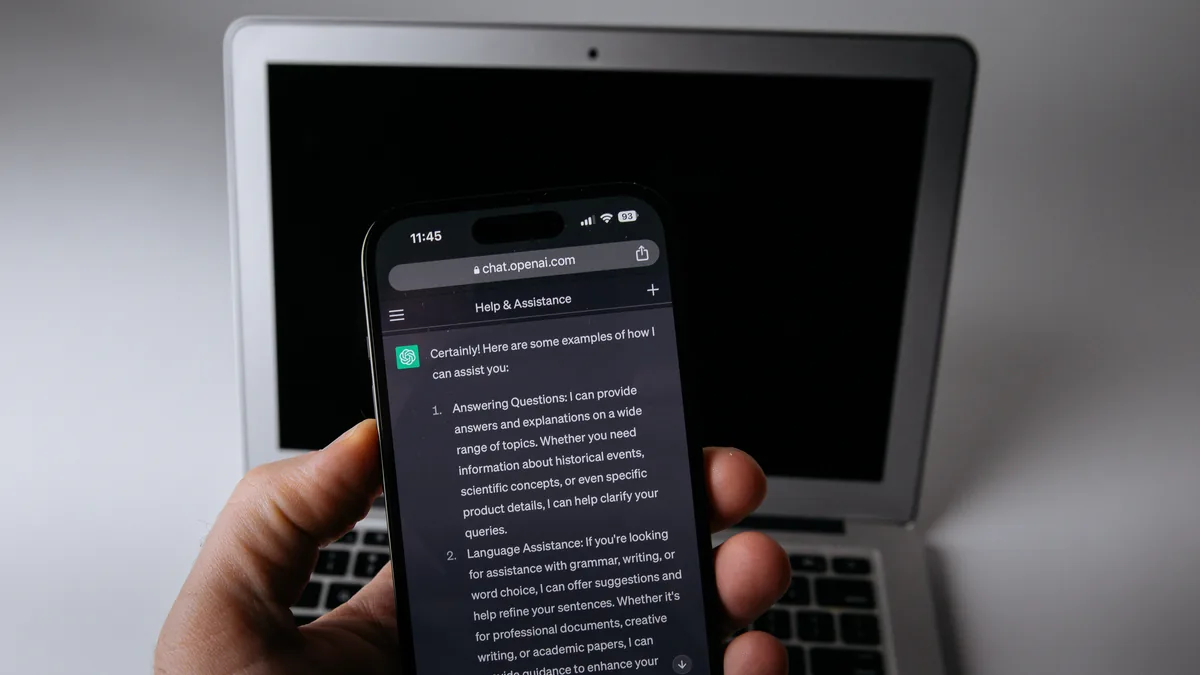
The next jump is about finishing the job
An AI can write an impressive opening paragraph and still lose the thread halfway through a project. It can propose a sensible plan, overlook a constraint and then confidently report that everything is finished. The distance between a convincing answer and dependable work is where the next AI contest becomes interesting.
OpenAI positions GPT-6 Astra around that gap: difficult reasoning, coding, research, computer use and document creation. The promise is not simply more polished conversation. It is a model that can carry a demanding assignment further before a person has to rescue it. That is the company's proposition; this article does not independently establish that Astra beats every rival.
First, the names matter. ChatGPT is a product experience, while GPT-6 Astra is a model. A ChatGPT subscription, an API endpoint and an agent equipped with a browser are not interchangeable. The available tools, account permissions and model settings can change what a user actually receives. Do not assume a published API specification describes every ChatGPT session.
What OpenAI says Astra changes
OpenAI's latest-model guide describes stronger instruction following and more coherent long-task execution than GPT-5.6 Sol. It also documents asynchronous tool calling: work on independent steps can continue while a tool is running. Mid-turn steering lets a user redirect work already in progress. These are workflow improvements, not a new definition of intelligence.
Imagine preparing a product comparison while one source is still loading, then receiving a correction that the budget has changed. A useful assistant should update the recommendation without forgetting the evidence it already collected. This is an illustrative scenario, not a test we ran. The important outcome would be a correct, traceable comparison, not the number of actions performed.
Astra's model page lists a 1,050,000-token context window and up to 128,000 output tokens. The endpoint accepts text and images and produces text; separate tools extend what a system can do. That should not be confused with native audio or video support on this endpoint, or with every feature inside ChatGPT.
Sources: OpenAI: GPT-6 Astra model specifications · OpenAI: latest-model workflow guide
The model is not the whole assistant
The model interprets the assignment and proposes the next step. The surrounding application supplies documents, decides which tools exist, executes permitted actions and presents the result. A model connected to a browser can retrieve a current price; the same model without that connection may only have older information or what you paste into the conversation.
OpenAI's web-search documentation makes that separation explicit: current web access is a tool that must be available to the system. Even when enabled, the model can decide whether to use it. A new model name does not guarantee that an answer about today's events was checked against today's sources.
This changes how you compare assistants. Give both the same evidence and permissions, or label the comparison as one between complete products. Otherwise, you may be measuring one app's search integration against another model's unaided response. Both comparisons can be useful; they answer different questions.
From your brief to a checked result
Conceptual workflow — not a performance measurement.
- 1 · Your briefGoal, evidence and limits
- 2 · ModelInterprets and plans
- 3 · ToolsRetrieve or act, if permitted
- 4 · ReviewCheck sources and outcome
Results can lead back to another search or revision. Tool access does not make every action appropriate or every answer correct.
Sources: OpenAI: web search and source access
From GPT-3.5 to Astra: what changed between generations?
The broad shift is from conversational generation toward systems designed to reason and coordinate work. But it is not a clean ladder on which every new model wins every task. Speed, cost, instructions, tools and the exact model version all matter.
GPT-3.5 Turbo represents an older text-chat baseline. GPT-4o widened the comparison to visual input in the API configuration shown here. OpenAI positioned o3 specifically around reasoning; GPT-5.5 and GPT-5.6 Sol already supported advanced professional work and tools before Astra. Calling Astra the first model able to research or code would erase that history.
The figures below describe representative API configurations, not the precise model behind the original ChatGPT launch or a promise that all these models remain selectable in ChatGPT. Context is capacity to accommodate material, not proof that every detail will be used correctly.
On small screens, scroll sideways to compare all columns.
| Model / configuration | Context limit | Output limit | What this represents |
|---|---|---|---|
| GPT-3.5 Turbo · 0125 | 16,385 | 4,096 | Legacy text-chat baseline |
| GPT-4o · 2024-08-06 | 128,000 | 16,384 | Text and image input |
| o3 · 2025-04-16 | 200,000 | 100,000 | Explicit reasoning-model generation |
| GPT-5.5 | 1,050,000 | 128,000 | Advanced reasoning and tool workflows |
| GPT-5.6 Sol | 1,050,000 | 128,000 | Professional work before Astra |
| GPT-6 Astra | 1,050,000 | 128,000 | OpenAI's demanding end-to-end-work model |
Limits are tokens, not words. Context and maximum output are not additive allowances. Representative API configurations checked September 5, 2026; consumer app limits can differ. Model names link to specifications.
Sources: OpenAI: GPT-5.6 Sol · OpenAI: GPT-5.5 · OpenAI: o3 · OpenAI: GPT-4o · OpenAI: GPT-3.5 Turbo
What a million-token context helps with — and what it cannot fix
For a long report, context capacity can let you supply source material, instructions, examples and previous work together. But tokens are pieces of encoded content, not fixed-size words or pages. A page full of tables, an image and a page of plain prose are not interchangeable budgeting units.
The chart compares the six OpenAI configurations already listed, with a common zero-based scale. Astra, Sol and GPT-5.5 share the same 1.05-million headline capacity. That visible plateau matters: the case for upgrading between those models has to rest on something other than this specification.
For useful document work, label each file, retain page references and ask which passages support the answer. Start with material relevant to the question instead of treating the maximum window as a target to fill. Ask the assistant to flag contradictory dates or figures before drafting a recommendation.
Also separate capacity from output allowance. Astra's documented maximum input is 922,000 tokens and maximum output is 128,000. The headline context window is not permission to send 1.05 million input tokens and then demand another 128,000 output tokens. Actual application limits may be lower.
Context windows across selected GPT models
Tokens per API context window · selected configurations · September 5, 2026
- GPT-3.5 Turbo · 012516,385
- GPT-4o · 2024-08-06128,000
- o3 · 2025-04-16200,000
- GPT-5.51,050,000
- GPT-5.6 Sol1,050,000
- GPT-6 Astra1,050,000
Common linear scale starting at zero. Capacity is not reasoning quality, permanent memory or consumer-app limits.
Sources: GPT-3.5 Turbo · 0125 · GPT-4o · 2024-08-06 · o3 · 2025-04-16 · GPT-5.5 · GPT-5.6 Sol · GPT-6 Astra
Sources: OpenAI: GPT-6 Astra model specifications · OpenAI: GPT-5.6 Sol · OpenAI: GPT-5.5 · OpenAI: o3 · OpenAI: GPT-4o · OpenAI: GPT-3.5 Turbo
Is Astra intellectually better? Ask six narrower questions
There is no responsible shortcut from a benchmark percentage to a human IQ. The documents examined here do not provide a validated human-IQ score for Astra. A system can perform well on a particular set of questions while failing a differently phrased version, misreading a source or overlooking the user's actual goal.
François Chollet's paper On the Measure of Intelligence distinguishes acquired task skill from the capacity to acquire new skills and generalise. That is a useful warning for this discussion: an impressive result is evidence about a task and its conditions, not a complete description of a mind.
Our practical framework separates six abilities. It does not award invented scores to the models. Instead, it describes the evidence we would want before calling one intellectually stronger for a particular use. A pleasant writing style belongs in the assessment, but it cannot substitute for correctness.
A larger context window is also not persistent memory. Nor does switching to higher reasoning effort establish a different human-like intellectual level. The meaningful question is whether extra computation produces a better, verifiable result on your work. Astra, Sol and GPT-5.5 sharing the same headline context capacity makes that distinction especially clear.
On small screens, scroll sideways to compare all columns.
| Ability | Evidence of improvement | What does not prove it |
|---|---|---|
| Language and explanation | Clear writing that preserves the meaning and answers the question | More confident or elaborate prose |
| Logical reasoning | Correct results on new problems and sensible checks | A long explanation with a wrong conclusion |
| Working with context | Uses the relevant facts and respects earlier constraints | A larger advertised token window |
| Evidence and uncertainty | Traceable sources, supported claims and appropriate uncertainty | Links that do not support the answer |
| Planning and execution | Completes the task, checks results and recovers within permissions | A detailed plan or many tool calls |
| Creative judgment | Useful, distinctive choices that fit the audience and brief | Novelty that ignores the brief |
Lumacta's evaluation framework, not measured scores or a ranking of these models.
Three everyday tests that reveal more than confident prose
The contradictory-source test: provide two product sheets, one older than the other, with different battery figures. Ask for a comparison that identifies the disagreement and explains which figure should control. An answer that silently mixes them is less useful than one that shows the conflict. This is a proposed exercise, not an observation about any model here.
The changed-constraint test: ask for a laptop shortlist, then lower the budget and require a lighter machine. A strong result should update the candidates and explain which recommendation no longer fits. Appending a sentence about the new budget while retaining the old shortlist would miss the point.
The transfer test: after the assistant solves a problem, change a meaningful assumption. For example, replace a flat delivery fee with a per-item charge. Check whether it recomputes the total instead of recycling the earlier answer. This probes adaptation more directly than asking the identical question again.
Define the correct answer or grading rules first. Hide model names when comparing outputs if possible. Record factual errors separately from writing preferences. An answer can win on tone and lose on substance; combining both into one unexplained score conceals that distinction.
Claude, Gemini and DeepSeek offer different trade-offs
Anthropic's Claude Fable 5.1, announced September 1, targets extended coding and knowledge-work projects. Anthropic describes planning across applications, recovering from failed steps and using vision with complex documents. That makes it a relevant alternative to Astra's long-task pitch, rather than merely another chatbot. These are provider descriptions, not results from our own comparison.
Google's Gemini 3.8 Flash combines a million-token context with adjustable thinking effort. Its model card lists text, image, audio and video inputs with text output. That broader input mix is a concrete specification difference from the Astra endpoint above, not proof of better reasoning. Google's documentation also warns that more complex workflows can consume more tokens.
DeepSeek’s price position has changed since the original article: the current Flash endpoint maps to V4.1, not V4. Its documentation lists thinking and non-thinking modes, tool calls and a million-token context. The updated rates below make it a low-cost candidate for a bounded evaluation, not an independently established peer of Astra on every task.
This is a selected comparison, not an exhaustive league table. A model's app integrations may matter more to one reader than its raw endpoint specifications. For another, the deciding issue may be what data they can send, what controls their organisation requires and whether the service is available to their account.
Sources: Anthropic: Claude Fable 5.1 and benchmark notes · Google: Gemini 3.8 Flash and introductory pricing · Google DeepMind: Gemini 3.8 Flash model card · DeepSeek: model specifications and pricing
October 1: Sol changes the OpenAI shortlist
OpenAI now documents GPT-6.1 Sol as its lower-cost option for complex coding, computer use and professional work. Its near-Astra positioning is a provider claim, not a Lumacta head-to-head result. Astra remains the candidate OpenAI positions for its most demanding work. Sol model documentation · Astra model documentation.
| Model | Uncached input / 1M | Output / 1M | Example request |
|---|---|---|---|
| GPT-6 Astra | $10.00 | $50.00 | $0.30 |
| GPT-6.1 Sol | $2.00 | $10.00 | $0.06 |
Assumption: 20,000 uncached input tokens and 2,000 total billed output tokens. Formula: (input tokens × input rate + output tokens × output rate) ÷ 1,000,000. At exactly those counts, 1,000 requests are $300 for Astra or $60 for Sol—a $240 token-cost difference, not equivalent quality or a measured project bill. Tools, retries, review, cache writes, tax and regional uplifts are excluded. Above 272,000 input tokens, higher full-request rates apply; Fast, Batch and Flex also have different rates. Official API pricing.
The decision changes when review time changes. In this hypothetical comparison the $0.24 gap per request equals 28.8 seconds of work valued at $30 an hour. Astra would have to save at least that much review time, or prevent a failure worth more, to offset the token premium under these assumptions. We did not measure either saving. Token volume, tools and acceptable output can differ between models.
API pricing is not a subscription entitlement. OpenAI lists the Sol launch rollout for Plus, Pro, Business, Enterprise and Edu in Work and Codex; Enterprise/Edu require administrator enablement, while Free and Go are excluded at launch. The Work/Codex models are not ordinary Chat choices. Actual account and client availability can differ. Official Work and Codex model availability.
For repeated document or coding work, compare Sol with Astra on the same acceptance checks before paying the premium. The cross-vendor table and charts below remain explicitly dated September 23 snapshots; Claude, Gemini and DeepSeek prices and availability were not rechecked in this update. For the separate Sol launch analysis, read our GPT-6.1 Sol explainer.
The September 23 cross-vendor price snapshot
This historical comparison assumes 20,000 uncached input tokens and 2,000 total billed output tokens per request, at standard text-token prices checked September 23, 2026. The output allowance includes any billable reasoning, not just visible words. These are API charges in US dollars, not subscription fees or measured project costs.
GPT-6 Sol and GPT-6 Luna are added as September 23 price references. They do not replace the historically labelled GPT-5.6 Sol context comparison elsewhere in this article. At these fixed counts Astra is $0.30, GPT-6 Sol $0.06, and GPT-6 Luna $0.003. No quality or task-completion equivalence is implied.
GPT-5.6 Sol’s $4/$20 rates remain promotional at least through November 21. Gemini 3.8 Flash’s $0.75/$3.75 introduction runs through December 31; Google lists $1.50/$7.50 from January 1, 2027. Astra requests above 272,000 input tokens use higher rates for the entire request. That condition does not apply to this example.
In the September 23 snapshot, DeepSeek’s deepseek-flash maps to V4.1 Flash; the older V4 Flash alias now routes to the replacement. Uncached input/output rates are $0.15/$0.60 per million off-peak and $0.30/$1.20 at peak. Peak periods are 01:00–04:00 and 06:00–10:00 UTC, Monday–Friday, excluding Chinese public holidays; all other times use off-peak rates.
| Model | Uncached input / 1M tokens | Output / 1M tokens | Example request |
|---|---|---|---|
| GPT-6 Astra | $10.00 | $50.00 | $0.3 |
| GPT-6 Sol | $2.00 | $10.00 | $0.06 |
| GPT-6 Luna | $0.10 | $0.50 | $0.003 |
| GPT-5.6 Sol · promotional | $4.00 | $20.00 | $0.12 |
| GPT-5.5 | $5.00 | $30.00 | $0.16 |
| GPT-4o · 2024-08-06 | $2.50 | $10.00 | $0.07 |
| Claude Fable 5.1 | $10.00 | $50.00 | $0.3 |
| Gemini 3.8 Flash · introductory | $0.75 | $3.75 | $0.0225 |
| DeepSeek V4.1 Flash · off-peak | $0.15 | $0.60 | $0.0042 |
| DeepSeek V4.1 Flash · peak | $0.30 | $1.20 | $0.0084 |
Formula: (20,000 × input rate + 2,000 × output rate) ÷ 1,000,000. Tokenisers differ, so equal token counts need not represent identical text. Cache use, tools, taxes, special tiers, regional charges, retries and human correction are excluded. OpenAI — API pricing · Anthropic — Claude Fable 5.1 · Google — Gemini 3.8 Flash pricing · DeepSeek — current model and pricing.
What the September scenario would cost at scale
The table and chart in this section retain September 23 model identifiers and price bands. Use the dated October 1 section above for the newly checked Astra/Sol comparison; these older competitor figures are not fresh offers.
At exactly these counts, 1,000 requests cost $300 with Astra or Fable 5.1, $60 with GPT-6 Sol, $3 with GPT-6 Luna, $120 with promotional GPT-5.6 Sol and $22.50 with introductory Gemini 3.8 Flash. DeepSeek V4.1 Flash is $4.20 off-peak or $8.40 at peak. These are recomputed scenarios, not bills from a test.
The bars use a common zero baseline and separate input from output. A smaller bar is lower token cost, not proof that a model can perform the same job. Count retries, rejected outputs and errors before comparing actual work.
For continuity with the original example, compare Astra with GPT-5.6 Sol: the $0.18 difference per request would break even at 21.6 seconds of review time valued at $30 an hour. This is a hypothetical threshold, not a measured saving, and is not the same calculation as comparing Astra with GPT-6 Sol.
For a real trial, divide complete model, tool and review costs by accepted outputs under the same acceptance criteria. Keep serious failures visible beside that average. A low average charge does not compensate for an uncontained failure.
Token cost for 1,000 example requests
USD · each request: 20,000 uncached input + 2,000 total billed output tokens · September 23, 2026 rates
Input chargeOutput charge
- GPT-6 Astra$300.00Input $200.00 + output $100.00
- Claude Fable 5.1$300.00Input $200.00 + output $100.00
- GPT-5.5$160.00Input $100.00 + output $60.00
- GPT-5.6 Sol · promotional$120.00Input $80.00 + output $40.00
- GPT-4o · 2024-08-06$70.00Input $50.00 + output $20.00
- GPT-6 Sol$60.00Input $40.00 + output $20.00
- Gemini 3.8 Flash · introductory$22.50Input $15.00 + output $7.50
- DeepSeek V4.1 Flash · peak$8.40Input $6.00 + output $2.40
- DeepSeek V4.1 Flash · off-peak$4.20Input $3.00 + output $1.20
- GPT-6 Luna$3.00Input $2.00 + output $1.00
Linear scale starting at zero. Fixed-volume arithmetic, not measured workloads or equivalent quality. Prices include applicable promotional bands but exclude tools, taxes, cache charges, regional surcharges and review time.
Sources: OpenAI — API pricing · Anthropic — Claude Fable 5.1 · Google — Gemini 3.8 Flash pricing · DeepSeek — current model and pricing
More thinking can change the bill — not just the waiting time
The next chart holds Astra's uncached input at 20,000 tokens and varies total billed output. It is a budget illustration, not a measured relationship between reasoning settings and token use. At 2,000 billed output tokens the example is $0.30; at 8,000 it is $0.60; at 20,000 it is $1.20; at 50,000 it is $2.70.
A setting called high or max is not a promise of a particular output length or success rate. Astra supports low, medium, high, xhigh and max reasoning effort, but not none. Choose the lowest effort that meets your quality requirement on representative work, then increase it for cases that need more deliberation.
For builders, set spending limits in the application and inspect total billed tokens rather than budgeting from visible answer length alone. Keep routine extraction prompts narrow. Let difficult synthesis use a larger budget only when the task justifies it. More steps can be useful, but steps are not a deliverable.
Astra cost at four billed-output volumes
USD per request · fixed 20,000 uncached input tokens · hypothetical output budgets · September 23, 2026 rates; Astra standard short-context price unchanged
Input chargeOutput charge
- 2,000 billed output tokens$0.30Input $0.20 + output $0.10
- 8,000 billed output tokens$0.60Input $0.20 + output $0.40
- 20,000 billed output tokens$1.20Input $0.20 + output $1.00
- 50,000 billed output tokens$2.70Input $0.20 + output $2.50
Selected token budgets, not low/medium/high/max settings or observed response lengths. Total billed output includes billed reasoning. Tools and other extras excluded.
Sources: OpenAI standard pricing
Sources: OpenAI: GPT-6 Astra model specifications · OpenAI: API pricing
Why we are not printing a universal winner
A fair head-to-head needs the same tasks, tools, time limits and grading criteria, with exact versions and reasoning settings recorded. Several runs matter because output can vary. OpenAI's evaluation guidance recommends task-specific evaluation and human judgment rather than relying on an impression that a system seems to work.
There is a concrete warning in Anthropic's own Fable benchmark notes: its OSWorld 2.0 figures use the August 2026 task release and are not directly comparable with earlier releases. That is why its table omits a competitor score for that row. Joining those numbers to an older chart would create an attractive but misleading comparison.
Likewise, SWE-bench concerns resolving software issues under a defined evaluation setup. Success there tells us something useful about that work, not everything about scientific reasoning, creative judgment or factual reliability. A scoreboard needs its methodology beside it.
For a future Lumacta test, we would give each model the same source pack and ask for a comparison, a code repair and an evidence-checked explanation. We would record unsupported claims, missed constraints, successful completion, elapsed time, cost and human interventions. That is a proposed method, not a claim that those tests have already happened.
Sources: OpenAI: evaluation best practices · Anthropic: Claude Fable 5.1 and benchmark notes · SWE-bench: benchmark and evaluation resources
A practical briefing template for better results
Instead of writing only 'compare these products', define the decision, evidence, boundaries and output. Adapt this example: 'Compare these three laptops for travel writing and photo editing. Use the attached specifications and current manufacturer pages. Stay under my stated budget. Separate confirmed facts from unknowns, link each price to its source and date, and do not invent battery test results. Give me a shortlist with trade-offs, then tell me what I should verify before buying.'
That brief does not make a weak model infallible. It makes the job observable: you can check the budget, whether sources support the figures and whether missing information was acknowledged. It also gives different models a more consistent assignment.
For code, specify intended behaviour and a small set of acceptance checks. For a report, name the audience and the decision it should support. For creative work, supply tone examples and explain what must remain unchanged. Clear constraints help even when a model can infer many routine details.
When a task could spend money, publish content or change important records, state the approval boundary explicitly. Asking an assistant to prepare something is not authorising it to send or publish it. Competence and permission are separate requirements.
What should you actually choose?
For everyday rewriting or organising short notes, begin with an option you already have. Judge whether the output needs correction before paying for a higher tier. A demanding flagship is not automatically a sensible tool for every small job.
For repeated, complex coding and document work, GPT-6.1 Sol now belongs beside Astra on the OpenAI shortlist. Start a controlled comparison with the same sources, permitted tools and acceptance criteria; reserve the higher-cost candidate for work where its checked result justifies the premium. That follows the documented product positioning, not a Lumacta performance test. The earlier Claude, Gemini and DeepSeek discussion remains dated context, not newly verified purchasing advice.
The strongest setup may use more than one tier: a cheaper model for a constrained first pass and a more capable candidate for genuinely difficult cases. But routing itself adds complexity. It only helps if someone can detect a weak answer and decide when escalation is needed; automatically trusting the first model's confidence is not enough.
Before uploading documents: privacy and control
Before uploading client work or internal files, check the terms for the exact product and account: whether inputs can be used for training, how long records are retained, whether deletion is available and what administrators can access. Do not assume an API and a consumer app have identical terms.
If the assistant can read a connected drive, give it access only to relevant material. If it can send messages or change files, require review for consequential actions. Removing unnecessary personal identifiers can reduce exposure without removing the information needed for the task.
Treat text retrieved from websites and documents as evidence to assess, not as instructions that should silently override your request. A page might contain misleading content or directions aimed at the assistant itself. Preserve the task's boundaries and verify the source.
These are practical checks, not a claim that one vendor's privacy arrangements are best. Policies and account controls need their own current comparison before an organisation makes a deployment decision.
Quick answers before you upgrade
Does Astra replace every older model? Not for every job. An older or cheaper option may already meet your needs. A worthwhile upgrade should improve accuracy, completion or review time, rather than simply change the name at the top of the screen.
Does browsing eliminate hallucinations? No guarantee follows from tool access. Check whether the source exists, supports the specific sentence and is current enough. A citation is a route to verification, not a substitute for it.
Does a million-token window mean permanent memory? No. Active context capacity, a product's saved-memory feature and provider data retention are different things. The figures here describe model specifications, not a personal-memory promise.
Can two people get different results from the same named AI? Yes: prompts, files, tools, reasoning settings and output variability can differ. Save those details when comparing results instead of relying only on the brand name.
Is there one winner here? There is a clear price difference under the stated assumptions, but no controlled Lumacta result proving a universal quality winner. Evaluate representative work instead of treating specification charts as an intelligence leaderboard.
Sources: OpenAI: GPT-6 Astra model specifications · OpenAI: evaluation best practices · OpenAI: web search and source access
Our conclusion: measure the work that survives checking
Astra's most consequential promise is not that it can sound more intelligent than older ChatGPT models. It is that the gap between asking for difficult work and receiving a usable result may become smaller. If that translates into fewer factual mistakes, fewer abandoned steps and less supervision, it would be a meaningful upgrade.
For now, the verified differences are specifications, documented workflow features and prices. The size of the practical advantage still needs independent, comparable testing. The model worth choosing is the one whose work remains useful after you check it — at a cost and level of oversight you can sustain.
Sources & Methods
October 1 update scope: current OpenAI pricing and Work/Codex availability, a new Astra/Sol cost calculation and the selection paragraph. Other providers and historical specifications were not rechecked. The new source links are in the October 1 section. No model trial was run. Published reporting and original source context are retained. September 23 revision: Rechecked current prices and model identifiers on September 23; replaced DeepSeek V4 rates with V4.1, added GPT-6 Sol/Luna price rows, and recomputed the table and cost chart. The September 5 historical context comparison remains labelled as such. New explanatory examples are explicitly hypothetical; no independent hardware or model benchmark is claimed.
- OpenAI: GPT-6 Astra model specifications — primary-source documentation
- OpenAI: latest-model workflow guide — primary-source documentation
- OpenAI: GPT-5.6 Sol — primary-source documentation
- OpenAI: GPT-5.5 — primary-source documentation
- OpenAI: o3 — primary-source documentation
- OpenAI: GPT-4o — primary-source documentation
- OpenAI: GPT-3.5 Turbo — primary-source documentation
- OpenAI: API pricing — primary-source documentation
- Anthropic: Claude Fable 5.1 and benchmark notes — primary-source documentation
- Google: Gemini 3.8 Flash and introductory pricing — primary-source documentation
- Google DeepMind: Gemini 3.8 Flash model card — primary-source documentation
- DeepSeek: model specifications and pricing — primary-source documentation
- OpenAI: evaluation best practices — primary-source documentation
- François Chollet: On the Measure of Intelligence — primary-source documentation
- SWE-bench: benchmark and evaluation resources — primary-source documentation
- OpenAI: web search and source access — primary-source documentation