
Two retirements and three dates
Google has put firm dates on two smart-home transitions that had previously unfolded in stages. The company announced on November 20 that the Nest app will retire on January 25, 2027. Google Assistant will then begin disappearing from speakers and smart displays on August 2, 2027 as Gemini for Home takes its place. Android Authority and Android Central independently reported the deadlines that day.
These are future changes. The Nest app and Google Assistant on home devices have not shut down as of November 22, 2026. The useful preparation starts by keeping three deadlines separate. January 25 ends Nest app access and begins automatic device transfers. March 25 is when Google says it will start processing deletion of legacy Nest accounts that were never linked to a Google Account. August 2 starts the home-device Assistant shutdown, which Google expects may take several weeks to reach everyone.
A household can therefore be ready for one transition and unprepared for another. Installing Google Home does not preserve every saved camera clip. Moving a camera does not by itself accept the Gemini experience on a speaker. The dates describe related platform changes, not one switch.
What moves and what needs an export
Google says supported thermostats, cameras, doorbells, smoke and carbon-monoxide alarms, and locks will appear in Google Home. Camera event recordings and continuous video history will also transfer and remain available until their normal retention windows expire. Settings and schedules are meant to follow supported devices. This is the automatic part of the move.
The saved clip library is the important exception. Clips created and kept through the Nest web app will not move into Google Home with the rest of the camera history. Google's instruction for older Nest cameras and doorbells is to visit home.nest.com before January 25 and use Download All for anything worth retaining. A successful device migration would not prove that this separate collection had been copied.
It helps to distinguish a recording still inside a 30- or 60-day camera-history window from a clip someone deliberately saved to the Nest web library. Google says the first category transfers. The second needs an export. After the transition, home.google.com is supposed to provide live view, history scrubbing and downloads of clips up to five minutes, but that future interface does not recover a saved library left behind in the retired service.
Automatic transfer is not feature parity
Google says the current transition does not withdraw support from the listed Nest hardware. That claim has a defined scope: supported devices from the last decade move into Google Home, and Nest Protect remains supported through the expiration date printed on the alarm. It should not be read as a lifetime guarantee for every Nest product ever sold.
The company's own transfer page also lists functions that are not currently present in Google Home. Examples include public or password-protected livestream sharing, email notifications, timelapses, saving a camera clip to the Nest library and changing Wi-Fi without resetting a device. Owners who rely on one of those functions have a different acceptance test from someone who only checks a thermostat or watches a live camera feed.
A manual move before January can expose other setup work. Google says eligible older cameras require the correct account and app version, and presence sensing must be configured again after transfer. Checking the exact device page is safer than assuming that one successful migration represents every camera, lock, alarm or thermostat in the same home.
Legacy accounts have a later data deadline
Google Home requires a Google Account. People who started signing in to Nest after August 19, 2019 already use one, according to Google's support page. Someone who still chooses Sign in with Nest and enters a separate Nest password has an older account that needs to be linked.
January 25 is the practical access deadline because the Nest app and home.nest.com stop providing control. Google sets March 25 as the final account deadline before it begins processing deletion of an unmigrated Nest account, its associated data and subscriptions. Cameras on an unmigrated account may continue background recording during that interval, but the support page says the user needs the account migration to view the material in Google Home.
That grace period should not be described as a general backup. It is a temporary account transition described by Google. A useful check is whether the household signs in with Google, whether the expected devices appear, and whether separately saved clips exist outside the service.
Speakers require a separate choice
The August transition applies to Google Assistant on speakers and smart displays, including Assistant-enabled speakers from other brands. Google says existing supported devices can move to Gemini for Home, but the change is not automatic. A user must accept the new experience and terms in the Google Home app or on Google Home for web.
If that step is skipped, Google says Assistant will stop responding when discontinuation reaches the account and the device will prompt for the free upgrade. Completing it later is meant to reactivate the device. The core Gemini for Home voice assistant carries no additional charge, while capabilities such as Gemini Live and camera-history search require a Google Home Premium subscription.
Availability is still a current-state question. Google says Gemini for Home is already offered in many countries and languages and will expand over time. That wording does not establish that every region has it today or that all advanced features behave the same on every model. The relevant evidence is the upgrade offer shown for the household's own account and devices.
Make a small household inventory
The transition is easier to reason about as four short lists. First, record the devices that still appear in Nest and the actions people actually use. Second, list saved camera clips separately from rolling video history. Third, check whether the home still uses a legacy Nest sign-in. Fourth, note which speakers and displays have offered the Gemini upgrade.
For each important device, test the ordinary task after it appears in Google Home. That might be changing a thermostat schedule, receiving an alarm alert, reviewing a camera event or unlocking a door. A device tile alone proves discovery, not that every household routine survived. If a listed legacy feature matters, keep it as an unresolved requirement and follow Google's current support page for that model.
Google has committed to the dates and described the transfer path. It has not claimed that every old interface choice survives unchanged. The strongest evidence before January is therefore modest and specific: the right account is linked, the expected device and history are visible, saved clips have an independent copy, and the functions the household depends on have been checked in the replacement app.
Sources & Methods
Lumacta checked Google's November 20 announcement, its device-transfer instructions and both transition FAQs against independent reporting from Android Authority and Android Central. The 2027 deadlines and future device behavior follow Google's published plan.
- Google Home and Nest announcement — Primary announcement published November 20, 2026. Establishes the Nest and Assistant retirement dates and the saved-clip warning.
- Nest app transition support hub — Primary current guidance. Account deadlines, supported device categories, video-history handling and replacement-app capabilities.
- Transfer Nest devices to Google Home — Primary current procedure. Manual-transfer requirements, post-transfer setup and legacy features not currently available in Home.
- Google Assistant transition to Gemini for Home — Primary current FAQ. August timing, consent requirement, device behavior and subscription boundary.
- Android Authority report — Independent report by Stephen Schenck, published November 20, 2026 at 2:52 p.m. ET. Confirms the announcement and flags concerns about missing Home features.
- Android Central report — Independent report by Jay Bonggolto, published November 20, 2026. Separates the app, account and Assistant deadlines.
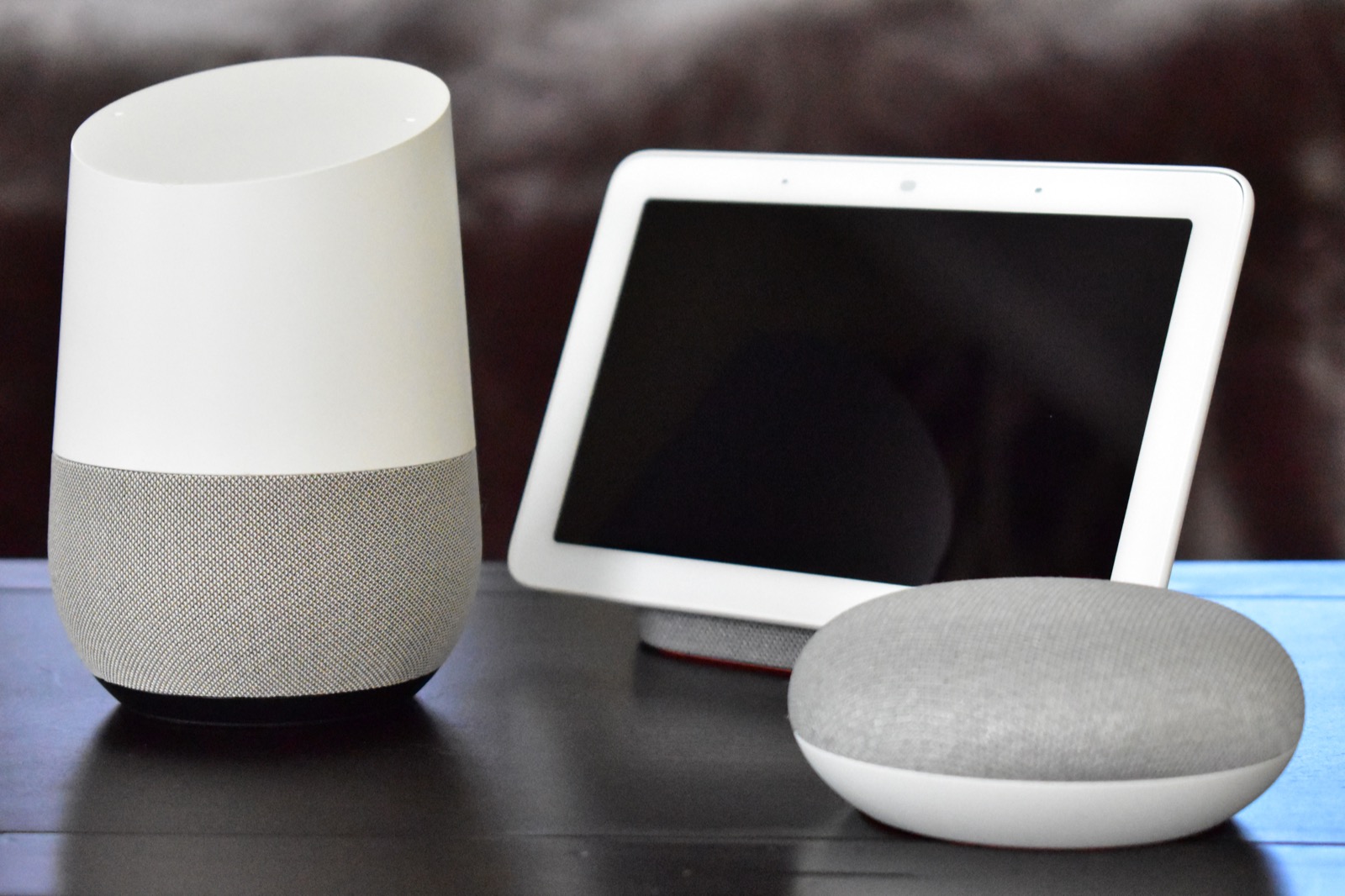
- Wikimedia Commons archive photograph — Original photograph record. Own work by Y2kcrazyjoker4, captured November 26, 2019, showing Google Home, Home Hub and Home Mini hardware.
- Creative Commons Attribution-ShareAlike 4.0 — License text linked by the exact Commons file record.
