
Read the plan as a set of interfaces
The most useful way to read an ambitious mission announcement is to follow what must be handed from one system to the next: momentum, propellant, electrical power, information and, eventually, people. Our assessment is that these handoffs are the real story. A simpler-looking diagram can still place a demanding new obligation on a connection between vehicles.
Keep three questions separate. What is the intended sequence? Which part of that sequence has actually been exercised? How closely did the exercised hardware and conditions match the intended mission? A design decision can improve the first answer without yet changing the second or third. That is neither a reason to dismiss the decision nor a reason to pronounce the mission ready.
This guide therefore compares dependencies rather than declaring a winner. The table below describes announced operations. The later sections examine the kinds of evidence needed to make such operations dependable. They are our engineering interpretation of public records, not an independent audit of either contractor.
Source notes: 1, 2. Original editorial interpretation and hypothetical examples are identified in the text.
Two routes to the same goal, with different work to prove
The important contrast is where the crew vehicle joins the lander and how the journey is supplied. NASA has not assigned either provider the first landing; selection is to depend on readiness. Both still require uncrewed demonstration and certification before carrying people to the surface. These arrangements replace the earlier near-rectilinear-halo-orbit rendezvous plan.
Our interpretation: deferring a difficult operation does not make the replacement free. Hardware launched with its propellant still needs an executable assembly and departure sequence. Retaining a refueling operation leaves a different collection of interfaces to qualify. Neither description, on its own, supplies a measured comparison of schedule resilience or crew safety.
Nor should the destination orbit be treated as an isolated ranking. It belongs to the whole route: getting there, waiting, descending, returning and reconnecting. Public summaries do not provide enough common mass, performance and reserve assumptions for us to independently calculate which complete architecture has the better margin.
| Dependency | SpaceX Starship HLS plan | Blue Moon 2028 landing plan |
|---|---|---|
| Orion meets the lander | Earth orbit; Starship then pushes the docked stack toward the Moon | Lunar elliptical polar orbit |
| Supplying the journey | Tanker/depot propellant aggregation retained | Initial refueling deferred; three transfer stages |
| Lunar meeting orbit | Low lunar orbit | Elliptical polar orbit |
Source notes: 1. Original editorial interpretation and hypothetical examples are identified in the text.
What an Earth-orbit rehearsal can—and cannot—buy
NASA’s October 23 Artemis III description plans a 2027 Earth-orbit campaign with lander test articles. It includes crew evaluations inside Blue Moon, but no crew entry into Starship during its docking test. These are different objectives and configurations, not a controlled comparison between two finished lunar products.
That distinction changes how a reader should interpret later coverage. A successful rendezvous would answer a different question from a habitable-cabin evaluation. Neither automatically demonstrates a lunar descent, an ascent after surface exposure, or a complete departure-and-return sequence. A test is useful precisely because it can isolate an uncertainty; its usefulness does not require it to prove everything.
A sensible evidence note would identify the configuration, objective, result and remaining gap. If a cabin is absent from a test article, that is a boundary of the experiment, not proof that a future cabin works or cannot work. Conversely, entering a cabin is not the same as validating every duration and contingency required later. Comparing headlines without these boundaries rewards the more photogenic demonstration rather than the more informative one.
Source notes: 2. Original editorial interpretation and hypothetical examples are identified in the text.
A dock is not just a latch
A February 2024 NASA report describes full-scale Starship docking hardware tested on the ground across more than 200 scenarios over ten days. That is real component evidence. Its old mission assignments should not be carried into the revised architecture as though nothing changed.
NASA says it is working to modify Orion so Starship can push it toward the Moon. The engineering distinction is between making contact and operating as a combined vehicle. ESA’s March 2026 service-module description separates major propulsion, correction and attitude-control roles. It is background on Orion, not qualification of a newly proposed docked stack. Moving a propulsion duty requires evidence about the new combination, not merely confidence in each vehicle separately.
Consider an original interface-review exercise: a latch reports closed, a pressure sensor disagrees, and a controller is waiting for permission to maneuver. Which system owns the decision? What inhibits the maneuver? What can the crew see? These are not reported Artemis faults. They illustrate why agreement between mechanical, sensing and command interfaces belongs in a readiness discussion alongside the photograph of two joined spacecraft.
Source notes: 1, 7, 10. Original editorial interpretation and hypothetical examples are identified in the text.
Cold-fluid transfer starts before a valve opens
NASA’s June 26, 2026 cryocoupler report describes early ground tests using liquid nitrogen and deliberate alignment offsets. The device was developed with L3Harris; the report does not establish its selection for either lander. It is an example of the problem being investigated, not a missing component we can assume has been solved for a particular flight vehicle.
A useful transfer review follows a sequence: establish a connection, verify its condition, prepare the flow path, start the transfer, detect an abnormal state and disconnect safely. Success at one stage does not license skipping the next. Temperature changes, seals and alignment make the connection more than the equivalent of plugging a hose into a familiar socket.
For future announcements, ask which fluid, configuration and operating environment were exercised. A ground demonstration may deliberately replace a flight condition with something easier to control. That can be excellent experimental practice. What matters is whether the report identifies the substitution and explains what additional evidence connects the experiment to its intended use.
Source notes: 4. Original editorial interpretation and hypothetical examples are identified in the text.
A depot also has a clock
Cold space does not automatically preserve cold liquid. NASA’s storage research describes heat from sunlight and onboard systems, boil-off and a ground investigation of two-stage active cooling for hydrogen. The article was published in July 2025 and updated in June 2026; it is not an October announcement of flight-qualified depot storage.
The original operational lesson is that a logistics plan needs a time budget as well as a mass budget. How long can a filled vehicle wait? What happens when the next launch is late? Which systems must remain powered while it waits? A delay can consume a reserve, require another operation or change the permissible sequence. Publicly available descriptions do not let us quantify these effects for the revised vehicles.
It would also be a mistake to transfer a numerical result between different propellants or tank designs without the relevant thermal model. An attractive cooling experiment establishes evidence about its own setup. The wider mission needs a demonstrated connection between heat loads, storage duration, power demand and usable remaining propellant. Describing that connection is more informative than calling a tank “zero boil-off” without its conditions.
Source notes: 5. Original editorial interpretation and hypothetical examples are identified in the text.
Count what is usable, not merely what was delivered
NASA’s propellant-measurement work describes using radio-frequency measurements to estimate fluid quantity in low gravity, including comparison with simulations and ground measurements. The report distinguishes measurement from bookkeeping, which can miss an unaccounted-for loss. It does not show that this instrument is part of either new lander architecture.
For a mission decision, the relevant quantity is not simply the sum of previous deliveries. It is the quantity available in the right state when a maneuver must begin, with an uncertainty the decision process can tolerate. This is our systems-level interpretation, not a disclosed Artemis acceptance rule. A record that a transfer ended and a measurement that a departure reserve remains answer different questions.
The same distinction appears in everyday project planning: recording what entered a system does not, by itself, establish what remains after losses and use. In spacecraft work, the confidence attached to that remaining quantity matters because later operations depend on it. Reporting should therefore look for how the quantity was established, not merely repeat a successful pumping headline.
Source notes: 6. Original editorial interpretation and hypothetical examples are identified in the text.
An important experiment is not the whole depot
A 2025 NASA Technical Reports Server presentation abstract describes moving multiple tonnes of liquid oxygen between tanks aboard a Starship in low gravity. It discusses settling acceleration and two-phase flow modeling. This is not an abstract describing transfer between two separately flying spacecraft.
The distinction is not semantic. A tank-to-tank experiment can supply valuable evidence about fluid behavior while leaving vehicle rendezvous, a connecting interface and repeated operations outside its boundary. It would be misleading both to erase that experiment from the history and to treat it as a completed orbital supply chain.
We read the public abstract, not a private flight-data package, and do not claim to have reproduced its models. A stronger next report would explain which uncertainty a new experiment reduces relative to this earlier work. Progress should accumulate through traceable differences in configuration and objective, rather than through repeated use of the same broad word, “refueling.”
Source notes: 3. Original editorial interpretation and hypothetical examples are identified in the text.
Why counting launches is not enough
Here is an original calculation, not an Artemis prediction. Suppose a hypothetical campaign needs four independent steps, each with a 95% chance of finishing within its allotted window. The chance that all four finish within those windows is 0.95 to the fourth power, about 81.5%. With eight otherwise identical steps it is about 66.3%.
No actual provider’s launch count or performance is represented by those inputs. The calculation illustrates why dependencies matter, but it cannot rank the real designs. Real operations are not necessarily independent: weather, shared equipment or a design fault can affect several steps together. Spare opportunities, recovery options and work done before the crew launches can change the consequences of a delay.
The better comparison asks which steps are on the critical path, which can be repeated, and what must remain healthy while recovery occurs. A smaller number of harder steps is not automatically better than a larger number of well-understood ones. Without common assumptions and current operational evidence, turning a count into a success percentage would create precision we do not possess.
Source notes: 1, 3. Original editorial interpretation and hypothetical examples are identified in the text.
Hardware heritage needs a transfer argument
NASA’s May 4, 2026 report says Blue Moon Mark 1, an uncrewed cargo demonstrator, completed thermal-vacuum testing. It connects lessons from that work to later human-class systems. It does not say that Mark 2’s crewed mission was thereby certified.
Reusing experience can reduce uncertainty, but the argument needs to identify what is actually shared. A similar manufacturing process, an inherited component and a new vehicle carrying people are three different claims. A useful review asks what remained unchanged, what changed, and which test results remain applicable after the change.
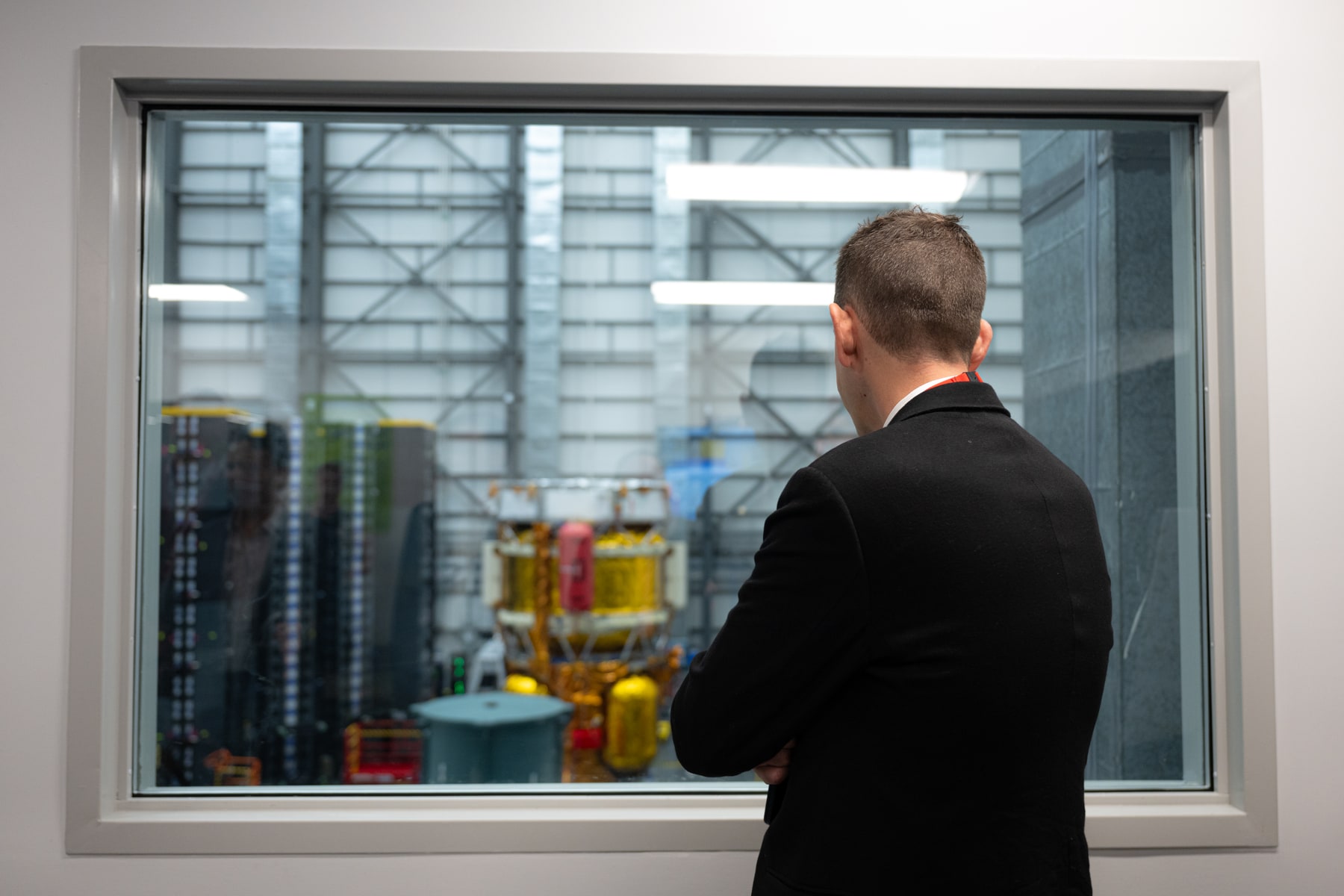
Our assessment is that this is where architecture announcements become practical engineering work. A family resemblance is a lead for investigation, not a substitute for evidence. The same discipline applies to both providers: earlier successes deserve recognition, while new environments, connections and crew obligations need their own justification. The archive photograph accompanying this guide illustrates development hardware, not a completed crewed landing system.
Source notes: 11. Original editorial interpretation and hypothetical examples are identified in the text.
Read the audit date as carefully as the launch target
GAO’s July 2026 assessment identifies cryogenic-transfer development as a major HLS risk and describes cost and schedule baselines under review. Its evidence includes earlier-2026 project snapshots. It is an independent acquisition assessment, not a fresh evaluation of the October 23 concepts.
NASA’s inspector general separately reported testing and crew-survival-analysis gaps in March 2026. That finding is important historical oversight. We have not checked current recommendation-closure evidence, so we do not claim every identified gap remains open today or that a later design change has closed it.
The original reporting lesson cuts both ways. A new plan does not invalidate an old concern merely by being new. An old concern does not prove that subsequent work accomplished nothing. Look for the specific risk, the response and the evidence that the response addresses it. Historic contract figures also should not be recycled as current prices for materially revised missions.
Source notes: 8, 9. Original editorial interpretation and hypothetical examples are identified in the text.
The scorecard for the next announcement
Our suggested scorecard has four entries: configuration, demonstrated operation, remaining dependency and recovery option. For each milestone, write one sentence under each heading. If an entry cannot be filled from the public evidence, leave it unknown rather than inferring it from a launch date or a dramatic image.
That method makes different demonstrations comparable without pretending they are identical. A mechanical test can make the connection entry stronger; an endurance test can change the waiting-time entry; a crew evaluation can expose operational questions. None needs to be dismissed for answering only part of the problem. Each needs to remain attached to the question it actually answered.
The practical conclusion is not that ambition should wait until uncertainty disappears. It is that ambition needs a sequence for reducing uncertainty and a rule for deciding when the evidence is sufficient. The revised Artemis plans are worth following for that sequence. The decisive progress will be the demonstrated handoffs that turn a plausible journey into an executable one—not our preferred logo on the lander.
Source notes: 1, 2, 8, 9. Original editorial interpretation and hypothetical examples are identified in the text.
Sources & Methods
Prepared October 24, 2026. We read NASA’s two October 23 mission descriptions, the public NTRS presentation abstract, the relevant HLS sections of GAO-26-108556, NASA OIG’s March summary, and the linked technical/agency reports. The October announcement is the news event; older tests and oversight retain their own dates and scopes. Table entries describe plans, not completed operations. The 95%-per-step calculation uses invented independent inputs and is not a provider forecast. Analysis and suggested evidence checks are original editorial interpretation. We did not inspect proprietary flight data, reproduce a simulation, interview experts, audit certification or verify current closure of oversight recommendations. No agency or contractor reviewed or endorsed this guide.
- NASA: revised lander concepts, October 23, 2026 — Current primary announcement; operations and dates are plans
- NASA: Artemis III test campaign, October 23, 2026 — Current primary mission description; test articles are not completed lunar systems
- NTRS 20250003325: in-space cryogenic transfer abstract — Primary 2025 presentation abstract; onboard tank-to-tank experiment, not a reproduced independent study
- NASA: developmental cryocoupler ground testing — June 26, 2026 report, updated September 16; no lander adoption asserted
- NASA: two-stage cold-propellant storage research — July 18, 2025 report, updated June 22, 2026; ground hydrogen research, not flight qualification
- NASA: radio-frequency propellant measurement — March 25, 2025 report, updated June 22, 2026; technical background, not a claimed installed lander sensor
- NASA: full-scale docking qualification tests, February 2024 — Historical component testing; old mission assignments are not adopted
- GAO-26-108556: HLS acquisition assessment — Independent oversight published July 23, 2026; relevant HLS sections and dated evidence, not October readiness certification
- NASA OIG: HLS oversight summary, March 10, 2026 — Independent historical oversight; current recommendation closure not independently checked
- ESA: European Service Module propulsion roles — March 30, 2026 hardware background; not validation of the revised docked stack
- NASA: Mark 1 thermal-vacuum testing, May 4, 2026 — Uncrewed cargo demonstrator test; not Mark 2 crewed qualification