
A new small tablet, with a future delivery date
Apple’s 8.5-inch OLED iPad mini with A20 Pro starts at $699 for Wi-Fi and $849 for cellular in the U.S. October 28 preorders and November 6 availability remain future milestones. MacRumors corroborates the October 26 launch.
For a photographer, illustrator or field worker, our starting question is narrower than whether this is a powerful tablet: which job would you carry it to finish? Reviewing a small selection of photographs, annotating a site plan and delivering a layered illustration impose different demands. Naming the job makes the buying comparison useful.
Define the intended output before selecting a configuration. If the task is choosing images for a client conversation, explain how those choices return to the main archive. If it is drawing, identify the application, required export and recipient. This is a planning method, not a claim that we have run those applications on the announced model.
Source notes: 1, 5. Original editorial examples and interpretations are identified separately.
Peak brightness answers only one screen question
Apple lists 600-nit maximum SDR and full-screen XDR brightness, with a 1,200-nit peak reserved for HDR content. Nano-texture glass is optional on 256GB and 512GB configurations. These are manufacturer specifications, not our measurements.
Do not use the largest number as a promise about every document or photograph. For a proposed outdoor workflow, the practical question is whether your ordinary application remains comfortably legible in the conditions where you work. For an editor, ask how the intended image and delivery format are presented, rather than treating a striking display demonstration as a color-verification certificate.
We would compare standard and nano-texture versions with the same ordinary document and a familiar photograph before paying for the option. Examine fine text, reflections and the appearance you prefer. That proposed comparison does not assume that either surface is universally better, nor that an appealing screen replaces a controlled finishing setup.
Source notes: 2. Original editorial examples and interpretations are identified separately.
The storage tiers are not computationally identical
The technical sheet assigns a five-core CPU and one 16-core Neural Engine to 128GB and 256GB models. The 512GB version has a six-core CPU and dual 16-core Neural Engines. Apple lists a seven-core GPU across those configurations.
That split makes an unqualified A20 Pro performance headline insufficient for choosing a model. It does not tell us the size of a difference in an untested app. An extra listed component is a reason to seek a configuration-specific test, not a reason to promise a proportionate reduction in waiting time.
Our suggested storage exercise is to total the files retained during a real assignment, including imported originals, working versions and exports. Add the applications and offline references you actually need. Keep a margin for unfinished work. Then compare the appropriate tier’s price against the value of avoiding an extra transfer during that assignment, rather than buying capacity solely for a benchmark expectation.
Source notes: 2. Original editorial examples and interpretations are identified separately.
Make the file handover part of the purchase decision
Apple’s storage guide describes external USB drives and card readers through compatible connections and supported apps. It specifies a single data partition and supported formats, including exFAT and APFS; external hard drives often need their own power. This general guidance is not a compatibility test of every reader or drive.
A useful rehearsal starts with disposable copies. Import a representative file, make the intended change, export the exact deliverable and open it on the receiving computer. Check names, organization and the information the recipient needs to continue. An image appearing in a gallery is an incomplete demonstration if you cannot recover the editable result.
Repeat the handover without the network your normal workspace supplies. This is especially relevant to a proposed travel kit: discover whether the actual task requires a cloud file, login or download before relying on it away from home. Keep the source archive untouched until the copied files and returned output are verified.
Source notes: 4. Original editorial examples and interpretations are identified separately.
Price the combination you intend to carry
Apple lists the separately sold Pencil Pro at $129 and Smart Folio at $79. Our base Wi-Fi illustration is $699 + $129 + $79 = $907 before applicable tax; this is not a Romanian quote.
Build a second total using the compatible equipment you already own and the accessories your task genuinely requires. A reader who only annotates occasional documents should justify a different kit from someone drawing for hours. Include any application or connectivity charges separately after checking their current terms; we have not priced a complete subscription workflow.
The relevant alternative can be keeping the existing tablet and changing a reader, carrying a larger device already owned, or waiting for a configuration-specific review. Those choices should be compared on completed work and carrying burden, rather than assuming every improvement requires replacing the whole setup.
Source notes: 1. Original editorial examples and interpretations are identified separately.
Check Siri availability separately from the hardware
The launch footnote describes Siri AI as beta in iPadOS 27.2 and says it is not currently available in the EU on iPadOS. Apple’s October 22 support document independently states the EU platform restriction and describes a waitlist. A compatible chip is therefore not evidence of immediate access.
For a Romanian buyer, a proposed workflow should stand on the functions actually available in the relevant region and language. If a promised assistant action is essential to the purchase, verify that precise action, account eligibility and software version first. Do not plan around changing region settings to defeat a restriction.
Our buying threshold is concrete: the required app opens the representative input, the work is comfortable at this size, the output reaches its destination intact and the complete cost is acceptable. The announced hardware gives buyers new options to evaluate. Whether those options improve their finished work remains a question for delivery, independent testing and their own bounded trial.
Source notes: 1, 3. Original editorial examples and interpretations are identified separately.
Sources & Methods
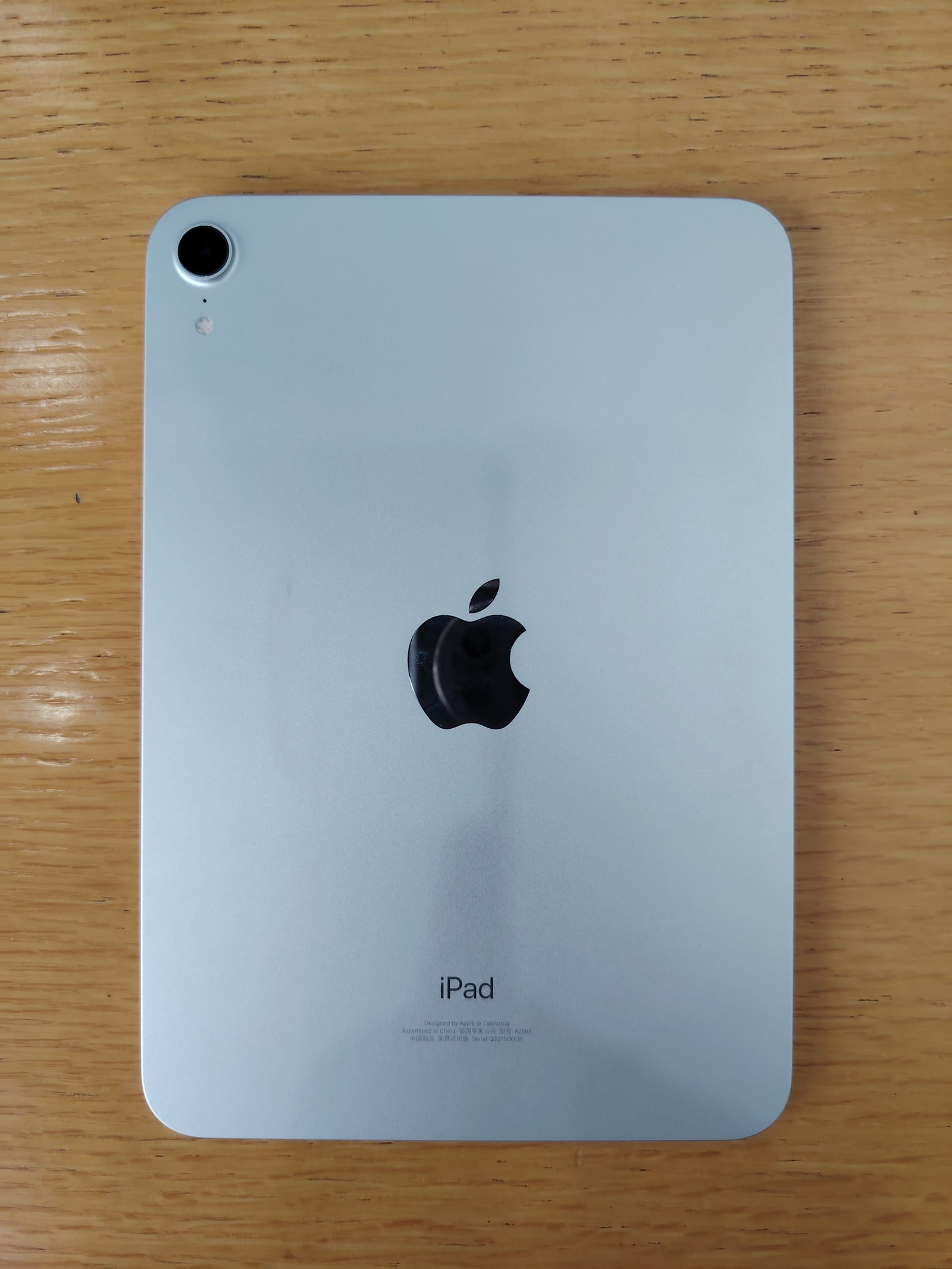
We checked Apple’s October 26 announcement against its current technical sheet and separate support guidance, with independent corroboration of the launch from MacRumors. Configuration, availability and regional limits are distinguished from our proposed buying and file-handover method. No hands-on, display measurement, battery benchmark or application test is claimed. The photograph shows an older sixth-generation iPad mini, not the announced model.
- Apple: October 26 iPad mini announcement — Primary announcement; preorder and delivery dates are scheduled
- Apple: configuration-specific technical specifications — Manufacturer specifications; not independently measured performance
- Apple Support: Siri AI eligibility — Published October 22, 2026; region, platform and waitlist boundaries
- Apple: connecting external storage to iPad — Official general storage guidance; not a device-specific compatibility test
- MacRumors: independent launch report — Independent October 26 report corroborating announcement and scheduled dates