An order opening, with deliveries still ahead
XREAL launched AURA, its wired Android XR glasses, on October 28 at Google’s Android Developer Summit. Its October 29 correction concerns an entertainment detail; mid-November shipments remain a forecast. Opening orders and delivering hardware are separate milestones, neither proving how a working day will feel.
Google lists October 28 ordering for the United States, Canada and Korea, and November 2 for Japan. XREAL’s release instead includes Japan in its immediate-order list. We retain that discrepancy and use Google’s later Japan date here, without claiming a separately verified Japanese checkout or availability elsewhere.
XREAL lists offers through December at $1,099 for 12GB/256GB, or $1,299 for 16GB/512GB; regular prices are $1,279 and $1,499. These U.S.-dollar manufacturer prices do not establish local taxes, import costs, support or a final checkout total.
Source notes: 1, 2. Original editorial examples and interpretations are identified separately.
Put the puck in the portability calculation
The company specifies optical see-through lenses, a 70-degree field of view and glasses weighing under 95 grams. Its split-compute arrangement puts the main processor and battery in a separate wired puck. The frame’s weight describes one component, rather than the complete equipment a traveller carries.
Our proposed comparison begins with the entire kit: glasses, puck, cable, case, power arrangement and any keyboard. Write where each part will sit during the task and how the arrangement returns to a familiar screen if it is inconvenient. We have not weighed that kit or tested it in transit.
This makes a modest alternative visible. A laptop screen or portable monitor may already accommodate a particular assignment. A more flexible virtual workspace has value when it removes an identified constraint, rather than because a demonstration contains more windows.
Source notes: 2. Original editorial examples and interpretations are identified separately.
Separate native apps from a mirrored laptop
Google describes native Android XR applications and a separate Wired Mirroring route. The latter requires a laptop connection through a USB-C cable supporting video output; its display becomes a spatial window beside Android applications, without additional mirroring software.
Those routes answer different questions. An application running on the laptop remains dependent on that laptop, while a native application needs its own supported features and account. Do not treat an application logo, an available store listing and a completed assignment as equivalent evidence.
For a proposed trial, name one ordinary task and its essential inputs and output. A designer might need to revise a document, consult reference material and export a file. Record which device runs each step. This is a hypothetical planning exercise, not an assignment Lumacta completed on AURA.
Source notes: 1. Original editorial examples and interpretations are identified separately.
The developer evidence is more specific than a catalogue promise
Godot’s October 28 announcement says its editor and companion application can develop and export spatial projects natively on AURA. It also describes a DOGWALK spatial port involving the Godot Foundation, Blender Studio and W4 Games as still being polished for release later this year. An announced development route is different from a finished example.
Khronos’s October 19 explanation provides older standards context: OpenXR spatial containers are system-managed spaces for content, with bounded and immersive modes. The system controls positioning. That description clarifies the windowing model; it does not guarantee that every engine feature or application behaves identically across devices.
A small team evaluating the platform should therefore identify one required interaction and one export target before extrapolating from a sample. Ask for the exact engine, plugin and device versions behind a demonstration. We have not built, exported or installed a project, and do not report development performance.
Source notes: 3, 4. Original editorial examples and interpretations are identified separately.
A private-looking screen still needs an information policy
Google Cloud’s October 28 enterprise post describes managed Google Play, zero-touch enrollment and fully managed device mode for AURA. It also says some applications and features require downloads, setup or subscriptions. These are supplier statements about management options, not a Lumacta security audit or proof that a particular employer has approved the device.
Google’s consumer announcement says Gemini can work with the user’s view, including a mirrored laptop window. A screen visible only to its wearer does not by itself settle what information an assistant may process. Establish the permitted data and account settings before bringing workplace documents into that arrangement.
Use harmless sample material for a proposed assessment. Keep required organizational approval distinct from a personal preference to try the hardware. If the information rules or application requirements remain unresolved, record that outcome instead of treating an available enterprise feature as blanket permission.
Source notes: 5, 1. Original editorial examples and interpretations are identified separately.
Outside reporting confirms the launch, with review questions open
Android Authority’s October 28 report independently covers the launch, ordering timetable and split-compute design. It explicitly leaves the comfort of reading small text for practical assessment. That is useful editorial scrutiny, but it supplies no Lumacta measurement or completed sustained-work review.
Readability, input accuracy, fit and a complete battery workload can matter more than how many windows appear in a promotional scene. A future review should state its application, text size, lighting and session conditions. One user’s comfortable brief encounter cannot automatically predict another reader’s assignment.
Source notes: 6. Original editorial examples and interpretations are identified separately.
Decide what result would justify a different screen
Before ordering, write the result that would justify carrying this arrangement: a particular task, completed under acceptable conditions, with an understood route back to the existing setup. Keep unknowns visible. This proposed decision record gives a later review or authorized trial something concrete to answer.
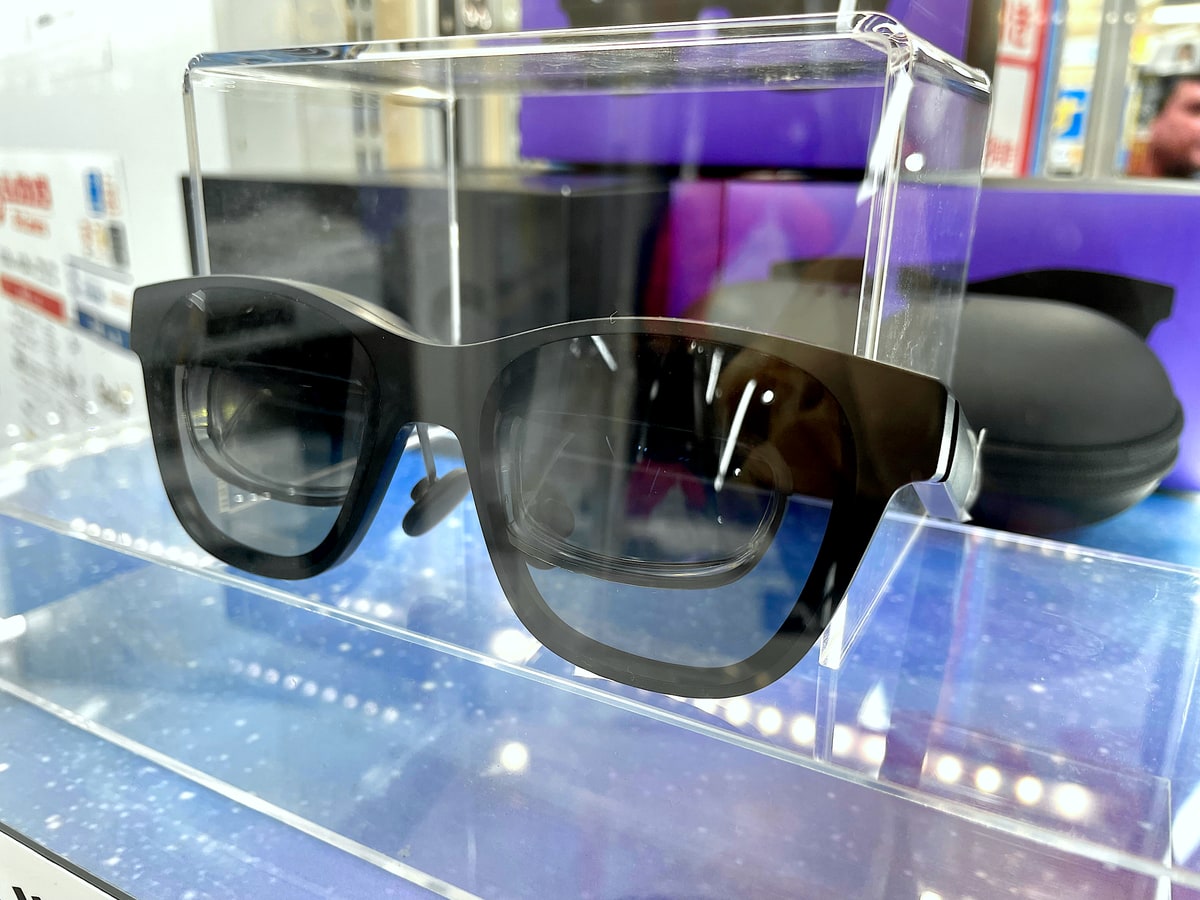
The accompanying photograph shows older Nreal Air glasses photographed on February 26, 2023, by KKPCW. It is clearly labelled archive context, not AURA, a new launch photograph or evidence that Lumacta tried this hardware. The product launch is current; the historical image must remain historical.
Source notes: 1, 2, 3. Original editorial examples and interpretations are identified separately.
Sources & Methods
We compared the dated Google launch and corrected XREAL release, retained their Japan-ordering discrepancy, and read complementary Godot, Khronos and enterprise documents plus independent launch coverage. The proposed task and kit comparisons are original editorial analysis. No hardware, application, security or performance testing was performed.
- Google: AURA launch and regional timetable — Primary announcement, October 28, 2026; supplier claims
- XREAL: corrected launch release — Primary company release: event October 28; correction October 29, 2026
- Godot: AURA editor and spatial projects — Primary developer announcement, October 28, 2026
- Khronos: OpenXR spatial-container model — Primary standards context, October 19, 2026; not a new October 28 specification
- Google Cloud: AURA enterprise management — Primary enterprise announcement, October 28, 2026; not an independent security assessment
- Android Authority: AURA launch coverage — Independent reporting by Shimul Sood, October 28, 2026; review questions remain