
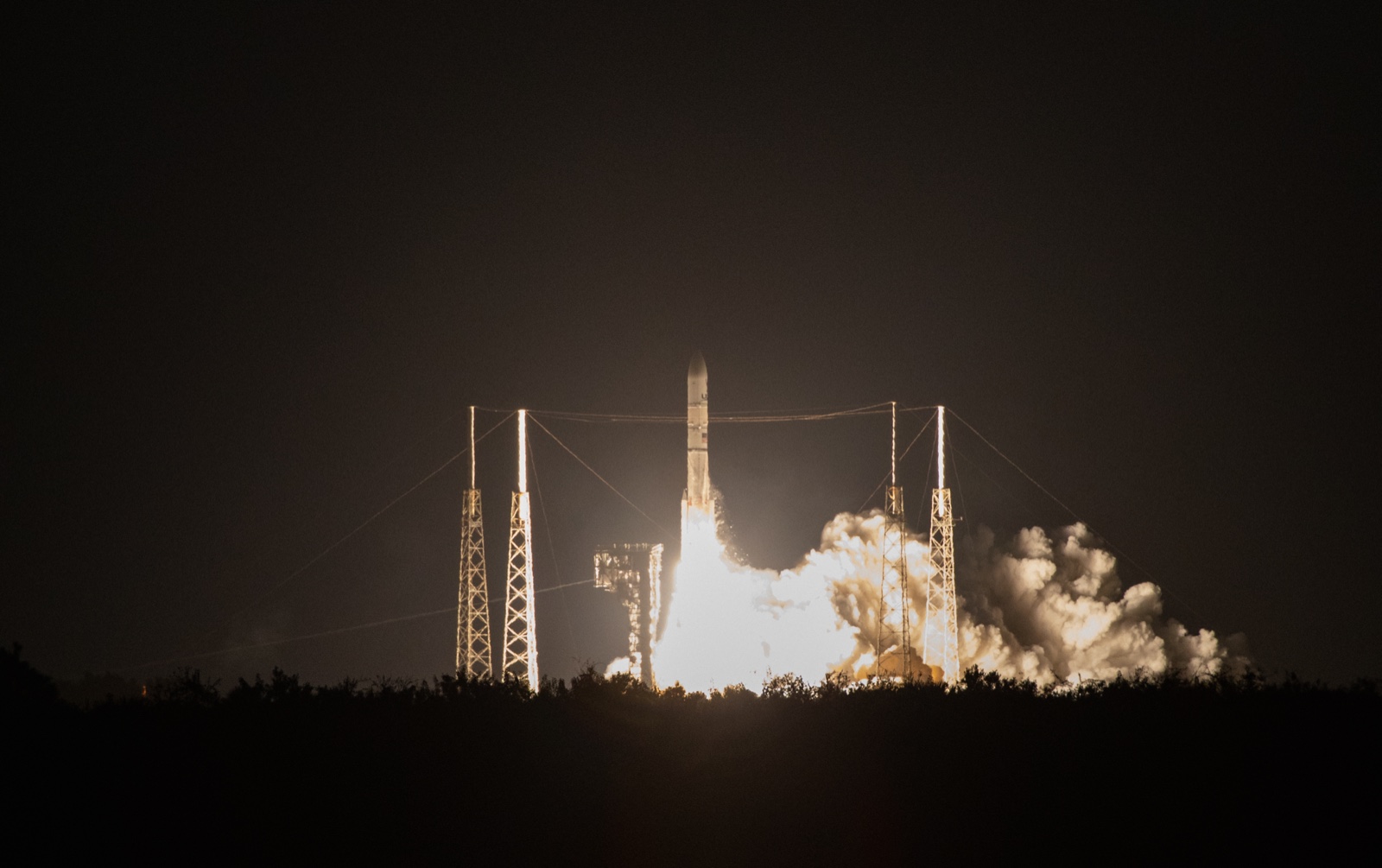
Liftoff was the start of the delivery
Amazon lost all 40 broadband satellites aboard a United Launch Alliance Vulcan rocket on Sunday, November 15. The rocket lifted off from Cape Canaveral Space Force Station at 12:40 p.m. EST, or 17:40 UTC. Amazon confirmed the payload loss in its mission log. Spaceflight Now reported that ULA placed the anomaly about ten minutes into the flight. The companies have yet to publish a cause.
This was the first flight on Vulcan for Amazon Leo, the network previously known as Project Kuiper. ULA’s mission description shows a configuration with six strap-on solid boosters, a longer fairing and a Centaur V upper stage configured for low Earth orbit. The solids and the core get the rocket through the first part of ascent. The upper stage then has to bring the stack to the speed and direction required for its target orbit before separating the satellites.
Watching a rocket clear the pad tells you it has launched. To judge whether a broadband mission delivered anything, keep watching for deployment and then for the operator to establish contact. A spacecraft has to be healthy and reach its assigned place in the network before it can contribute to coverage. On Sunday the mission stopped before it could deliver its satellites to orbit.
The public timeline narrows the questions
Independent reports describe deviations from the planned flight sequence. Ars Technica reported that an animation driven by launch telemetry showed the vehicle rotating after main engine cutoff, with motion continuing through the transition between stages. Spaceflight Now found that the core appeared to burn longer than scheduled. Those are observations from public coverage. They give investigators intervals to examine and leave open which event started the problem.
Ars also reported that unnamed sources pointed to the core stage, without establishing the failed component. An investigation has to test whether the upper stage developed a fault of its own or inherited an unfavorable attitude or trajectory from earlier in the flight. Propulsion, control and stage separation each leave different evidence. A real-time animation gives the audience a view of the sequence. Raw flight measurements and ground tracking are what allow a team to test competing explanations.
The launch returned Vulcan to flight after an earlier problem with a solid booster, as Spaceflight Now reported. That history is a reason to read the engineering findings carefully when they appear. Similar consequences can come from different faults. A properly bounded account of Sunday’s loss starts with the observed timeline and leaves the component-level explanation for the investigation.
A large batch changes the cost of a missed flight
Before the launch, Amazon had described Vulcan as the carrier for more than 1,500 first-generation satellites across 38 missions. Its launch portfolio also includes Arianespace, Blue Origin and SpaceX. That gives this loss two kinds of weight. The immediate one is the hardware on Sunday’s rocket. The longer-running one is the capacity Amazon expected from subsequent flights. A factory can build up inventory while its launch schedule falls behind.
For a constellation operator, filling a larger rocket may reduce the number of launches needed to reach a deployment target. It also places more satellites behind a single launch outcome. The number aboard gives the scale of the immediate loss. It cannot tell you how many other launches the company could reschedule this year. Payload preparation, a compatible dispenser, a launch slot and a suitable orbital destination all have to line up.
Consider two ways to recover the schedule. An extra flight on a different rocket could add satellites sooner, but it would need its own available vehicle and room on that launcher’s manifest. Waiting for Vulcan could let Amazon use its existing dispenser and orbit plan for a future batch, with timing tied to the investigation and flight clearance. A large order book gives Amazon options over several years. The question for the next few months is how many compatible flights can actually move.
The same distinction applies to readers waiting for broadband. A constellation-wide satellite count is a partial signal. Coverage at a particular address depends on which orbital groups have enough commissioned satellites, when terminals become available and when the operator offers service in that market. The loss changes the deployment arithmetic. By itself it does not establish a change to anyone’s installation date.
Ariane 6 offers a separate route
Arianespace is preparing to send 36 Amazon Leo satellites from French Guiana aboard an Ariane 64. The company lists November 23 as the earliest launch date. This is a previously planned mission, so any successful deployment would keep one part of the programme moving while Vulcan’s return remains uncertain. It would still leave the job of recovering the Florida launch schedule.
Reaching the deployment orbit and releasing the payload are the rocket’s job. Spacecraft checkout is Amazon’s. The handoff matters because tracking a satellite in space establishes where it is, while commissioning establishes that the operator can control it and put its communications equipment into service.
Here is the useful way to read the next round of announcements. Look for a finding that explains which hardware or procedure has to change before a Vulcan can fly again. Treat the Ariane date as a planning target until liftoff. Once a different batch is in orbit, wait for Amazon to confirm contact and commissioning before assuming it has added usable network capacity.
For customers, follow confirmed service availability in the intended location and keep existing connectivity arrangements until the new service works where it is needed. For anyone tracking competition in satellite internet, the stronger signal will be a run of successful deployments on several rockets, followed by evidence that those satellites are providing usable service.
Sources & Methods
We read Amazon’s postflight log, checked the Vulcan configuration against ULA’s mission page and used independent launch reporting to distinguish observed flight behavior from a failure diagnosis. We checked the Ariane plan with its launch operator.
- Amazon Leo mission log and confirmation of the payload loss — Primary satellite operator update
- Vulcan Leo 1 mission overview and vehicle configuration — Primary launch operator mission plan
- Spaceflight Now reports the launch and ULA’s postflight statement — Independent launch reporting
- Ars Technica examines the launch sequence — Independent aerospace reporting
- Amazon’s earlier description of its Vulcan rollout and booked capacity — Primary preflight programme statement
- Arianespace update for the separate VA271 launch — Primary launch operator schedule
- NASA Kennedy’s archive photograph of Vulcan’s first flight — Original archive photograph and attribution