
A mechanical-looking fallback in a connected product
Ring’s October 9 announcement introduces Smart Lock, with a power dial the company says can recharge a depleted battery by hand. It is scheduled for U.S. purchase in early 2027, not available now. The release does not give a lock price.
The appealing idea is that recovery could happen at the door, rather than depend on finding a charger. But an announced mechanism is not evidence of how comfortably someone can use it when carrying shopping, wearing gloves or struggling with hand movement. Those are questions for a documented procedure and independent testing.
Our reading is that the fallback deserves attention without becoming a universal reliability claim. Buying a connected lock means deciding what happens when each dependency fails, not simply collecting more convenient ways to open a door.
Source notes: 1. Editorial interpretation and illustrative calculations are identified separately.
Battery, connection, permission and mechanics are different dependencies
Ring says the lock requires Amazon Sidewalk coverage, which can vary or be interrupted. That qualification matters: a power-recovery feature should not be treated as proof that remote commands, account access or every unlocking method continue working without a network.
Our proposed decision framework has four columns: available power, usable connection, authorized person and functioning door hardware. Write the recovery route beside each one. A solution in one column does not automatically solve the other three; a phone with a working connection is not the same thing as an account you can still access.
Ask the manufacturer which operations remain possible in each state, how access is restored and who can assist. Request the actual instructions rather than extrapolating from a demonstration. We have not established offline operation, emergency-access performance or the effort required to recharge this lock.
Source notes: 1. Editorial interpretation and illustrative calculations are identified separately.
The indoor-camera shutter is a boundary residents can see
The U.S. Pan-Tilt Indoor Cam 2K product page currently lists $69.99 and describes a built-in shutter that disables both camera and microphone. These are published product claims, not a purchase or a privacy test performed by Lumacta.
A visible physical control can make a household agreement easier to understand. Decide who may reopen it, when monitoring is appropriate and which spaces should never be included. A visitor should not need to decipher an application dashboard to understand the agreed recording boundary.
There is an important time distinction: stopping future capture and handling footage already stored are separate jobs. Closing a shutter should not be read as a promise that previous recordings have disappeared. Our proposed privacy check therefore covers the current capture state, who may view earlier material and the retention settings, without claiming an audit of the device’s internals.
Source notes: 2. Editorial interpretation and illustrative calculations are identified separately.
Camera resolution is not a substitute for an upload budget
For this indoor camera, Ring recommends at least 5 Mbps upload for optimal performance and says resolution may vary with bandwidth. The specification also identifies a 2.4 GHz Wi-Fi connection. An advertised download speed does not answer either requirement.
Consider a hypothetical planning check, not a measurement of Ring’s bitrate. If two simultaneous feeds each actually needed 5 Mbps, their combined demand would be 10 Mbps before other traffic. We cannot multiply a recommendation into a guaranteed stream rate, but the exercise explains why checking each device in isolation is insufficient.
Our proposed trial checks the intended location while other household work is happening, records interruptions and compares the usable picture with the identification task. A clear image on an empty network does not establish consistent operation during uploads or calls. Nor does a sharper camera establish that the thing you need to see remains in view.
Source notes: 2. Editorial interpretation and illustrative calculations are identified separately.
Account permissions deserve the same attention as the lens
The camera page separates subscription features from the hardware purchase and qualifies cloud recording with network dependencies. Treat the desired service as a specific feature-and-plan combination, not an entitlement implied by the camera’s price.
Before connecting a home, our proposed access inventory records who can view, change settings or grant access, and when each permission ends. A temporary visitor and a household administrator should not be interchangeable roles. Ask whether the available controls match that policy; we have not configured or verified Ring’s permission system.
We also found inconsistent movement-angle figures between the product page’s technical table and FAQ, so we do not use them as a coverage guarantee. More broadly, a camera that turns toward activity is not a camera viewing every direction simultaneously. Plan around the room and the event you need recorded, then obtain clarification of specifications that affect placement.
Source notes: 2. Editorial interpretation and illustrative calculations are identified separately.
The useful upgrade is a recovery plan, not a bigger feature list
Our editorial view is conditional: a feature is valuable when it removes a real inconvenience and leaves a recovery route the household can understand. First define the requirement—access at the door, remote status or indoor observation—then identify which dependencies the product introduces as well as those it removes.
For a working setup, these announcements do not establish a reason to replace it. For a new installation, wait for instructions, local availability and independent evidence before trusting a product with a role it has not demonstrated. This is a decision framework, not a hands-on recommendation or a claim that one device is secure.
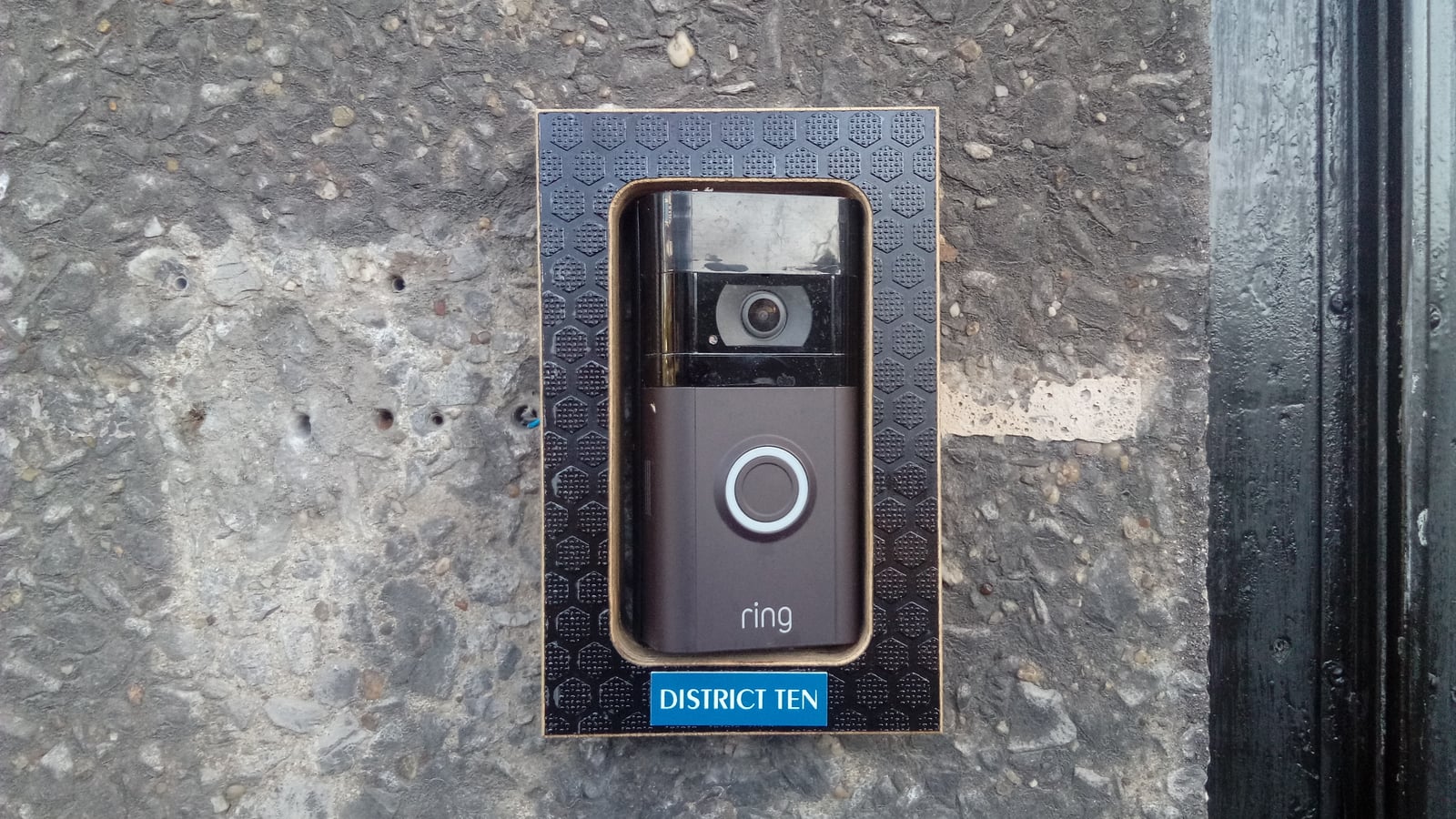
Our accompanying photograph documents an older Ring doorbell in Rotterdam in 2020. It shows neither the new lock nor the current indoor camera. Its role is archival context: the substantive news is an announced approach to recovery, while dependable everyday use remains the question to test.
Source notes: 1, 2. Editorial interpretation and illustrative calculations are identified separately.
Sources & Methods
Prepared October 11, 2026. We read Ring’s October 9 announcement, including its availability and dependency notes, and the current U.S. indoor-camera page, technical table, FAQ and feature qualifications. Manufacturer claims are not independent results. The network arithmetic is explicitly hypothetical, not a measured bitrate. The dependency matrix and household questions are original editorial analysis. We performed no hardware, privacy, access-control or offline-operation tests, completed no purchase and interviewed no manufacturer representative.
- Ring: October 9 hardware announcement — Primary announcement; planned availability and qualified features, not a delivered lock or reliability test
- Ring: U.S. Pan-Tilt Indoor Cam 2K information — Primary product page checked October 11, 2026; price, specifications, FAQ and subscription qualifications. Not a checkout or independent test