
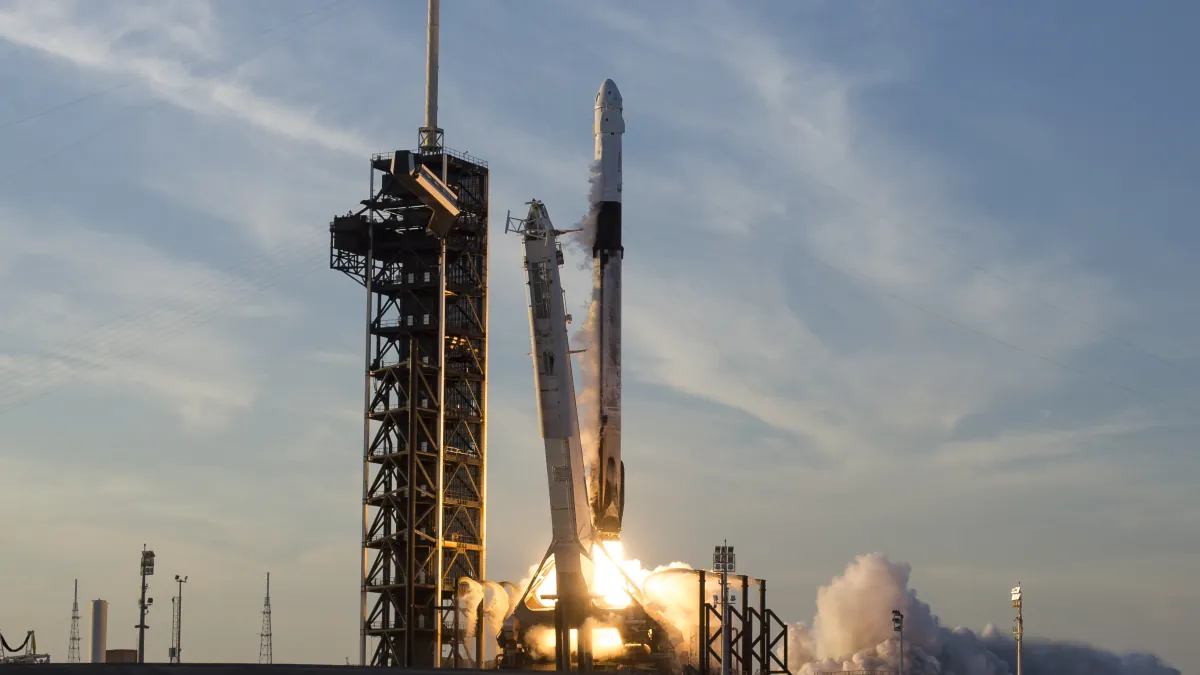
Buying continuity in orbit
NASA has ordered three additional SpaceX crew missions through a $946 million contract modification announced on September 18, 2026. The package covers Crew-15, Crew-16 and Crew-17. NASA gives mission readiness dates in 2027 and 2028, within a performance period extending through 2030. These are planning milestones, not three confirmed launch dates.
The purchase is important because a research station is only useful if people, equipment and supplies can reach it reliably. Transport is part of the laboratory's operating infrastructure. It is easy to focus on the spectacular few minutes around launch and overlook the longer service that makes a mission possible.
For this week's news, the central development is a procurement commitment. The announcement does not mean these missions have flown, that all their crews have been named, or that the experiments they may support have already produced results. Keeping those stages separate is essential to evaluating both the spending and the science.
Sources: NASA: three additional SpaceX crew flights (September 18, 2026)
The price is a service package, not an astronaut fare
NASA says the modification includes ground and launch operations, in-orbit support, return and recovery, cargo transport and a docked lifeboat capability. It increases SpaceX's CCtCap contract to 17 missions and a total value of $5.92 billion. The immediate $946 million figure covers the three new missions and related services.
Dividing $946 million by three gives approximately $315.3 million per mission as a simple arithmetic average of the package. It is not a published individual flight price and not a seat price. The announcement does not allocate the sum among its different services.
That distinction changes the economic interpretation. A fair comparison with another provider would need equivalent mission scope, crew and cargo capacity, duration, support obligations and price-year assumptions. Otherwise, an apparently cheaper ticket may leave substantial work outside the quoted number. Our calculation is only a way to understand the size of the bundle; it cannot establish whether NASA obtained the lowest possible cost.
Sources: NASA: three additional SpaceX crew flights (September 18, 2026)
A mature service still needs mission-by-mission assurance
The relevant history is not just how often a rocket has launched. NASA certified SpaceX's human-transportation system in November 2020 after a programme of design work, ground testing, uncrewed demonstrations and the crewed Demo-2 flight. The certification covered the transportation system, including associated ground operations, rather than a rocket considered in isolation.
NASA's account of that milestone describes escape demonstrations, parachute testing and rescue preparation. These illustrate why human spaceflight is a chain of capabilities: ascent, docking, time in orbit, return and recovery must work together. A successful start is not a successful mission by itself.
The economic benefit of an established service can include accumulated procedures and operational experience. But familiarity should not become a substitute for scrutiny. Our assessment is that future value must be judged through safe completed missions, dependable scheduling and transparent handling of problems. This article is not making a new safety certification or declaring that previous flights remove the risks of the next one.
Sources: NASA: human-rated SpaceX system certification (November 2020)
What reliable transport can enable
NASA's description of station research explains why access matters beyond astronaut rotation. Crews operate and maintain experiments, work with scientists on the ground and help test technologies such as water recycling, communications and computing systems. The station also supports investigations that run with little direct crew involvement. Humans and automation serve different roles in the same laboratory.
That does not make every experiment equally valuable or every orbital study necessary. A persuasive project should explain what the space environment changes, what can be learned on Earth first, and how results will be compared with an appropriate control. Paying for access creates an opportunity to do research; it does not by itself prove that an eventual finding has practical value.
For readers interested in technology, this is a useful way to think about infrastructure spending. A laboratory building, a research network and a spacecraft service are enabling investments. Their contribution is easier to judge when the work made possible by them is documented, reproducible and accessible to the relevant scientific community.
Scientific perspective: access is an input, not an outcome
Lumacta's evidence-based assessment is that the contract should be understood as continuity for a research platform. The scientific return would need to be evaluated through the investigations supported, the quality of their evidence and the usefulness of the resulting knowledge. Launch count alone is a poor substitute for those measures.
Our proposed evaluation would separate transport performance from research performance. For the former, track schedule reliability, safe crew return and delivery of the contracted services. For the latter, examine completed experiments, data quality, publication of methods and whether findings survive follow-up work. These are editorial criteria, not a new audit of NASA's purchase.
Benefits can also take time to emerge. A result that rules out an unproductive approach can be scientifically useful even when it does not lead to a product. Conversely, a promising demonstration should not be counted immediately as an economic success. Evidence of demand, manufacturability and real-world performance would still be needed before making that stronger claim.
Sources: NASA: benefits and operation of station research; NASA: low Earth orbit microgravity strategy
The larger question is what follows the station
NASA's current commercial-station strategy describes a transition from the International Space Station toward commercially owned and operated destinations as the ISS approaches the end of operations in 2030. The intended model is for NASA and other customers to buy services. That is a programme direction, not proof that every proposed station will be ready on schedule.
The three additional crew missions should not be confused with purchasing or certifying those future destinations. Transport capacity and somewhere to go are complementary requirements. A market needs both, along with customers willing and able to pay for sustained activity.
For the wider economy, the meaningful question is whether dependable infrastructure can support useful research and services beyond a single government customer's needs. The new order helps clarify near-term demand, but it does not answer the long-term business case by itself. The next evidence to watch is concrete: flight readiness, successful operations, research delivered and progress toward whatever orbital facilities are meant to follow.
Sources: NASA: commercial space station strategy; NASA: low Earth orbit microgravity strategy
Sources & Methods
Checked September 21, 2026. Contract news and updated readiness dates come from NASA's September 18 announcement. The approximate $315.3 million average is Lumacta's calculation: $946 million divided by three, not an official seat price. The 2020 certification and station research pages are background. Future missions, research returns and commercial destinations remain distinct from completed outcomes.
- NASA: three additional SpaceX crew flights (September 18, 2026) — Primary contract scope, value and readiness dates
- NASA: human-rated SpaceX system certification (November 2020) — Historical certification and testing record
- NASA: benefits and operation of station research — Research context; not a forecast of returns from the new missions
- NASA: commercial space station strategy — Current programme direction; future plans
- NASA: low Earth orbit microgravity strategy — Scientific and exploration objectives