
The spacecraft has left; the experiment’s result has not arrived
The October 9 Ames account describes KREPE-3: twelve experimental capsules aboard Cygnus XL, intended to collect measurements during destructive re-entry. The later station log records release on October 9 and schedules deorbit for Monday, October 12. That is the latest operational timing we checked—not a completed descent.
For today’s reader, this separation matters more than a dramatic claim about a breakthrough. Three different outcomes are involved: transporting the experiment, obtaining measurements and showing what those measurements establish. Completing the first does not automatically complete the other two.
Our scientific reading is that the valuable idea is turning an already-required disposal journey into an instrumented trial. It offers a way to confront predictions with a real flight. Its value will ultimately depend on evidence returned, not the spectacle of a vehicle breaking apart.
Source notes: 1, 2. Editorial interpretation and illustrative calculations are identified separately.
A fleet of capsules is not one interchangeable test
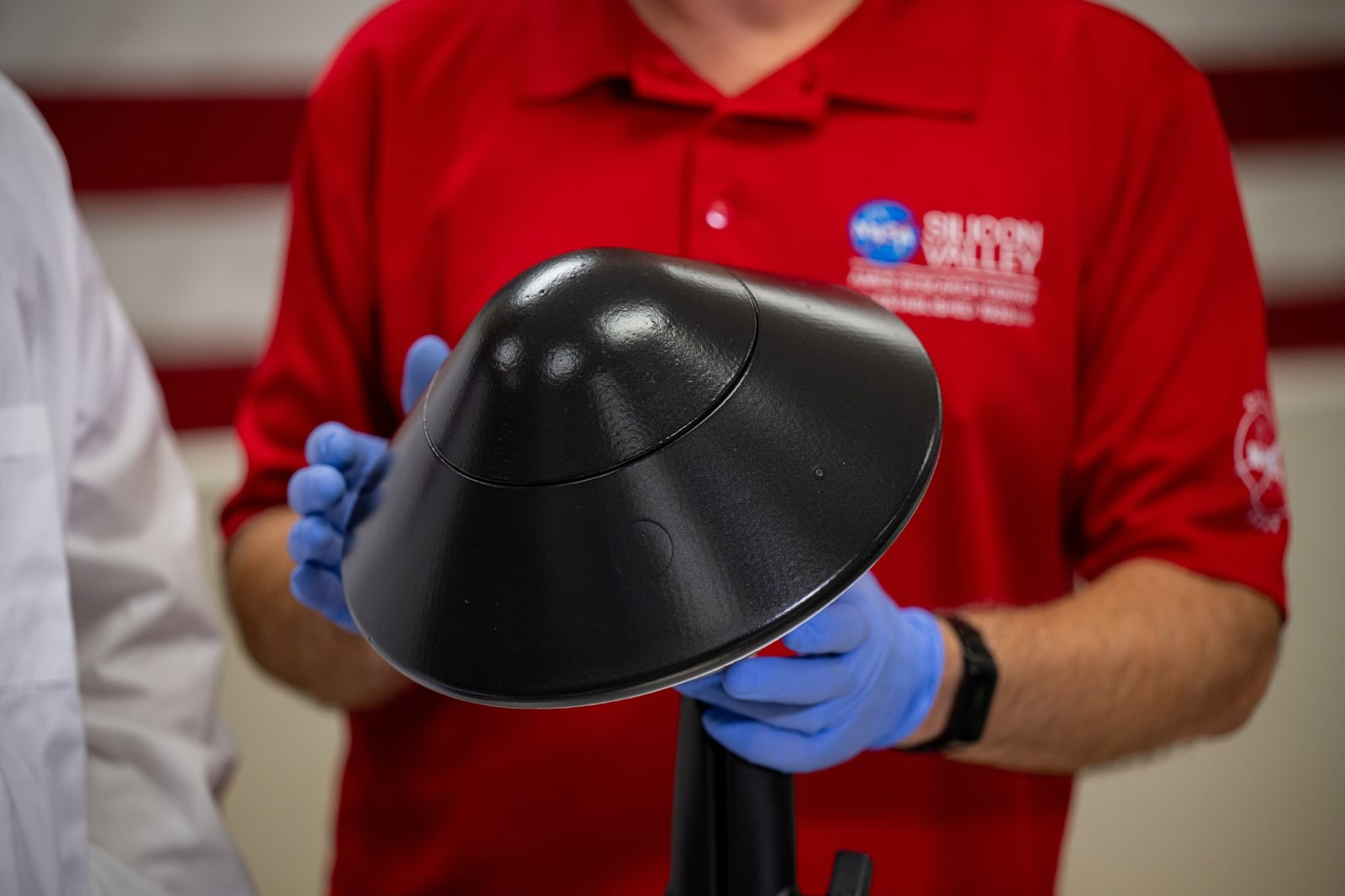
The Ames account includes 3D-printed protection, stitched carbon-and-phenolic MERINO coverings, a Dragonfly-like aeroshell and an umbrella-shaped deployable design. The 2025 research abstract planned both ordinary capsule geometries and alternative shapes. That earlier abstract describes intentions, not a verified inventory of the final flight configuration.
Our proposed comparison begins by separating material from shape. If two capsules differ in both, a different temperature history cannot be attributed to the covering alone. Record geometry, sensor position and the conditions each actually encountered before declaring one material superior.
This is useful beyond spacecraft. A changed enclosure, airflow path or mounting arrangement can complicate any thermal comparison. The disciplined question is not merely which object became hotter, but which variable the experiment can isolate. A mixed-design flight may answer several narrower questions rather than produce one universal winner.
Source notes: 1, 3. Editorial interpretation and illustrative calculations are identified separately.
The highest heat rate and the accumulated exposure are different
The flight account includes temperature and motion measurements and a heat-flux sensor contribution. These are complementary observations, not interchangeable ways of reporting one number. Our teaching example explains why a peak alone can mislead.
Imagine two entirely hypothetical, constant exposures. One surface receives 1 watt per square centimeter for 5 seconds: 1 × 5 = 5 joules per square centimeter. Another receives 2 watts per square centimeter for 2 seconds: 2 × 2 = 4. The second has twice the rate but less accumulated energy per unit area.
Neither calculation predicts a capsule’s temperature, safety or damage. It omits changing conditions and the material’s response. The point is narrower: preserve both intensity and duration when reading a thermal claim. To evaluate protection, also ask where the temperature was measured and what remained behind the protective layer.
Source notes: 1. Editorial interpretation and illustrative calculations are identified separately.
A successful sensor still needs a successful route home
The 2025 abstract proposed capsule-to-capsule communication alongside the Iridium satellite network. It also records 34 transmitted data packets from KREPE-2. Those historical packets are not this mission’s results, and a planned communication design is not evidence that every new capsule delivered a complete record.
Our original evidence checklist keeps separate columns for sensor operation, stored measurements and received measurements. A gap in the last column may have several possible explanations. Without additional diagnostic evidence, it should not silently become a claim that the protective material failed—or that it worked.
This makes completeness part of the scientific result. Before comparing traces, ask which channels and time intervals are missing, how clocks were aligned and whether calibration changed. An attractive curve can be genuine yet insufficient for the question a reader wants it to answer.
Source notes: 3. Editorial interpretation and illustrative calculations are identified separately.
A small flight can challenge a model without certifying a large vehicle
Our proposed analysis would preserve a model’s prediction before examining the flight trace. Then compare the predicted and observed quantities using their uncertainty ranges, rather than adjusting the model and describing the improved match as an independent confirmation.
A disagreement can be informative. It may identify a missing process, an unsuitable assumption or a measurement problem. The next step should distinguish those possibilities. Conversely, agreement at one sensor and one moment should not erase a mismatch elsewhere in the record.
Moving from a capsule experiment to another vehicle needs its own argument. We would ask what conditions the test covered, which requirements remain untested and how manufacturing consistency will be assessed. This is an editorial framework, not a certification judgment or a simulation Lumacta has performed.
Source notes: 1, 3. Editorial interpretation and illustrative calculations are identified separately.
Watch for a dataset, not just a celebration
The University of Kentucky advertises an October 12 data-watch event where participants expect to see capsule data populate. It is an event announcement, not independent proof that a complete dataset already exists. We will not turn an invitation into a results report.
The next useful account should identify what returned, which comparisons are supported and which questions remain open. Published methods and limitations would make that account more valuable than a single success label. Missing data disclosed honestly can teach more than an unexplained victory claim.
We would give the result room to be mixed. An experiment can validate one prediction, contradict another and leave a third unanswered. Readers benefit when those distinctions survive the headline. The research deserves attention because it is a concrete test of ideas—not because preparation can already guarantee their outcome.
Source notes: 4. Editorial interpretation and illustrative calculations are identified separately.
Sources & Methods
Prepared October 11, 2026. We read the complete October 9 Ames experiment account and later station departure log, the complete August 2025 conference abstract, and the university data-watch notice. The later log governs the scheduled October 12 deorbit; this is not a report of recovered KREPE-3 telemetry. We read the abstract, not the full conference paper. The constant heat-exposure arithmetic and measurement, comparison and model-review frameworks are original editorial teaching exercises. No measurements, simulations, interviews or safety certification were performed by Lumacta.
- Ames: the KREPE-3 experiment — Primary institutional experiment account, October 9, 2026; full body read
- Station log: confirmed departure and later deorbit schedule — Primary operational log, October 9, 2026, 1:01 p.m. EDT; complete log read
- Research team: the earlier KREPE-3 design abstract — Primary research-team abstract, Small Satellite Conference, August 12, 2025; complete abstract read, not the linked full paper
- University of Kentucky: capsule data-watch event — Primary university event notice for October 12, 2026; complete notice read, not a flight-results dataset