
One eclipse, several different experiments
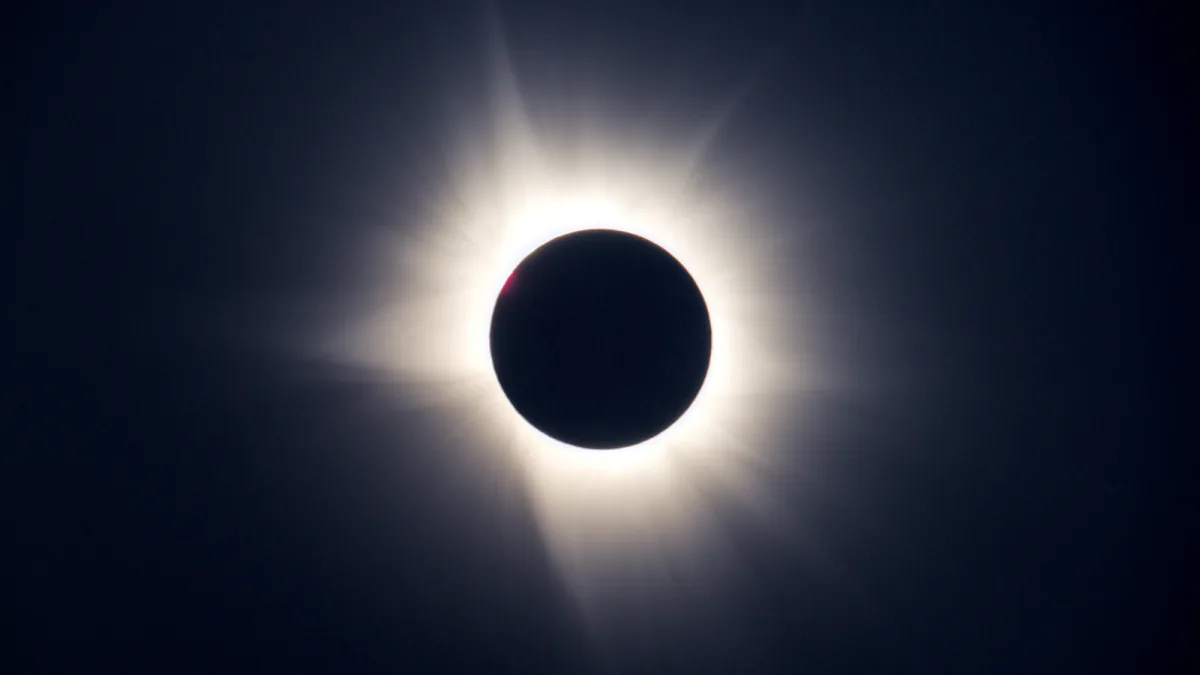
The dark lunar disc and pale corona in Victor R. Ruiz’s photograph are an immediate record of the August 12, 2026 eclipse from Molina de Aragón, Spain. But the scientific significance of that day extends beyond the appearance of the Sun in a single frame.
In its August 21 follow-up, NASA described observations collected from its research jet and balloon campaigns, with analysis to follow. The useful distinction is between having captured data and having established a result. This article explains what the different measurements can test; it does not announce that the eclipse has settled the questions it was used to investigate.
The corona is more than a bright halo
The corona is the Sun’s outer atmosphere. During totality, the Moon hides the much brighter solar surface, making faint surrounding structures easier to observe. NASA’s science overview connects this observing opportunity to questions about how energy moves through the corona and how the solar wind accelerates.
The puzzle is not simply why a photograph looks white around the edges. Researchers want to understand heating, moving material and the relationship between structures at different scales. An attractive outline is a starting point, not a thermometer or a three-dimensional map.
Nor is a natural eclipse the only way to study this region. Coronagraphs use an artificial obstruction to suppress bright sunlight. What matters is the region, wavelength and interval a particular instrument can observe, together with the unwanted light that remains in its measurements.
What each observing method contributes
| Observation | What it contributes | Essential limitation |
|---|---|---|
| A ground photograph | A documented view of the eclipse from a particular place and time. | A processed frame alone does not establish temperature, density or motion. |
| WB-57F aircraft | Access to visible and infrared views with less interference from the lower atmosphere. | Each camera still has a specific response, exposure and observing window. |
| Scientific balloons | Measurements of Earth’s atmospheric response, alongside views of the moving shadow. | A shadow video is not itself a measurement of the corona. |
| Proba-3 in space | A natural eclipse superimposed on its artificial one, useful for optical calibration. | Its viewing geometry and eclipse duration differ from those on the ground. |
NASA’s flight account says the WB-57F operated at about 50,000 feet, above much of the cloud, dust and water vapour affecting ground observations. Some infrared wavelengths become accessible there because less absorbing atmosphere lies above the instrument. Flying higher changes which signals can be recorded; it does not automatically make every conclusion more certain.
Time, wavelength and polarization are different kinds of information
A sequence can reveal change that a still image cannot. NASA’s pre-flight description of the SAMI camera system specified several visible and infrared bands and a target of at least 20 images per second. That number describes the planned acquisition, not a verified count of usable frames recovered from this flight. A faster sequence is useful only if its exposures contain a measurable signal.
Polarization adds another kind of information: the orientation of the light’s oscillation. In the separate CATE 2024 experiment, purpose-built cameras measured four polarization angles across the corona. Coordinating ground sites also extended the observing sequence beyond the brief totality available at one location. This is an earlier example of measurement design, not evidence that Ruiz’s 2026 photograph contains those polarization data.
Scientific interpretation: more pixels, more frames and more wavelength channels are not substitutes for one another. Before comparing two eclipse images, ask which physical quantity each records. Otherwise, differences in instrument response or processing can be mistaken for differences in the Sun.
A concrete 2026 result: using the Moon to check an instrument
ESA’s August 14 account reports that the Moon covered the solar disc in Proba-3’s view for 8 minutes 40 seconds on August 12, while the spacecraft maintained their artificial eclipse. This was a space-based geometry, not the duration experienced by the photographer in Spain.
The extra occultation suppressed unwanted light associated with diffraction at the spacecraft’s occulting edge. ESA says this gave researchers a way to calibrate ASPIICS’s optical performance. That is a concrete use of the event: learning how much of an instrument’s signal belongs to its optics rather than to the target.
Earlier ASPIICS research, posted as a preprint in November 2025, had already reported observations of coronal structures and inward and outward flows. Those results establish research context; they must not be relabelled as discoveries made during the August 2026 eclipse.
How an eclipse can test a prediction
NASA’s post-event comparison places a prediction beside a processed composite assembled from observations near León. The Predictive Science project explains that its evolving model incorporates measurements of the Sun’s surface magnetic field. It also shows different viewing orientations and uses display processing to make coronal structure visible.
Lumacta’s reading guide: a meaningful comparison needs more than a visual resemblance. These are questions to ask of a reported validation, not a new score calculated here.
- 1 · Fix the prediction
Which version existed before the observation?
Keep its timestamp and input data. A model updated after the event can be informative, but it is not the same test as a prediction frozen beforehand.
- 2 · Compare like with like
Match the view and the measured quantity
Align orientation and scale, and state the exposure and processing. A display adjusted for visibility is not automatically a calibrated brightness map.
- 3 · Report the disagreement
What matched, and within what uncertainty?
Define the feature or quantity being assessed and show residual differences. Do not convert a persuasive side-by-side picture into an accuracy percentage.
Why the work matters after the spectacle
Understanding the corona helps build the physical account of the solar wind and eruptions. SwRI’s explanation connects this work to space-weather effects on satellites, power systems, communications and navigation. It does not follow that one eclipse image can forecast a disruption at Earth.
There is also a different experiment beneath the shadow. NASA’s balloon-campaign plan proposed comparing the atmosphere before, during and after the temporary loss of sunlight, including questions about the near-surface boundary layer and ozone. The later agency report confirms balloon observations, not a quantified 2026 answer to each of those questions.
Lumacta’s assessment: the photograph earns attention; the measurements make that attention useful. The strongest follow-up will identify its dataset, calibration, comparison method and uncertainty. Until then, the accurate story is an opportunity being investigated, with a documented instrument-calibration example—not a claim that a beautiful frame has solved solar physics.
About the photograph
The Commons record attributes the existing image to Victor R. Ruiz and describes a single 0.5-second exposure with a Canon R7 and Askar 65PHQ telescope, processed in Darktable and GIMP. Lumacta retains its credited CC BY 4.0 crop and resize. No new image edit or analysis of a RAW file was performed for this revision.

This article is not an observing or camera-setup tutorial. For future eclipses, follow NASA’s safety guidance; ordinary sunglasses do not protect your eyes when viewing the Sun.
Sources & Methods
Documentary review on September 23, 2026. Agency plans are distinguished from post-event reports; CATE 2024 and the November 2025 ASPIICS preprint are explicitly earlier context. The research-paper citation is based on its abstract and record, not a reproduced analysis. Commons and the original Flickr item were rechecked, including the attribution and CC BY 4.0 marker. The existing photograph, derivative and credits are retained, with no new image processing or claim of renewed RAW-file authentication. The comparison table and three-step reading guide are Lumacta’s synthesis, not measured results or an expert interview.
- NASA: the August 2026 eclipse — Event geometry and observing-safety guidance; the page retains pre-event wording.
- NASA: views and observations after the eclipse — August 21 report of collection, balloon flights and the image/model comparison; not a final science-results paper.
- NASA Johnson: the WB-57F science flight — August 26 account, updated August 28; altitude, atmospheric interference and infrared access.
- NASA: eclipse science — Background on the corona, solar wind and Earth’s atmosphere.
- NASA: planned 2026 investigations — July 27 campaign plan, updated July 30; instrument goals are not assumed achieved.
- ESA: a double eclipse for Proba-3 — August 14 account of the August 12 observation and optical calibration.
- Zhukov and colleagues: first ASPIICS results — November 3, 2025 arXiv preprint; abstract used as earlier research context, not a result from the 2026 eclipse.
- Predictive Science: 2026 corona prediction — Model inputs, changing predictions, display orientation and processing.
- SwRI: CATE 2024 and airborne experiments — April 22, 2024 account; example of multi-site polarimetric observing, not the 2026 campaign.
- Wikimedia Commons: Victor R. Ruiz’s eclipse photograph — Current image attribution, creator’s exposure description and licence record.
- Victor R. Ruiz: original Flickr item — Original source rechecked; exposure description, attribution and CC BY 4.0 marker.
- Creative Commons Attribution 4.0 — Existing image-licence link retained with credit and crop/resize notice.