
A moving pattern, not ten solid sides
The useful question is not whether Saturn has acquired a geometric object. It is what a changing pattern in its atmosphere can reveal about the flow beneath it. A shape can be recognisable while the material passing through it continues to move.
The original paper reports a ten-sided southern wave and contrasts it with the established northern hexagon. These are atmospheric structures. Their resemblance is a reason to compare evidence, not permission to assume the same age, stability or cause.
Observation date is not discovery date
The study looks back across several observing seasons. That matters because an archive can reveal a feature that was not initially recognised as the main subject of an image.
- 2023 · Earlier evidence
Fainter structure in the archive
The paper identifies weaker features in the October 2023 Hubble observations. This establishes evidence by that date, not the exact day the wave formed.
- 2024–2025 · Clearer structure
The pattern becomes easier to identify
The ESA/Hubble account describes ground-based recognition in 2024 and a stronger signal in 2025. The paper’s Hubble series includes August 2024, August 2025 and September 2025 observations.
- September 2, 2026 · Publication
The results are reported
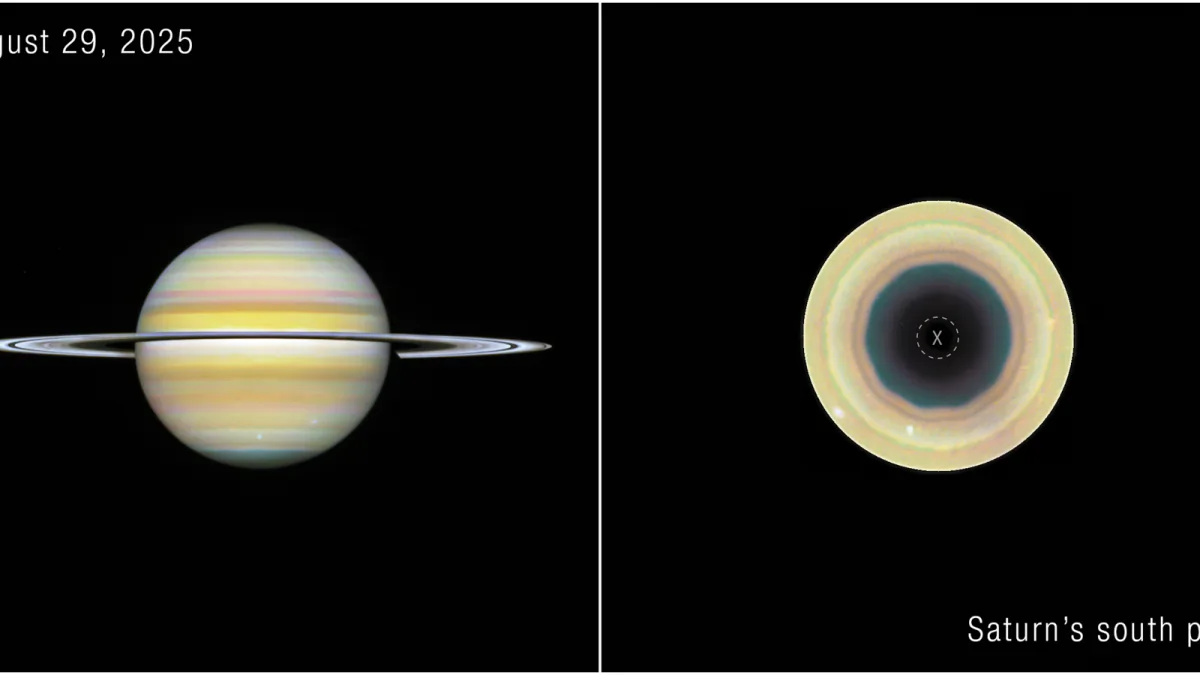
This is the study’s publication date, not the acquisition date of every photograph. The main image accompanying this article was taken on August 29, 2025.
Dates: paper, pages 1 and 6, science release and image record. The sequence is an editorial guide, not continuous monitoring.
How to read the picture without overreading it
The official image record pairs a view of Saturn with a polar projection. Its X and dashed circle mark missing data. They do not indicate a physical hole, a newly discovered object or an empty part of the atmosphere.
A projection changes how a curved surface is displayed, not where a telescope has actually collected evidence. Likewise, a clearer outline does not by itself tell us whether the wave has grown stronger or has become easier to see. Viewing geometry and image contrast need to be considered alongside physical change.
The researchers describe contrast enhancement and map projections in their methods. They also report different precision for locating vertices: roughly ±1° in Hubble images and ±2° to ±3° in the ground-based images used for that purpose. Those are positional limits in the paper, not uncertainty bars for every claim in the article. A visually sharp boundary should not be mistaken for an infinitely precise measurement.
The wave is much slower than the jet
On printed page 4, the researchers report the pattern’s eastward motion at 63°S as 2.5 ± 0.2 metres per second, relative to Saturn’s System III rotation reference. The jet’s peak, at a different latitude of 60.5°S, is reported as 116 metres per second. These are not two measurements of the same object at the same place.
The first follows the pattern’s vertices; the second describes the wind profile derived from tracking atmospheric features. Think of a familiar distinction: the progress of a queue does not tell you how quickly every person moves within it. That is only an analogy, not a model of Saturn, but it helps explain why “the decagon’s speed” and “the wind speed” cannot be swapped in a headline.
Both values come from the authors’ analysis. We have not reprocessed the images or independently reproduced their measurements. In particular, the jet’s maximum must not be presented as the speed of the decagon’s corners.
Three levels of evidence that should stay separate
| Evidence | Reasonable reading | Not established |
|---|---|---|
| Repeated images | A changing, recognisable southern pattern across the observing series. | Its exact birth date or future lifetime. |
| Different wavelength bands | A clue that the visible structure samples different atmospheric levels. | A direct, complete three-dimensional scan of the wave. |
| Simplified simulations | Candidate ways that a disturbed jet or nearby vortex could produce a periodic pattern. | Proof that one simulated pathway created the observed feature. |
The wavelength-dependent appearance is evidence for a vertically structured phenomenon in the authors’ interpretation. But their exploratory shallow-water model is a single-layer simplification: it does not include vertical motion, stratification or thermodynamics. An atmospheric-depth inference and a model that omits that depth are different pieces of the argument, not interchangeable confirmations.
A similar shape is not yet a solved mechanism
The paper tests disturbances in the jet, the influence of a nearby anticyclonic vortex and an imposed wave. Some simulations generate periodic structures but move faster than the observed decagon. That mismatch is scientifically useful: reproducing an outline is only one test of an explanation.
Our reading is that a stronger model should be judged against several properties together: the location of the pattern, its movement, its variation with wavelength and its evolution over time. Selecting only the most attractive matching image would hide the harder questions. This is an explanation of how to read the evidence, not an independent validation of the researchers’ code.
The northern hexagon’s long observational history supplies a valuable comparison. It does not give the southern decagon the same lifetime by analogy. Six sides versus ten is the visible distinction; stability, motion and the conditions that sustain each wave are the more consequential ones.
What a useful follow-up would need to show
For readers, the next meaningful result is more than another striking image. Look for comparable measurements across later observations, a clear account of viewing and processing differences, and models that explain motion as well as shape.
The present evidence supports a changing atmospheric pattern worth studying. It does not justify a claim that Saturn’s weather has been “solved”, that the southern wave will last for decades, or that a particular vortex is certainly responsible. Keeping those questions open is part of the finding, not a weakness to conceal.
Sources & Methods
Documentary scientific explanation, not independent research. We read Sánchez-Lavega and colleagues, Science Advances 12, eaee4251 (2026), DOI 10.1126/sciadv.aee4251, in the open university-repository PDF. Printed pages 1–4 support the observations and motion; pages 5–7 support the simulation and measurement limits. The supplementary files, raw observations and simulation code were not independently rerun. The comparison and evidence checklist are LUMACTA’s synthesis. No researcher was interviewed.
- Sánchez-Lavega et al. — full research paper — Open repository copy, CC BY 4.0; published September 2, 2026; printed pages 1–9
- ESA/Hubble — science release — Announcement and ground-based discovery context
- ESA/Hubble — exact image record — August 29, 2025 image, processing credits and missing-data annotation
- NASA Cassini — northern hexagon background — Historical comparison, not a new southern observation
- ESA — Hubble tracks new decagon — agency release and licence record
- NASA — Hubble tracks Saturn's south-pole decagon — mission release