
A new image release is not a new census
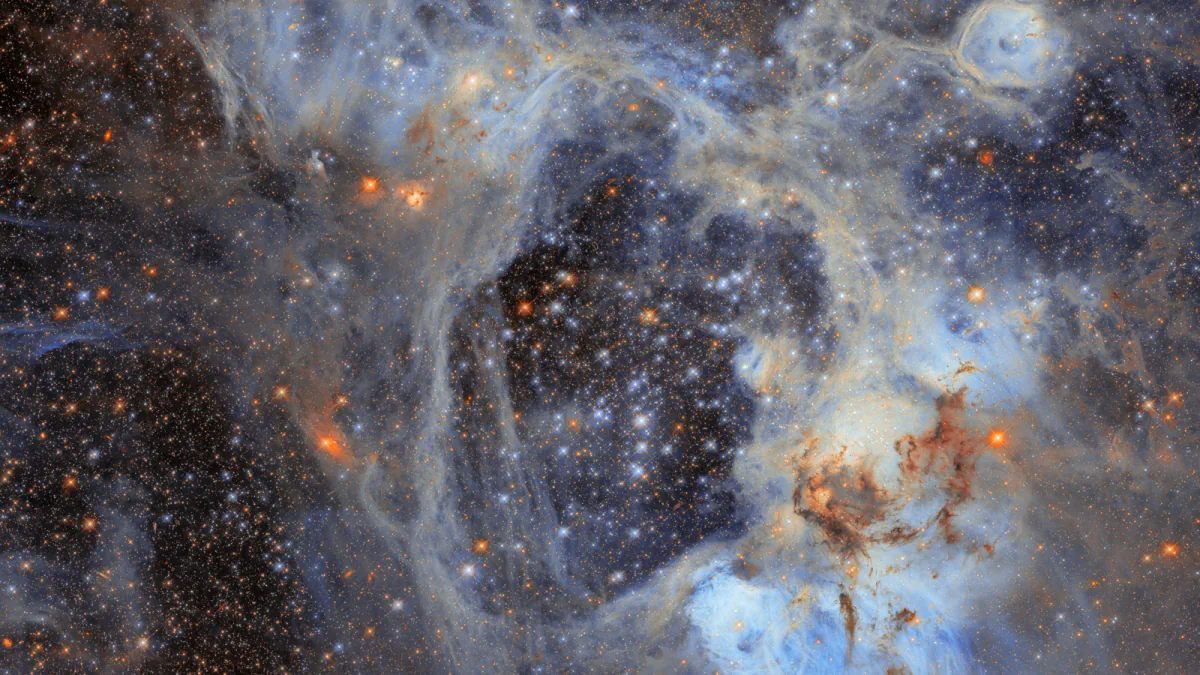
The September 3 ESA/Hubble release shows the star-forming complex N44 in the Large Magellanic Cloud, roughly 160,000 light-years away. Stellar winds and past supernovae have shaped its large central cavity. The photograph makes that environment visible; it does not, by itself, count or date every star.
The distinction in timing is just as important. The MYSST archive lists a March 29, 2021 data release, and the two linked research papers were revised that March. The September 2026 public image should not be presented as the discovery of a newly counted half-million stars that month.
Three numbers, three different meanings
| Quantity | Source and meaning | Reading to avoid |
|---|---|---|
| 461,684 catalogue entries | Paper I: the photometric catalogue across the surveyed field and reference fields. | Every entry is a young star physically inside the central bubble. |
| About 26,700 candidates | Paper II: candidates selected with a reported PMS probability above 95%. | Each star’s internal state was directly measured. |
| About 210 × 140 light-years | Image release: the dimensions quoted for the central cavity. | This is the size of the complete survey footprint. |
The image’s public description rounds the young population to nearly 30,000. The research paper specifies a high-probability selection. Those levels of precision should remain attached to their sources rather than be treated as competing measurements made on the release date.
From detector measurements to a young-star candidate
- 1 · Observe
Measure light through filters
The observations use Hubble’s ACS and WFC3/UVIS with the F555W and F814W broadband filters. These are measured light bands, not a direct reading of stellar age.
- 2 · Record
Keep the measurement and its uncertainty together
The MAST catalogue documents positions, magnitudes, measurement errors and quality information, including crowding and signal-to-noise.
- 3 · Infer
Classify using a trained model
Paper II combines support-vector-machine and random-forest predictions to select pre-main-sequence candidates. A selected class is an inference, not another detector measurement.
- 4 · Compare
Ask where the candidates occur
The paper then examines their spatial clustering. A pattern can motivate a physical explanation; it does not alone establish a cause.
Reading guide based on Paper I, MAST documentation and Paper II. This is a conceptual workflow, not a new analysis of the catalogue.
Why “candidate” is scientifically important
Paper II explains that young and older populations overlap in the colour–magnitude diagram, with dust and other effects complicating classification. Its models learn from a carefully selected subset of the observations. The quoted probability threshold describes that classification procedure; it is not a measurement of fusion occurring inside each star.
Paper I separately studies extinction—the alteration of the observed light by intervening material. That is why an attractive red patch or a faint point in the published picture cannot serve as a simple age label. The underlying measurement and its interpretation are different products.
How to read the public data documentation: MAST lists fields such as f555w_mag, f814w_mag and their measurement errors. These describe photometry. The documented photometric table is not itself a list of confirmed young stars, and its listed columns should not be confused with Paper II’s classifier output.
Does the bubble cause new stars to form?
The image release describes how stellar activity can sweep up gas and compress surrounding material. It offers a physical reason to investigate star formation around the rim. It does not show the sequence unfolding over time in a single exposure.
Scientific interpretation: finding young-star candidates near a shell makes a triggered-formation scenario testable, not automatically proven for every object. A convincing causal account must connect the proposed mechanism to the ordering of events and the relevant gas and stellar populations. “They are close together in the image” is a weaker statement than “this event caused that star to form”.
This distinction is useful beyond astronomy. A detailed image can reveal where a question should be asked; a catalogue makes the question measurable; a model supplies an interpretation that still has assumptions. Combining those stages is powerful. Collapsing them into a single claim hides the scientific work.
What to take away from the photograph
The credited Hubble image remains the visual starting point, with processed filter observations rather than a naked-eye view. The stronger story is not just that the scene is beautiful: its underlying measurements can be documented, reused and challenged.
Read the full-survey count as a census of measured sources, the young-star count as a selected candidate population and the cavity dimensions as a description of one structure. That gives the picture a scientific meaning without asking it to prove more than it can.
Sources & Methods
Documentary research checked September 23, 2026 using the ESA/Hubble release, MAST catalogue documentation and MYSST Papers I and II, including the latter’s methods. The workflow is a Lumacta explanation of those sources, not a new measurement or reproduced experiment. No catalogue download, model rerun, spectroscopic confirmation or researcher interview was performed.
- ESA/Hubble: N44 image and release information — Image released September 3, 2026; image scope and attribution.
- NASA: Hubble superbubble account — Public explanation of the image; not a separate new stellar census.
- MAST: MYSST data archive — Released March 29, 2021; survey footprint, catalogue columns and data provenance.
- Ksoll and colleagues: MYSST Paper I — Photometric catalogue, observational scope and extinction analysis; revised March 2021.
- Ksoll and colleagues: MYSST Paper II — Machine-learning candidate selection and spatial analysis; revised March 2021.
- ESA/Hubble — Usage of images and videos — CC BY 4.0 reuse terms