
The new result is a device, not a thinking machine
A research team at MIT has reported a nanoscale device that responds to repeated stimulation in a neuron-like way. The study, published online in Science Advances on September 16, 2026, uses the time-dependent mechanical behavior of a thin polymer film to process information. That is a different approach from making a conventional processor run a software model of a neuron.
The publisher-deposited abstract describes an artificial-neuron demonstration and projects potential energy-efficiency advantages. It does not establish that a complete computer has beaten biological intelligence or modern AI accelerators. The distinction matters: a promising physical operation is one ingredient of a machine, not a measurement of everything that machine would need to do.
For readers following the search for less power-hungry computing, the interesting question is therefore narrower and more useful. Can the material itself perform part of a calculation that would otherwise require additional electronic components? This work offers a research route to investigate that question.
Sources: MIT: nanoscale mechanics and brain-inspired computing (September 16); Science Advances: viscoelastic nanomechanical devices; Publisher-deposited abstract and dates via Crossref
A material that keeps a temporary trace of the past
MIT's explanation describes a soft polymer called PDMS between metal electrodes. Applying voltage pulls the electrodes together and compresses the material, changing the current. Because the polymer is viscoelastic, its recovery is not instantaneous. What happens now depends partly on earlier stimulation. With suitable conditions, the response accumulates toward a threshold, produces a neuron-like event and then relaxes.
Think of it as a component with a short-lived physical history. This analogy is about timing and response, not conscious memory. It does not remember a photograph or know what a sentence means. Information can nevertheless be represented in when a response occurs and how earlier inputs change that response.
The research abstract describes an electrically adjustable tunneling junction and control at subnanometer scales. Its larger conceptual contribution is to treat motion and material relaxation as useful elements of computation rather than merely mechanical complications. Turning that concept into a useful circuit will still require decisions about encoding, readout and how one device communicates with another.
Sources: MIT: nanoscale mechanics and brain-inspired computing (September 16); Science Advances: viscoelastic nanomechanical devices
Brain-inspired hardware has more than one possible route
Neuromorphic computing is not a single material or a single product category. An earlier NIST experiment, reported in January 2018, used superconducting hardware to make an artificial synapse: a connection whose response could be adjusted. That device relied on a Josephson junction and magnetic nanoclusters, not MIT's new polymer mechanism.
The distinction between a neuron and a synapse is also important. One concerns the behavior of a signaling unit; the other concerns a connection between units. A usable network needs a way to coordinate both signal generation and communication. Demonstrating one biological analogy does not demonstrate every function of a biological nervous system.
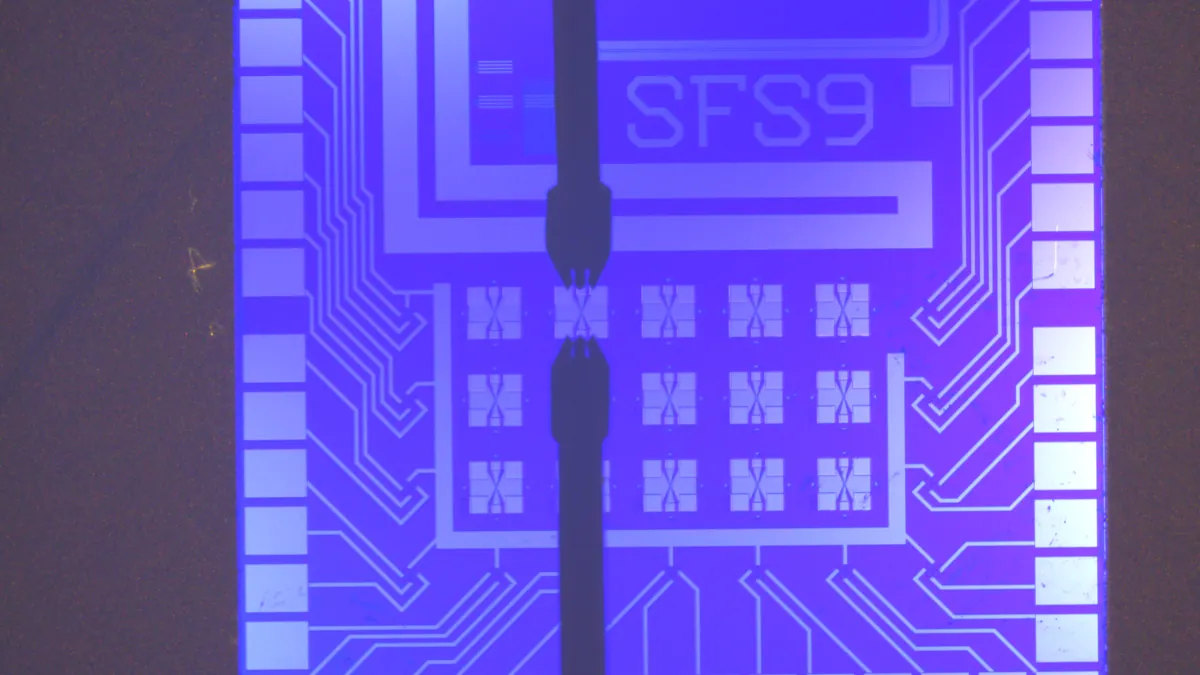
The archive micrograph accompanying this article shows the earlier NIST work, not the September 2026 MIT device. It illustrates the broader field and is labeled accordingly. These different research directions should not be ranked by comparing isolated headline numbers: operating temperature, supporting equipment and the function being measured may be very different.
The connections can be as important as the components
NIST's separate 2022 research on superconducting optoelectronic synapses highlights a second challenge: communicating between many artificial neural elements. Its researchers demonstrated a circuit in which individual photons could trigger a superconducting response. They also described further integration work needed to bring multiple components together.
That historical example does not validate the new MIT design. It shows why a field full of impressive component demonstrations still needs difficult systems engineering. A useful computing architecture has to move signals, preserve the information that matters and avoid spending all its savings on the infrastructure around the clever element.
For the polymer approach, meaningful next tests would therefore connect devices into networks and measure a real task. An evaluation should include the energy used to supply inputs, read outputs and control the circuit. It should also explain how many devices work as intended and whether calibration must be repeated. These are questions for future evidence, not defects that Lumacta has measured in the prototype.
Sources: NIST: communicating between artificial neural elements (2022)
Scientific perspective: measure useful work, not just a spike
Lumacta's evidence-based assessment is that the result is most interesting as a materials-and-device advance. A physical component can be valuable without behaving like an entire brain. The strongest follow-up would identify a task where the device's natural time dependence is helpful and compare it with a conventional solution at the same accuracy and response time.
Consider a hypothetical sensor that must distinguish a brief disturbance from a repeated pattern. A component with a temporary response history might help process such signals near their source. But that possibility needs a demonstrated circuit and a representative input stream; the analogy alone cannot establish battery-life savings.
We would also want repeatability across many devices, behavior over repeated operating cycles and sensitivity to changing conditions. A particularly efficient example is less informative if a production process cannot reproduce it reliably. This is editorial analysis of the evidence and the evaluation questions it raises, not an independent peer review, an expert interview or a laboratory replication.
Sources: MIT: nanoscale mechanics and brain-inspired computing (September 16); Science Advances: viscoelastic nanomechanical devices; NIST: communicating between artificial neural elements (2022)
Why it matters—and what it does not promise
The possible benefit is a wider choice of ways to build specialized electronics. If a physical device eventually performs a useful local computation with fewer supporting components, designers could gain flexibility in how they allocate space, power and processing. That would be relevant to compact sensing and adaptive machines, but it remains a conditional engineering opportunity.
There is no basis here for claiming that laptops will soon abandon silicon, that an artificial neuron is conscious, or that this experiment has solved AI's electricity demand. Such conclusions jump from a small demonstration to an entire industry without the intermediate evidence.
The sensible reading is more encouraging than a dismissal and more restrained than a breakthrough slogan. Researchers have shown another way for matter to participate in information processing. The next important milestone is not a more dramatic metaphor; it is a reproducible, integrated system completing a well-defined task. Until then, this is research to watch, not a product to buy.
Sources: MIT: nanoscale mechanics and brain-inspired computing (September 16); Science Advances: viscoelastic nanomechanical devices
Sources & Methods
Checked September 20, 2026. News event: September 16. We examined MIT's report and the publisher-deposited abstract and bibliographic record through Crossref; the complete Science Advances paper was not accessible in this check. The NIST studies are dated historical context, not independent confirmation of MIT's result. Scientific perspective is editorial analysis.
- MIT: nanoscale mechanics and brain-inspired computing (September 16) — Primary institutional announcement
- Science Advances: viscoelastic nanomechanical devices — Original study; publisher abstract and metadata checked
- Publisher-deposited abstract and dates via Crossref — Primary publisher metadata; not a separate experiment
- NIST: superconducting artificial synapse (2018) — Historical research context
- NIST: communicating between artificial neural elements (2022) — Historical systems-engineering context