
A research result with a deliberately chosen destination
Rutgers’ October 9 account describes an experiment using up to 100 connected qubits on IBM’s Heron processor. This is a physical-qubit count, not a claim of 100 error-corrected logical qubits. The result concerns controlling a deliberately programmed system, rather than demonstrating a general-purpose fault-tolerant computer.
Our scientific reading begins with the destination. A controller can be excellent at bringing a system into one selected condition. A memory has a different obligation: retaining whichever information someone entrusted to it. Calling both tasks reliable would conceal the most important distinction in this story.
The achievement is worth examining on its own terms. For a reader, the useful question is what behavior the experiment produced and how that behavior was evaluated. It does not need an unsupported claim that all the remaining difficulties of quantum computing have disappeared.
Source notes: 1, 2. Editorial interpretation and illustrative calculations are identified separately.
Measurement is part of the action, not a passive inspection
The author manuscript describes a competition between scrambling operations and local measurement-conditioned resets. A reset leaves a selected qubit in the zero state; repeated control attempts steer the system toward an all-zero target.
For our interpretation, that difference determines the question to ask next. Are we trying to prepare a known starting condition, keep a chosen observable within bounds, or preserve information that may initially be unknown? Each objective needs its own success criterion. Evidence for one cannot automatically certify the others.
This is not an argument against resetting. A destructive operation can be exactly the right operation when preparation is the objective. The mistake would be judging a preservation task with a preparation metric. Define the information that must survive before celebrating how consistent the final output looks.
Source notes: 3. Editorial interpretation and illustrative calculations are identified separately.
A repeatable answer need not retain the original information
Consider an original, entirely classical teaching example. A rule accepts a bit and always outputs zero. Give it two equally weighted cases: one input is zero and the other is one. Both outputs are identical, so its output is perfectly repeatable in this simplified exercise.
But if the task is to retain the input, only one of the two cases is correct: 1 ÷ 2 = 50 percent. If the task is instead to prepare zero, both cases meet that target. The rule has not changed; the question and the scoring rule have.
This arithmetic is not a simulation of qubits, a reconstruction of the reported circuit or a measurement of IBM’s accuracy. It isolates a logical distinction. Before interpreting a performance percentage, identify the allowed inputs, desired output and information the procedure is permitted to discard.
Original editorial teaching example. This classical calculation is not a result reported by the study.
A feedback operation has a time budget as well as a count
The manuscript’s experimental-details supplement notes that reset duration exceeds two-qubit gate duration. Counting operations alone therefore cannot describe the time cost of this particular feedback protocol.
Our proposed engineering checklist separates sensing, deciding and acting. Record the complete sequence, including waiting and communication, rather than reporting only the shortest component. If a decision arrives after the opportunity to act has passed, fast arithmetic inside the controller does not rescue the complete loop.
The same checklist asks whether interventions introduce additional disturbance and what happens when a measurement or decision is wrong. These are questions for a documented implementation, not claims that Lumacta measured this processor. Useful comparisons need the same objective and operating conditions, with time and error accounted for together.
Source notes: 3. Editorial interpretation and illustrative calculations are identified separately.
New publication is not the same thing as a new experiment
The journal publication is dated October 9, 2026; the arXiv record lists the first submission on September 22, 2025. We do not describe the experiment as having happened this weekend. The publisher links source data for Figures 2–4; the full experimental and simulation records and code are available by request.
Our evidence checklist keeps publication, access and reproduction separate. Reading an author’s methods helps us understand the claim. Obtaining the underlying records would support another level of scrutiny. Repeating the work with documented choices would support another still. None of those stages should silently substitute for the next.
A responsible follow-up would identify which observations distinguish the proposed explanation from alternatives, how uncertainty changes the conclusion and which details another team would need. We have not requested the dataset or rerun the circuit, so this article makes no independent validation claim.
Source notes: 2, 3. Editorial interpretation and illustrative calculations are identified separately.
Ask what survives, not only what becomes orderly
Our editorial conclusion is that this is a control experiment with a meaningful but specific objective. Future claims about information protection need to identify what was encoded, what was recovered and how the complete task compared with an appropriate reference—not merely show a more orderly final state.
Keep room for intermediate progress. A technique can improve one part of a future system without proving the entire system ready. Clear boundaries make an engineering result more useful because another researcher or reader can see what question it actually answers.
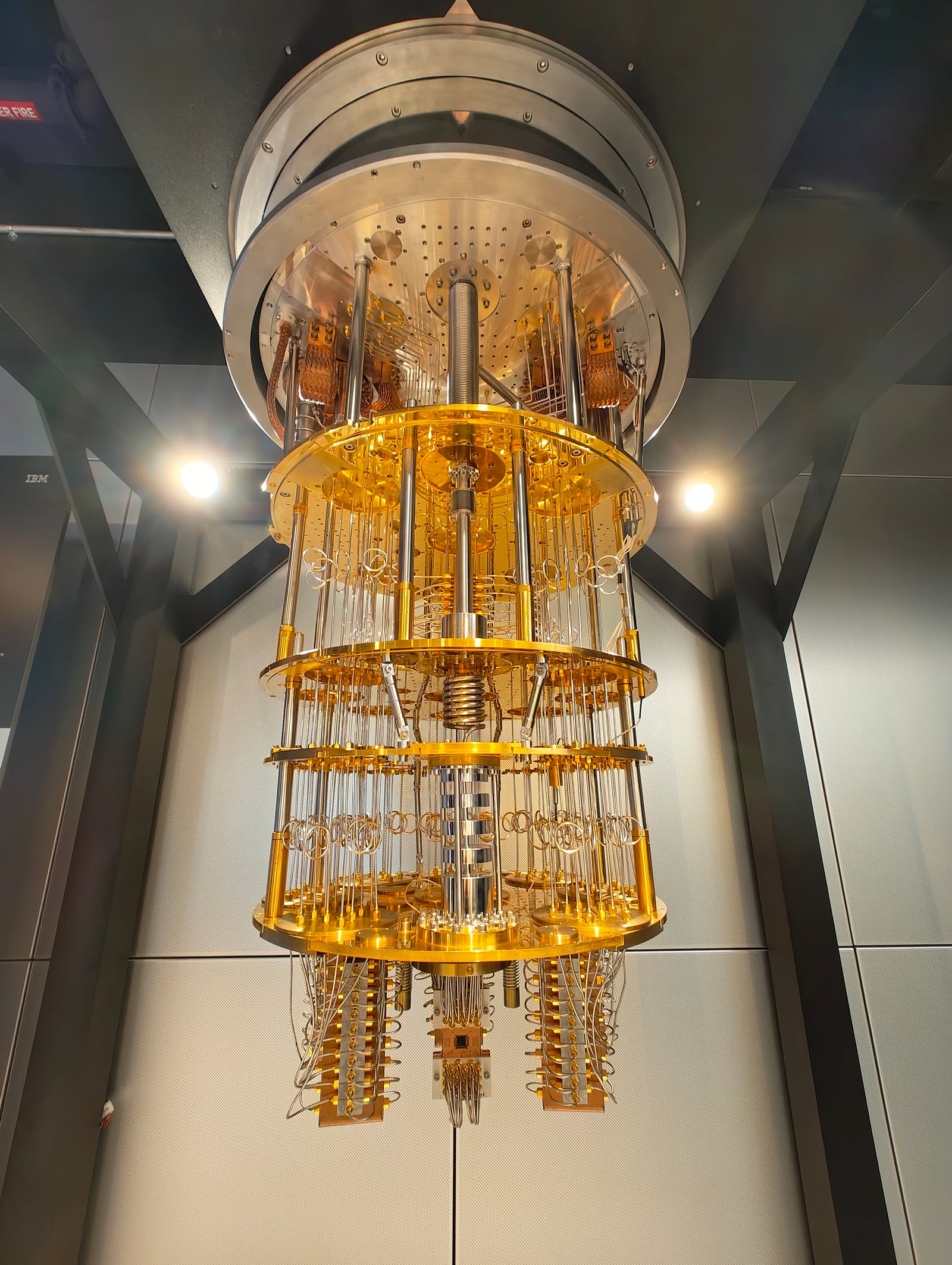
The accompanying real photograph shows an IBM Quantum System One in 2024, not the Heron experiment. It supplies archival hardware context. The scientific argument rests on the reported protocol and evidence, not on the appearance of a machine or a photograph’s dramatic lighting.
Source notes: 1, 3. Editorial interpretation and illustrative calculations are identified separately.
Sources & Methods
Prepared October 12, 2026. We read Rutgers’ complete account; the publisher-indexed public abstract, publication record and data/code availability statements; and the arXiv main manuscript through Methods plus its complete Device Specifications and Experimental Details supplemental sections. We checked the arXiv submission record. Direct journal access was unavailable; the full journal body and remaining mathematical supplement were not read. The classical two-input arithmetic and engineering/evidence checklists are original editorial explanations. No circuit, simulation, hardware test, dataset request or interview was performed by Lumacta.
- Rutgers: the experiment and its wider context — Primary institutional account, October 9, 2026; complete body read
- Nature Physics: Order from chaos with adaptive circuits on quantum hardware — Primary journal record, October 9, 2026; indexed public abstract and availability statements read, not full journal body
- Author manuscript: control protocol — Main text, Methods and supplemental sections I–II read; remaining supplement not read
- arXiv: submission history — Primary record; first submission September 22, 2025; abstract read