
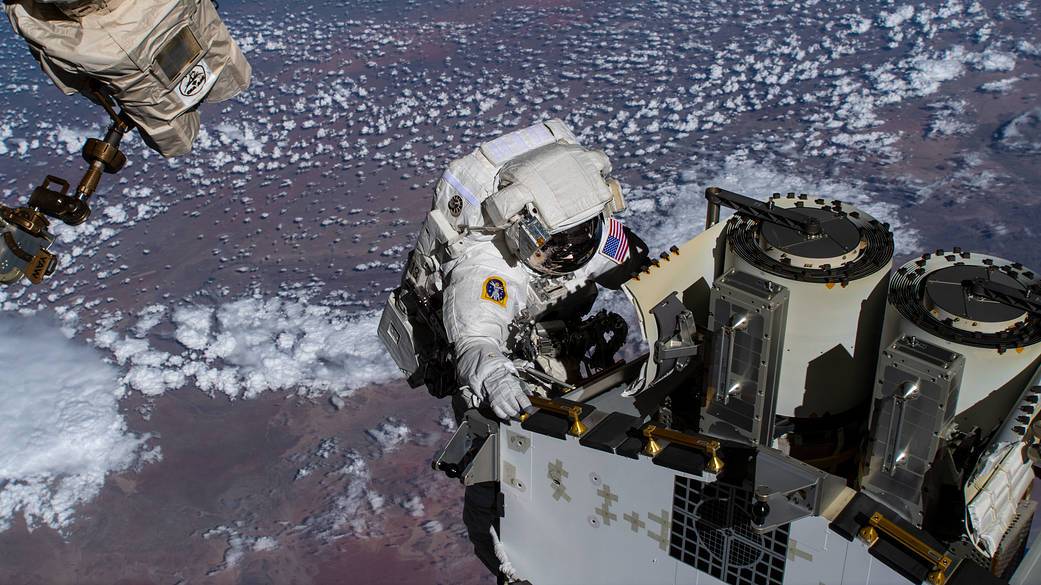
A spacewalk completed the installation campaign
Anil Menon and Joshua Kutryk installed and unfurled the eighth and final roll-out solar array on the International Space Station on November 5. NASA’s completion report places it on power channel 3B on the starboard side of the station’s truss. The excursion lasted six hours and 59 minutes. This was the final installation in the augmentation campaign, rather than a replacement of every original solar surface.
The Canadian Space Agency separately confirmed completion and described how the astronauts inside the station and controllers on the ground supported the work. Luke Delaney and Jessica Watkins operated Canadarm2, which helped move the hardware outside the station. Space.com independently reported the transfer from temporary stowage and the installation on a bracket already in place.
The sequence gives readers useful markers for what was completed. Getting a package to the right point on the truss solves a handling problem. Attaching it establishes the mechanical connection. Unfurling it puts the new collecting surface into its working geometry. A report can describe the successful end of those steps without giving a time series of how much electricity the station drew from the upgraded channel.
The original panels still have a role
NASA’s earlier design explanation describes a retrofit. The new, smaller collecting surfaces partially shade the larger original arrays and feed the existing power system. The exposed parts of the older hardware keep contributing. The station therefore gains capacity through the combination of the two generations of equipment.
Think of this as an upgrade to a working system with limits on where new hardware can go. Adding a new collecting surface changes the light reaching the older one. The net effect depends on what the new hardware adds and how much contribution the rest of the system retains. Adding an isolated panel rating to the full pre-upgrade station total would count some old output that the retrofit changes.
A successful retrofit also has to fit how the existing system is operated. The design question includes where to attach the equipment, how to move it to that position, and how to connect it to the station’s power distribution. The new hardware is easier to understand when its mounting and power channel are treated as part of the design.
Source notes: 3.
The roll stores the energy that unfurls it
NASA’s technology overview explains that the array’s composite booms store strain energy while rolled. Releasing the stowed assembly allows the booms to extend and support the solar blanket. Space.com’s account describes the crew releasing two bolts and the array reaching full length in about ten minutes.
The simple way to picture the mechanism is a spring held in a compact shape. The stored energy can do the work of opening it when released. The engineering challenge includes getting that motion to end in a stable configuration that can hold the collecting surface. An open array demonstrates deployment. Measurements of its electrical behaviour answer a separate question.
Packing geometry also matters. A component has to fit its launch envelope and be practical to handle once it arrives. A design that occupies little space on the way up but needs an elaborate installation can move work from the launch vehicle to the station crew. The handling steps during this spacewalk make that exchange visible.
Read the capacity figure in its operating context
NASA’s completion report describes the station’s power generation capacity as rising from 160 kilowatts to about 215 kilowatts with the upgrade. The figures are a station-level comparison. The report does not include a power trace for the final channel or a breakdown of what different systems drew during a full orbit.
Power and energy answer different questions. A kilowatt measures the rate of producing or using energy. Holding one kilowatt for an hour yields one kilowatt-hour. A capacity figure is therefore useful for comparing how much generating equipment can deliver under the stated conditions. It cannot be multiplied across an entire orbit as if sunlight and loads were constant.
NASA’s original design explanation separates daylight generation from the energy stored in batteries for periods without sunlight. That distinction matters to research as well as to station operations. An experiment that runs intermittently and one that needs continuous service can have the same peak draw while placing different demands on the station over time. A larger generating margin gives operators more room to plan around those demands. How they use it depends on the rest of the power system and its operating schedule.
What would show the benefit in service?
The next useful evidence would be an operational account that identifies the relevant channel, the conditions of the measurement and the period being compared. A check of output while the station is illuminated answers one question. A record covering the transition into darkness would help show how the batteries and the rest of the power system support changing loads.
A comparison also needs to hold the rest of the system in view. If two observations come from different attitudes relative to the Sun, different activity schedules or different equipment configurations, their difference can reflect several changes at once. A useful report would say whether it is comparing the array with its design target, the upgraded channel with its previous state or the whole station with its earlier operating margin. Those comparisons can all inform decisions, but each has a different baseline.
The completion reports establish that the hardware was installed and opened. For readers following the station, that closes the construction milestone and gives them a better question for future updates. Look for the conditions under which the added generating capacity becomes usable power, alongside the work or operating margin it supports.
Sources & Methods
We compared the NASA and Canadian Space Agency completion reports with NASA’s earlier descriptions of the retrofit and the roll-out mechanism. Space.com provided independent coverage of the work outside the station. The power-versus-energy examples are editorial explanations. Lumacta did not inspect station telemetry or measure output.
- NASA: final roll-out solar array installed — Primary completion report, November 5, 2026
- Canadian Space Agency: Kutryk’s second spacewalk — Primary partner-agency completion report, November 5, 2026
- NASA: design of the power retrofit — Primary pre-installation explanation, January 2021; original scope
- NASA: roll-out solar array technology — Primary technology overview for deployment mechanism
- Space.com: independent spacewalk coverage — Independent reporting by Robert Pearlman, November 5, 2026
- NASA archive photograph and caption — Primary source for the December 2022 archival photograph and its context
- NASA image and media guidelines — Primary guidance on factual editorial reuse