
IBM changes how it plans to pass 1,000 qubits
IBM is changing the shape of its next quantum computer. The company announced on November 11 that Nighthawk r3 is being designed around 520 programmable qubits, with a plan to connect two processors into a 1,040-qubit system in 2027. Each chip is intended to support computations containing 10,000 quantum operations. The two-chip system is a development target for 2027.
The interesting change is how IBM intends to reach that scale. As John Timmer reports in Ars Technica, its earlier roadmap envisaged connecting nine 120-qubit processors for a 1,080-qubit system. The new approach uses two much larger chips and arrives at a slightly smaller total. That shifts more of the scaling effort onto the individual processor, while inter-chip communication remains essential.
The extra hardware has a job
A programmable-qubit count describes only part of the machine. IBM lists 2,034 total physical qubits for r3, alongside those 520 programmable qubits and ten interconnects called l-couplers. The programmable count describes the qubits available for computation.
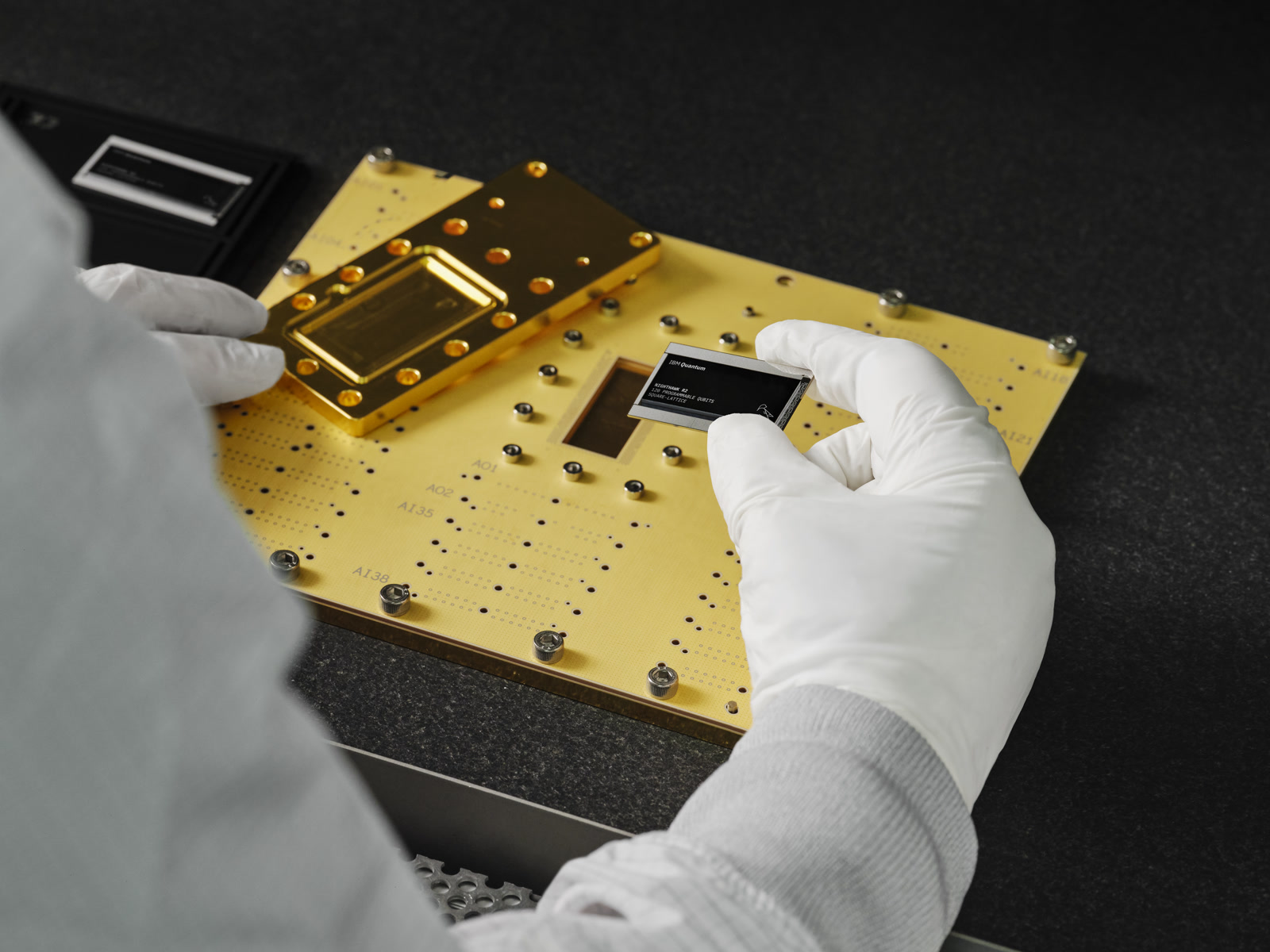
The existing Nighthawk r2 illustrates why. Its 120 programmable qubits sit alongside 218 couplers and 120 reset elements. IBM's technical description calls the complete set 458 physical quantum elements. Much of that machinery supports the qubits researchers actually program, helping control interactions and prepare the next calculation.
Resetting is especially consequential because a quantum calculation is usually repeated many times to collect measurement results. Waiting between repetitions becomes a substantial part of the job. On r2, a dedicated reset mechanism draws each programmable qubit back toward its starting state, reducing idle time between runs to as little as a microsecond, according to IBM. The purpose is practical: collect more useful samples within the time allocated to an experiment.
Faster experiments need a named comparison
IBM says customers and partners have executed more than 34 billion circuits on r2 and reported workload improvements of up to 19 times over earlier IBM quantum processors. Its conference update describes an Algorithmiq materials experiment running eight times faster than the original Heron version. Those comparisons measure particular workloads against earlier IBM quantum hardware.
For researchers, the useful question is whether faster execution buys more reliable results, more demanding experiments, or lower overall resource use. A headline multiplier needs that workload context. Circuit throughput, the duration of an entire experiment, and the cost of classical processing around it describe different parts of the same research pipeline.
Connecting chips is its own engineering challenge
IBM has already demonstrated links between two Nighthawk r1 processors using four connections, each with an 80-centimeter cable. Its October technical account reports average quantum-state transfer fidelity of 99 percent, with a best result of 99.3 percent. The experiment used full processor chips but wired out only a subset of their qubits for development.
The r1 demonstration tests one component the larger r3 system will need. IBM also identifies remaining work on connection error rates, reproducibility and the number of links that can be installed reliably. Those details matter when a laboratory demonstration becomes a larger machine that must operate repeatedly.
The surrounding refrigeration is changing too. IBM has joined two cryogenic modules and cooled them below 15 millikelvin. Their box-shaped design creates room for wiring and connections between neighboring modules, making the refrigerator part of the scaling architecture.
What would make the next milestone meaningful?
IBM's longer-term Starling target remains a fault-tolerant system in 2029. Its latest technical update describes parallel work on error-correcting codes, decoding, control electronics and modular cooling. Nighthawk’s programmable-qubit target measures a different capability from Starling’s goal of error-corrected logical qubits.
The next useful evidence will be the connected hardware running demanding workloads with documented accuracy and execution time. IBM has given researchers a more specific design to watch. Delivery, repeatable results and access to that system will determine how much the new route changes what they can actually compute.
Source notes: 7.
Sources & Methods
We checked the revised plan against IBM’s announcement, hardware posts and independent Ars Technica reporting. Speed and fidelity figures refer to the experiments and hardware identified by IBM.
- IBM’s November 11 Nighthawk announcement — Primary announcement
- John Timmer’s roadmap reporting for Ars Technica — Independent reporting
- IBM’s technical account of Nighthawk r2 — Hardware documentation
- IBM Quantum Developer Conference update — Primary technical update
- IBM’s Nighthawk r1 interconnect experiment — Hardware experiment
- IBM’s cryogenic-system demonstration — Primary engineering report
- IBM’s Starling progress update — Roadmap and technical update