
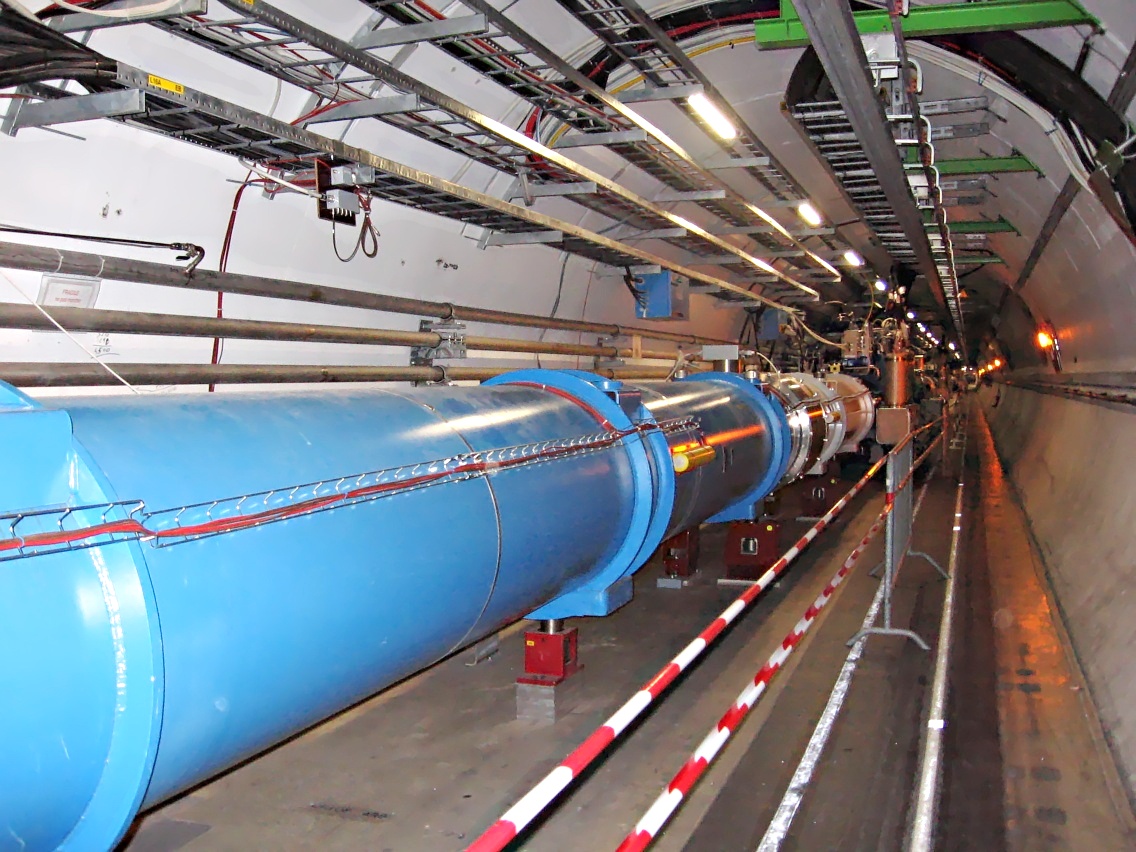
A signal assembled from several years of collisions
At a November 3 seminar at CERN, the LHCb collaboration presented evidence for a neutral B meson decaying into a muon and an antimuon. The upgraded experiment’s 2024 and 2025 data reached 3.0 sigma. Adding earlier LHCb data from 2011 to 2018 brought that figure to 3.2 sigma. The collaboration reported submitting the paper for publication on November 3. The arXiv record dates its preprint submission to October 30.
The result refers to a particular route by which a particle disappears and leaves other particles behind. The Standard Model puts the probability of this route at roughly one in ten billion decays of this kind of B meson. The denominator counts decays of the parent particle. An experiment that begins by colliding protons has to determine how many relevant mesons it produced and how many decays its selection could have seen.
Producing a parent particle, recording the particles it leaves behind and identifying a candidate are different steps. One way to read the result is as a chain of conditional questions. Was the relevant parent produced? Could the detector record the products? Would the analysis keep a genuine decay and reject a misleading lookalike? An increase in the first quantity helps the search, but the other steps still determine how much can be learned from the extra collisions.
Source notes: 1, 2, 3. Original editorial examples and interpretations are identified separately.
What 3.2 sigma says about the background
The quoted significance measures how surprising the signal-like excess would be under a background-only interpretation of the data. That is a question about a statistical model and the data used to test it. It is different from asking for the probability that the decay exists. Answering that second question directly would require assumptions that the significance figure alone does not supply.
Particle physicists commonly use three sigma for evidence and five sigma for a discovery claim. This result clears the former threshold. The distinction protects an important part of the scientific process. When the signal is small, researchers need time to check how much it depends on the way backgrounds are estimated and how consistently it appears as data accumulate.
Imagine two analyses that report the same significance. One examines a well-defined signal with a background that can be constrained from nearby parts of the data. The other searches many possible signatures with difficult-to-model backgrounds. The headline number by itself cannot tell readers whether the two cases have the same evidentiary weight. The search design and the treatment of uncertainty are part of the result.
Source notes: 1, 3. Original editorial examples and interpretations are identified separately.
More collisions help when the experiment can sort them
CERN says the upgrade raised LHCb’s data collection rate by a factor of five relative to its earlier running and improved particle identification. It also credits machine-learning methods with helping separate candidate decays from other processes. The collaboration reports 3.0 sigma for the new sample and 3.2 sigma across the combined sample. These figures describe overlapping evidence, because the combined result already includes the new data.
A higher acquisition rate increases the supply of potentially useful collisions. It also gives the analysis more material to sift. An illustrative example is a pair of tracks that looks like the intended muon pair until other measurements suggest that one track came from a different particle. Improving identification makes those cases easier to separate. Better selection matters alongside collecting more data, because a rare process can remain hidden if the analysis also admits too many lookalikes.
The right follow-up is therefore more specific than asking how many additional collisions were recorded. Ask whether the new sample tightened the uncertainty on the decay probability and whether plausible variations in the background description left the conclusion intact. These are editorial questions for evaluating future updates, rather than results from a separate analysis of the collaboration’s data.
Source notes: 1, 3. Original editorial examples and interpretations are identified separately.
Two similar particle names, two different benchmarks
The paper also reports improved measurements of a related neutral meson, Bₛ⁰, decaying to the same muon pair. Its decay probability and effective lifetime provide complementary tests. The collaboration says some models beyond the Standard Model could change a time-dependent quantity without noticeably changing the decay probability. Counting a decay and studying when it occurs can therefore test different features of a theory.
That companion result has a different history. LHCb and CMS jointly observed the Bₛ⁰ decay in 2015. Their analysis also gave evidence for the rarer B⁰ channel that later analyses did not confirm. The new result concerns the first evidence for B⁰ from one experiment. Sci.News independently reported the announcement and the separate treatment of the two channels. Its reporting draws on the same experiment and paper.
For the current result, LHCb finds agreement with Standard Model predictions within the reported uncertainties. That makes the measurement useful as a boundary on what an alternative theory could plausibly change. It also leaves open how far future data can reduce those uncertainties. The next useful comparison will show the updated probability, uncertainty and background assessment together, so readers can see whether the evidence strengthened and what the more precise measurement actually rules out.
Source notes: 2, 3, 4. Original editorial examples and interpretations are identified separately.
How to compare the next measurement
Start with the uncertainty around the measured probability. A narrower interval near the predicted value would give theory a more demanding test. A shift away from the prediction would raise different questions, starting with whether the shift survives changes in the analysis and whether other data support it. The same significance against background can accompany quite different answers to those questions.
Then ask which data are new. A larger combination can use earlier observations well, but it remains connected to those observations. A result from a separately collected sample would test whether the signal recurs under another set of conditions. Reading the sample description alongside the probability and the significance gives a clearer picture of what changed between announcements.
Source notes: 2, 3. Original editorial examples and interpretations are identified separately.
Sources & Methods
We compared the CERN seminar announcement, the collaboration’s account and the submitted preprint’s public record with Sci.News coverage. The collaboration supplies the experimental data. The comparisons and worked examples are editorial explanations. Lumacta did not reanalyse detector data or replicate the experiment.
- CERN: the November 3 result — Primary seminar announcement, November 3, 2026
- LHCb: technical result and measurement history — Collaboration account, November 3, 2026
- LHCb Collaboration: the submitted preprint — Primary preprint record and abstract; arXiv submission dated October 30, 2026
- Sci.News: coverage of the particle decay — Independent coverage, November 3, 2026