
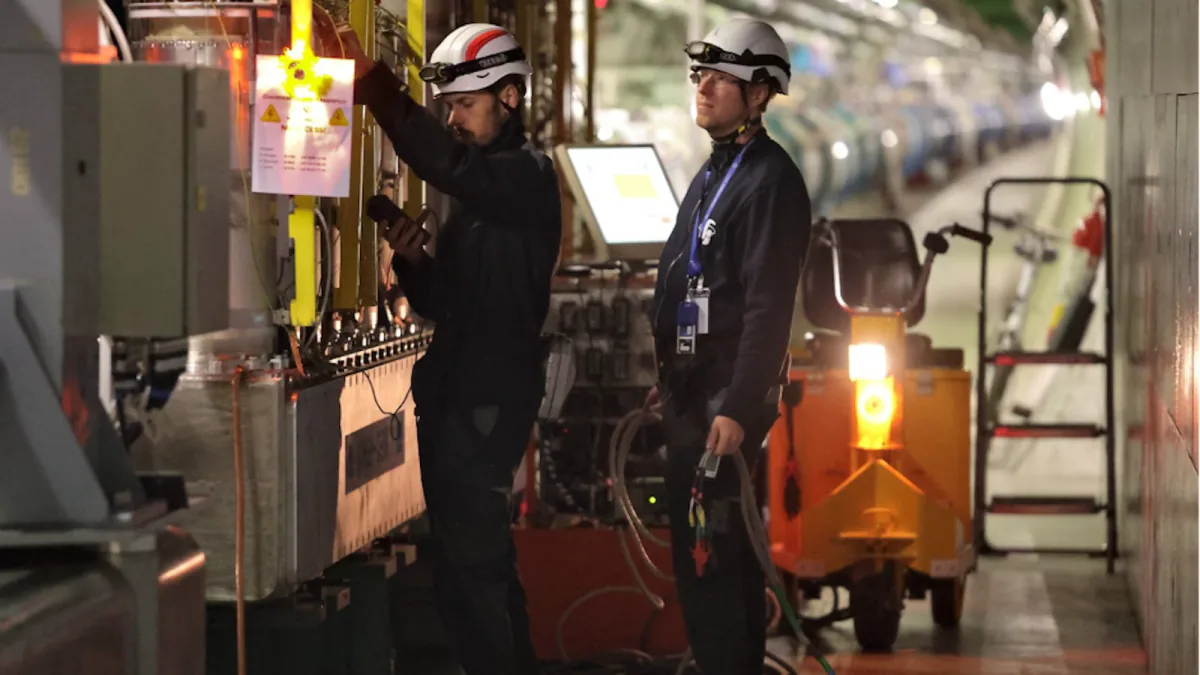
Why “tested” needs an object and a condition
A machine can pass one class of checks without being ready for its final job. In the LHC, that distinction matters because electrical integrity, controlled magnet powering and behaviour with beams are different questions. Calling all three “testing” can make an engineering update sound closer to completion than its evidence supports.
CERN’s September 3 account describes work on more than 1,600 superconducting electrical circuits in the 27-kilometre ring. It presents a programme, not a complete set of results. Read the sequence below as the announced work order, not a live progress indicator.
The three-phase shutdown map
- 01 · Establish the baseline
Cold → warm-up → room temperature
Test sectors under cryogenic conditions, monitor the warm-up and test again at room temperature.
- 02 · Support the interventions
Work alongside LS3 changes
Support four magnet replacements, repairs to 11 cold bypass diodes and new high-luminosity magnets around ATLAS and CMS.
- 03 · Check the return to cold
Before → during → after cool-down
Repeat sector checks across the cool-down sequence before moving to hardware commissioning.
Sequence: CERN. Diagram wording and layout: LUMACTA. No phase is marked complete here.
What this sequence helps engineers distinguish
CERN’s electrical-QA team description includes circuit diagnostics, simulation of shorts and other non-conformities, protection studies, bypass-diode work and long-term monitoring. That remit is broader than looking for a visibly damaged cable.
Our reading is that the timing of a measurement is part of its meaning. A record taken before an intervention and one taken afterwards answer a more useful question than an isolated result with no configuration history. Likewise, a check made in one thermal condition should not be silently described as evidence from every condition.
This does not identify a particular fault or establish its cause. The September announcement does not provide the measurements needed for that diagnosis. We therefore do not assign a failure rate, say that temperature caused damage or infer how much repair work remains.
A separate example shows what powering adds
CERN’s April 24 report on the Inner Triplet String offers a concrete comparison. The 95-metre test stand combines magnets, powering equipment, cryogenics, protection and alignment systems in 17 circuits. CERN described progressive powering after cool-down, first checking infrastructure and protection, then advancing to more complex circuits and higher current.
That is a different question from establishing electrical integrity: how do connected systems behave when brought into an operating regime together? The example explains the purpose of commissioning. It is not a claim that the entire LHC ring reached the same milestone, nor confirmation that every milestone projected in April subsequently happened.
| Milestone | Evidence to look for | Do not infer |
|---|---|---|
| Electrical QA | The circuits, configuration and conditions actually checked. | That every integrated operating mode has been commissioned. |
| Hardware commissioning | The powered systems, current regime and protection checks reported. | That beams are circulating or physics data are being collected. |
| Operation with beam | An explicit, dated operational announcement. | A stable production schedule from one initial beam milestone. |
This comparison is an editorial reading aid, not CERN’s acceptance specification.
The useful conclusion is narrower than a countdown
When the next update appears, ask three questions: what was checked, under which conditions, and what decision does that result support? If an announcement answers only the first, keep the other two open.
That discipline makes gradual progress easier to understand without turning every maintenance story into either a breakthrough or a delay. The engineering achievement lies in accumulating the right evidence for the next decision. The sources reviewed here do not justify a new restart date, a percentage-complete graphic or a declaration that all circuits have passed.
Sources & Methods
The three shutdown phases come from CERN’s September 3 update. The April 24 Inner Triplet String announcement is a separate, historical test-stand example, not evidence that the ring has completed commissioning. CERN’s engineering-team page supports the diagnostic and protection context. The evidence-reading checklist is LUMACTA’s interpretation. We did not visit CERN, obtain test logs or interview the team.
- CERN — electrical quality assurance — September 3, 2026: shutdown sequence and original documentary image
- CERN — Inner Triplet String powering — April 24, 2026: historical example, not current ring status
- CERN — Performance Assessment and Electrical QA — Team remit, diagnostics and magnet-circuit protection
- CERN — Image use conditions — informational-use terms
- CERN — High-Luminosity LHC — project background