
A phone platform is more than one AI score
Arm announced CSS for Mobile 2 on September 8, pairing its C2-Ultra and C2-Pro CPU designs with the Mali G2-Ultra NX GPU. The company presents the platform as a foundation for AI-assisted actions and more demanding mobile graphics. This is a design announcement for an ecosystem of partners, not a finished phone arriving in every shop.
For users, the important distinction is between providing computing capability and delivering a useful feature. A processor can make an operation more practical, but the phone maker and application developer still have to decide what the product does and how someone controls it.
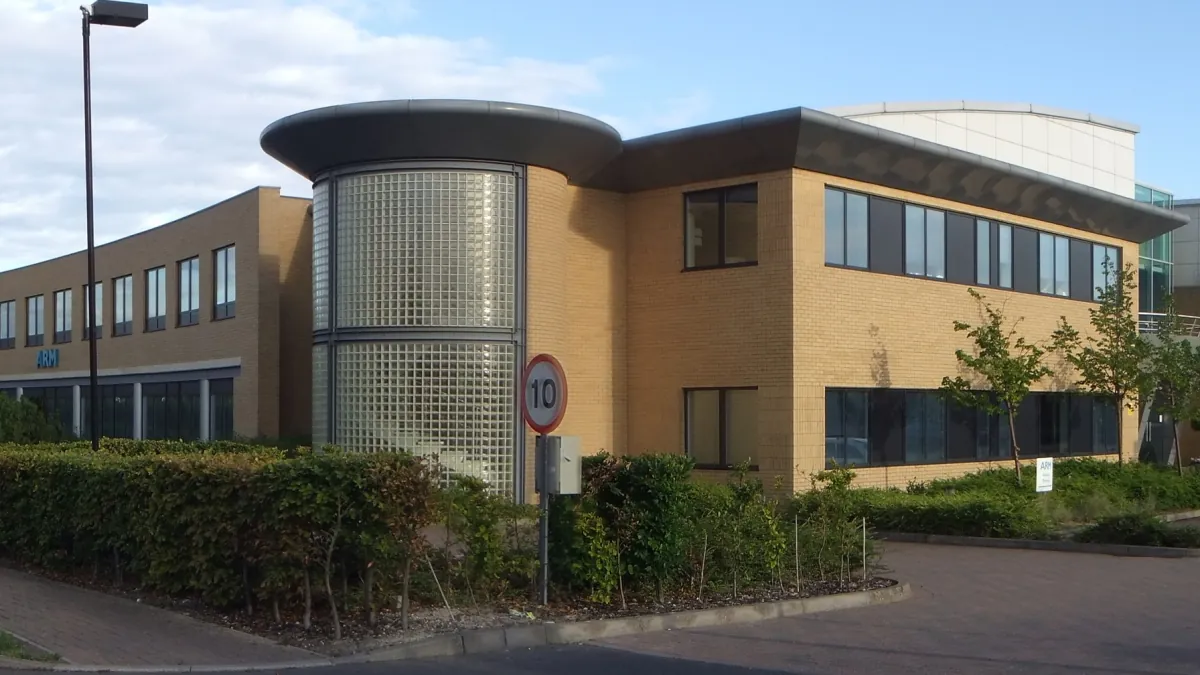
The archive photograph accompanying this article shows an Arm building in Cambridge, from an image uploaded in 2011. It supplies company context, not a picture of the new chip designs, a current manufacturing facility or a 2026 launch event.
The CPU coordinates work that crosses several applications
Arm's technical account describes a workflow that gathers context, plans actions and coordinates applications and services. Its C2 cluster adds matrix-processing capability through SME2, while system components help manage communication between different computing resources. Partners can configure the platform and combine it with other designs.
In plain language, running a model is only one possible stage. An assistant may also need to retrieve information, prepare inputs and ask an application to perform an action. Moving between those stages is part of the work, even if a headline benchmark measures only the model.
Our illustrative example is an assistant preparing a travel plan from several sources. Retrieving the right dates, checking a calendar and presenting a coherent result are distinct operations. Making one of them faster does not establish that the entire task will be accurate or finish proportionally sooner. The example explains the system problem; it is not a feature we tested on the new platform.
The GPU can reconstruct images as well as render them
Arm says Mali G2-Ultra NX integrates neural accelerators into its graphics architecture. Its described techniques include reconstructing a higher-resolution image from a lower-resolution render, generating intermediate frames and combining upscaling with denoising for demanding scenes. These are different operations, not three names for ordinary rendering.
The distinction matters when reading a frame-rate claim. A frame reconstructed or generated with assistance is not the same measurement as a wholly conventionally rendered frame. That does not automatically make the result worse. It means visual quality, motion and responsiveness must be examined alongside the displayed frame count.
Our proposed viewing check would include fine moving detail, objects appearing from behind other objects and rapid camera motion. Look at the complete sequence, not just a flattering still. Those are evaluation conditions we suggest, not defects we observed in Mali G2-Ultra NX; we have not tested the hardware.
Four times the efficiency is not four times the battery life
Arm reports up to four times the performance efficiency for neural graphics in its Neural Dawn demonstration compared with native rendering. It separately reports a 14% gain in non-AI gaming performance over the preceding generation. Those comparisons involve different workloads and should not be merged into one universal speed increase.
The CPU account reports up to 1.7 times the performance across selected AI models and up to 15% higher single-thread performance. These are vendor-reported results. They do not establish the same improvement in every application, or an independently measured battery-life benefit in a retail phone.
For interpretation, ask what changed between the two sides of a comparison. Were the output quality, scene, model, operating conditions and measurement boundary equivalent? A narrow result can be valuable without answering a broader question. The mistake is to silently substitute one question for the other.
Sources: Arm: CSS for Mobile 2 and the C2 CPU cluster; Arm: Mali G2-Ultra NX neural graphics
A phone has to sustain performance within its limits
Android's Dynamic Performance Framework documentation explains that mobile performance changes with thermal state, CPU clocks and core configuration. Its APIs let demanding applications monitor conditions and adjust their workload toward sustainable operation. This is platform background, not Android's validation of Arm's new designs.
Our reading is that a short demonstration and a long session answer different questions. A device may handle a brief burst well while behaving differently under repeated use. The relevant result for a player is not just the best moment; it includes what happens after the workload has continued.
We would therefore want reviewers to record the conditions of each test and compare sustained behaviour. A cool room, a different screen setting or an unequal workload could make a comparison difficult to interpret. Those are reasons to document a test carefully, not reasons to assume that the announced improvements cannot appear in real products.
Scientific perspective: compare complete tasks at comparable quality
Lumacta's evidence-based assessment—not an independent silicon review—is that moving the discussion from one accelerator to the complete system is technically meaningful. The evidence presented so far still comes primarily from Arm. The next test is whether the platform's advantages survive implementation choices and realistic use.
For AI features, we would measure time to a correct, completed task and the energy used, not only a raw processing rate. Include repeated attempts and recovery from errors. For graphics, hold the intended visual quality and game workload as comparable as possible, while reporting whether reconstruction or generated frames are enabled.
A fair comparison should also keep accuracy visible. A system that responds sooner but needs more corrections may not save the user time. Equally, a slightly slower result could be useful if it is dependable and runs under the intended conditions. These are our proposed criteria for future reviews, not new results from Arm's announcement.
Sources: Arm: CSS for Mobile 2 and the C2 CPU cluster; Arm: Mali G2-Ultra NX neural graphics; Android: Dynamic Performance Framework
Better hardware does not replace software or permission controls
Our conclusion is that this announcement is worth following as a direction for future devices, not as a reason to assume an existing phone will receive the new hardware capabilities through a software update. Hardware design, product integration and application support are separate steps.
The same separation applies to safety and privacy. Faster local processing does not decide which data an assistant may access or which actions need confirmation. A useful product should make those boundaries understandable, especially when it crosses from giving information to changing something on the user's behalf.
The potential benefit is a phone that handles more demanding work responsively within its practical limits. The evidence still needed is concrete: which finished products deliver it, in which applications, at what quality and for how long. That is where an architecture announcement becomes a meaningful everyday improvement.
Sources: Arm: CSS for Mobile 2 announcement, September 8; Arm: CSS for Mobile 2 and the C2 CPU cluster
Sources & Methods
Checked September 14, 2026. News peg: Arm's September 8 platform announcement. CPU and GPU figures are explicitly vendor-reported and refer to different comparisons. Android supplies thermal-management background, not independent validation. We did not test silicon, retail phones or games. The scientific perspective and proposed benchmarks are Lumacta's editorial analysis.
- Arm: CSS for Mobile 2 announcement, September 8 — Manufacturer announcement
- Arm: CSS for Mobile 2 and the C2 CPU cluster — Manufacturer technical account
- Arm: Mali G2-Ultra NX neural graphics — Manufacturer technical account
- Android: Dynamic Performance Framework — Technical background