
A result that changes two assumptions in opposite directions
WHOI’s October 15 account reports rapid cliff calving followed by stabilization. The observed failures can outpace existing model representations, without developing into sustained runaway retreat. This concerns land-ice margins, not seasonal sea-ice extent.
Our interpretation begins with that tension. A faster event can increase concern about a near-term loss while a shorter event changes the interpretation of a long-term cascade. Combining those findings into either a reassuring slogan or an inevitable catastrophe would erase the very distinction the observations make useful.
The immediate scientific question is therefore not whether collapse sounds dramatic. It is what happens after the first failure. Does the next exposed ice face become more vulnerable, or do changing conditions interrupt the sequence? That question asks about the system’s response, not simply the size of its initial disturbance. A useful explanation must keep the event, the response and the eventual outcome separate.
Source notes: 1, 2. Original editorial examples and interpretations are identified separately.
Why a broken cliff is not automatically an unstable ice sheet
MIT describes the marine ice-cliff instability hypothesis: failure exposes a taller inland face, which fails again. Height alone, often represented by an approximately 100-metre threshold, does not adequately describe the observed behaviour.
In the author preprint, retreat into thicker ice competes with dynamic thinning. A small upstream thickness gradient can limit the growth of the newly exposed face.
That competition is the important physical idea. A trigger and a feedback are different things: a trigger starts a change, whereas a positive feedback makes the next step reinforce it. A mechanism that promotes one failure does not establish that every later step becomes easier. Conversely, an interruption does not undo the ice that has already been removed.
We would describe stability here as conditional behaviour, not a permanent property stamped onto a glacier. The relevant question is whether a particular geometry and flow response maintain or reduce the vulnerability after retreat. Describing a glacier as stable without stating the process and conditions would make the word misleading.
Source notes: 1, 3. Original editorial examples and interpretations are identified separately.
Original arithmetic: the same initial cliff can lead to different next steps
Here is an invented accounting example, not the authors’ equation or a climate simulation. Start with a notional exposed height of 110 metres. For one illustrative interval, let retreat expose ice that adds eight metres to that height, while a separate thinning adjustment removes 12 metres. The next value is 110 + 8 − 12 = 106 metres.
Repeat those arbitrary adjustments once and the value becomes 102 metres. Now change only the assumed exposure increment to 16 metres: 110 + 16 − 12 = 114, followed by 118. The starting height and thinning adjustment are identical, yet the signs of the net changes differ: minus four versus plus four metres per invented interval.
Nothing in these chosen numbers estimates an actual glacier, sets a universal failure threshold or predicts when retreat stops. Real adjustments need not stay constant or be independent, and no duration has been assigned. The exercise illustrates why a starting height cannot determine the trajectory without knowing how the competing terms evolve. It is a deliberately simplified explanation of a balance, not evidence that either hypothetical path occurs in Antarctica.
Source notes: 3. Original editorial examples and interpretations are identified separately.
A height observation, a calving rate and a sea-level contribution are different quantities
WHOI describes laser altimetry, which derives elevation from the travel time of light pulses. Its account compares cliff heights with water depth, ice thickness, crevassing and calving rates.
The older preprint distinguishes cliff height above the waterline from total thickness and estimates calving using ice motion together with front-position change.
A useful physical check is to name the quantity before comparing numbers. A vertical distance does not measure a horizontal retreat rate. A moving front also does not, by itself, tell us the volume transferred: an imaginary narrow, thin slice and a wide, thick slice could retreat by the same distance while containing very different amounts of ice.
For that reason, we would not convert a photographed wall’s apparent height into a sea-level claim. Such a conversion would require a defined geometry, an appropriate mass balance and a treatment of what was already afloat. Our point is not that the observations lack value; it is that a measurement becomes more useful when its physical meaning is preserved rather than silently upgraded into a different result.
Source notes: 2, 3. Original editorial examples and interpretations are identified separately.
Observed stabilization does not establish that future Antarctica is safe
MIT describes repeated satellite observations from 2019 to 2023. The author preprint explicitly leaves open future configurations with steeper upstream thickness gradients and greater vulnerability.
The observation window and the publication date answer different questions. An announcement this week does not make the underlying glacier changes events of this week. Equally, an observed interruption provides evidence about the sampled circumstances, not a demonstration that every possible future configuration must behave the same way.
Our scientific perspective is that the finding should refine a mechanism rather than settle climate risk with a yes-or-no verdict. It challenges the idea that a tall face necessarily guarantees continued acceleration, while leaving a reason to examine rapid losses carefully. Rejecting one automatic cascade is not equivalent to rejecting sea-level rise, and an uncertain cascade does not make an individual loss inconsequential.
The most useful next comparison would follow how front height, retreat and the competing thickness changes evolve together. That is our proposed follow-up question, not an additional dataset or an experiment performed for this article.
Source notes: 1, 3. Original editorial examples and interpretations are identified separately.
What this evidence changes—and what we have not verified
Our assessment is that an ice-sheet model needs to answer two distinct questions: how quickly failure proceeds, and what maintains or interrupts it. Matching a retreat speed without reproducing its interruption would leave an important part unexplained. Reproducing stabilization while missing the rapid loss beforehand would also be incomplete.
We checked the institutional accounts against the authors’ earlier manuscript rather than treating several announcements as independent experiments. The July 21, 2025 preprint is an earlier version, not the final Science text; we cannot confirm that every detail survived peer review unchanged. Its mechanisms provide context, while the current institutional releases establish the new publication and reported outcome.
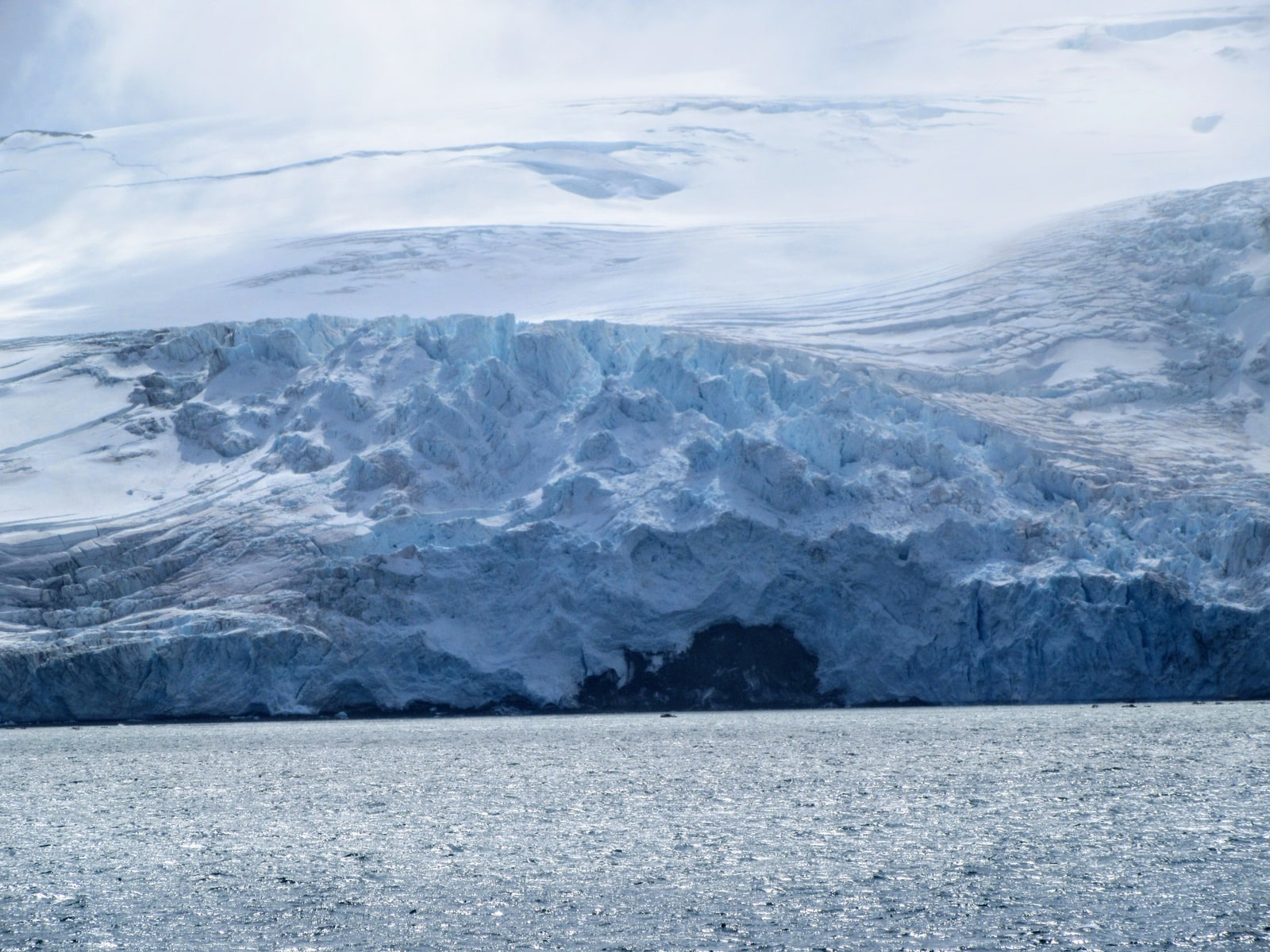
The archive photograph shows a glacier face at Elephant Island in December 2019. It is not a measurement used here, a photograph of the reported failures or evidence of the proposed feedback. Lumacta has not conducted fieldwork, interviewed the researchers, replicated their analysis or generated an independent climate projection.
Source notes: 1, 2, 3, 4. Original editorial examples and interpretations are identified separately.
Sources & Methods
Prepared October 16, 2026. We read both institutional accounts completely and the author preprint’s cover, abstract, main text and methods, pages 1–13; not its extended-data or supplementary analysis. Direct access to the final Science article was unavailable. The earlier manuscript and current announcements are not independent replications. Our numerical example and scientific assessment are original editorial explanation, not reported measurements. The Commons photograph description, licensing, metadata and Flickr license-review record, plus the complete CC BY 2.0 deed, were read. No research photographs were borrowed from MIT’s restricted media download.
- MIT: the behaviour of Antarctic ice cliffs — Primary institutional account, October 15, 2026; complete body read
- WHOI: an observational ice-cliff survey — Primary institutional account, October 15, 2026; complete body read
- Needell, Walker and Bassis: earlier author manuscript — Primary preprint, July 21, 2025; cover, abstract, main text and methods read, not final journal article
- Wikimedia Commons: Elephant Island glacier face, amanderson2 — Photograph description, metadata, attribution, licensing and Flickr license-review record read
