
A new blueprint, not a delivered fleet
AMD introduced Helion on October 12 as an agentic-AI rack blueprint. Partner configurations remain under development, with availability planned for November 2026. AMD also plans to contribute the specification to the Open Compute Project; that is not confirmation of an already accepted contribution.
This is a proposal for organizing infrastructure, not evidence that a buyer can install a validated system today. Ask for the finished configuration, support commitments and a workload demonstration. A roadmap date cannot replace delivery terms.
For readers outside the data center, the interesting change is the question being asked. Instead of treating every AI requirement as a demand for more model capacity, examine the work surrounding each response. Preparing data, checking an action and recording its outcome deserve their own consideration.
Source notes: 1. Original editorial examples and interpretations are identified separately.
Separate the worker from the model it consults
AMD describes a CPU-only configuration connected to separate model-inference infrastructure, and an all-in-one design combining EPYC CPU nodes with Instinct MI350P GPU nodes. Those configurations address workload placement; they do not establish that each business action is appropriate.
Consider an invented purchasing assistant: it reads a request, asks a model to interpret it, checks stock and drafts an order. The interpretation and the surrounding steps are different jobs. This example describes no AMD benchmark or deployed customer; it is a way to map a workflow before buying equipment.
Our proposed first worksheet labels each step: local processing, model call, external service or human decision. Next, record where time is spent and what constrains completion. A slow external approval does not automatically call for another processor. An expensive model call does not establish that its surrounding software needs a larger rack.
Source notes: 1, 2. Original editorial examples and interpretations are identified separately.
Read capacity figures as ceilings—not completed tasks
The current product page lists up to 32,768 CPU cores and up to 16 MI350P GPUs. Its FAQ describes two independent eight-GPU nodes without a scale-up GPU fabric between them. These are configuration statements, not a measured count of reliably completed agent tasks.
Our useful-work test would define one representative task, its acceptance conditions and the permitted operating boundary. Record completion time alongside errors, human interventions and total resources consumed. Comparing maximum hardware numbers without defining the task leaves the most important part unspecified.
An invented denominator shows why this matters: if 100 attempted tasks produce 80 acceptable outcomes, judging only the 80 successes hides 20 attempts. This is simple accounting, not a reliability estimate for Helion. Include rejected outputs and repeated work when evaluating any proposed system, rather than reporting only its best-looking result.
Source notes: 2. Original editorial examples and interpretations are identified separately.
Keep the authority to act outside the speed claim
Our proposed permission checklist starts with the consequence of each action. Reading a public document, preparing a draft and changing a customer record should not inherit one undifferentiated permission. This is our operational recommendation, not a security feature AMD has demonstrated or a claim about the rack’s default configuration.
For the fictional purchasing workflow, let the assistant prepare an order without automatically authorizing payment. Assign a responsible person to approve the consequential step, and decide which records that person needs to inspect. The point is an explicit boundary, not the assumption that a human click makes every decision safe.
Check whether permissions remain understandable when many tasks run together. Which task initiated an action? Which authority allowed it? Can that authority be withdrawn without stopping unrelated work? Answers should be inspectable in the proposed application. More cores do not provide those answers merely by being present.
Source notes: 1. Original editorial examples and interpretations are identified separately.
A useful demonstration should include an interrupted task
AMD distinguishes Helion’s enterprise design from Helios, which targets larger training and inference workloads. That distinction does not establish an application’s recovery behavior. Our suggested evaluation deliberately asks what happens when a tool call stalls or a process stops after only part of its work.
Return to the fictional order. If a confirmation is lost, repeating the last action might duplicate an order rather than repair it. Require a visible status record and a defined recovery owner; ask the supplier to demonstrate how the application identifies unfinished work. We have not run this test on Helion or any partner system.
Recovery is also a scope question. Specify what may be resumed, what must be checked and what cannot be reversed. A successful demonstration should make those limits visible, rather than treating a restart as evidence that the business task ended correctly.
Source notes: 2. Original editorial examples and interpretations are identified separately.
Buy a solved bottleneck, not an impressive rack headline
Our editorial conclusion is conditional: Helion is worth examining where a documented workflow bottleneck matches the offered configuration. Begin with a representative task and compare keeping the existing setup, changing the application and acquiring hardware. Include support and the people needed to operate it, not merely the initial quotation.
For a small team, that exercise may identify a simpler change than purchasing rack-scale infrastructure. For a larger operator, it may justify a supplier trial. Neither conclusion follows from a launch headline alone. Ask for evidence addressing your task, your constraints and your failure cases, with an exit plan if the proposed system disappoints.
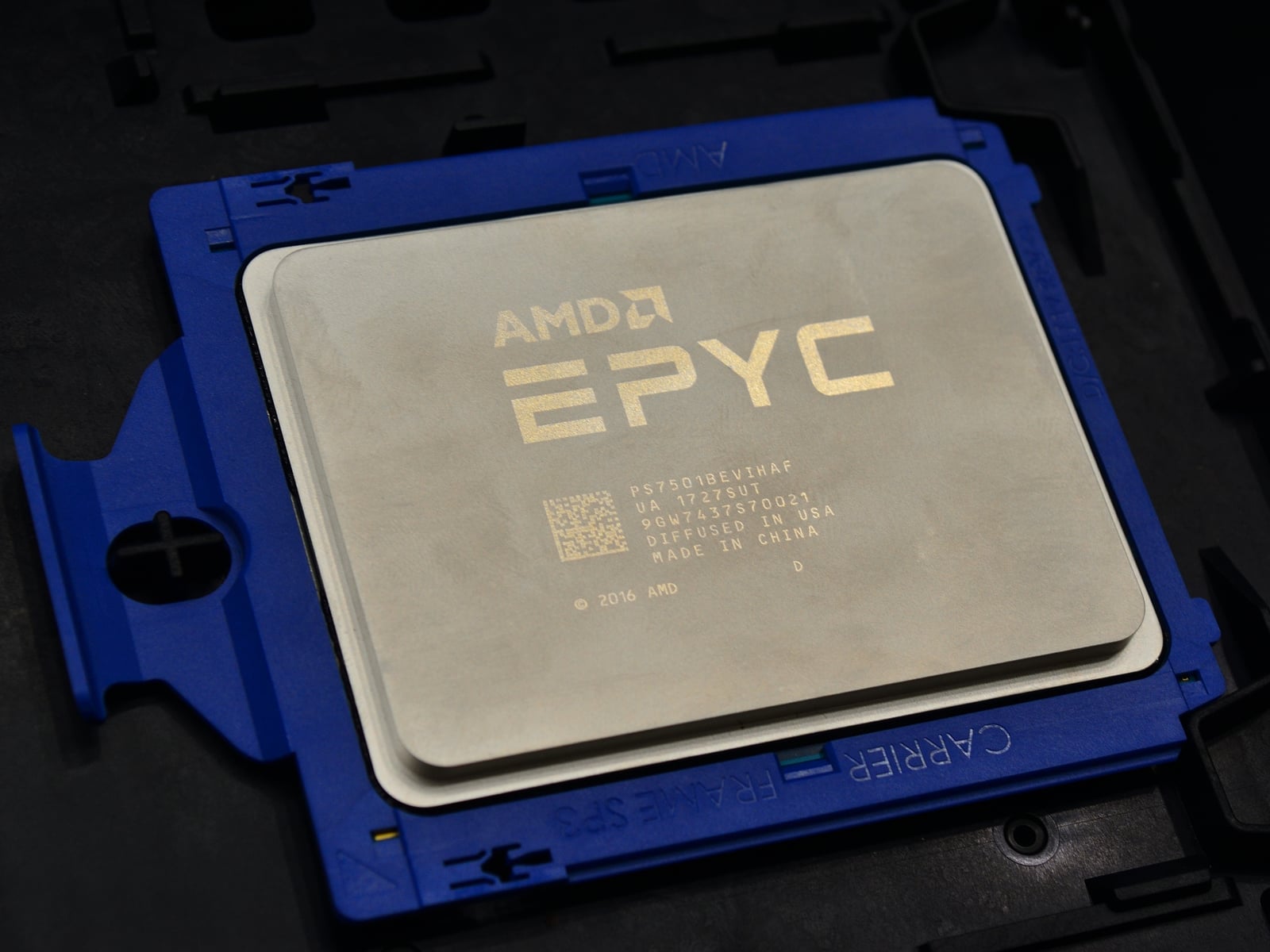
The archive photograph shows an older EPYC 7501 engineering sample photographed in 2018—not Helion, a current CPU or a 2026 event. The new announcement offers an infrastructure direction; the buying decision still depends on whether the whole workflow produces acceptable, recoverable work.
Source notes: 1, 2. Original editorial examples and interpretations are identified separately.
Sources & Methods
Prepared October 13, 2026 from two complete AMD primary pages. Vendor descriptions are not independent performance results. The purchasing assistant, task accounting and proposed permission/recovery checks are original editorial examples, not observed deployments. We performed no benchmark, interview, purchase or installation.
- AMD: October 12 announcement — Primary launch record; future availability and intended standards contribution
- AMD: Helion configuration, specifications and FAQ — Primary technical description checked October 13; not independently measured performance