
A radio signal confirmed the crossing
A radio signal took a full day to reach Earth from Voyager 1. NASA confirmed on November 19 that the signal had left the spacecraft at the one-light-day mark the previous morning. The distance was about 25.9 billion kilometres, or 16.1 billion miles. The team received the signal while investigating a separate problem: Voyager was still transmitting, but its science readings and engineering data had stopped coming through.
When Lumacta covered the milestone earlier this month, the crossing was a forecast. NASA now has the received radio signal and a trajectory calculated from years of tracking. Those are the two parts of the confirmation. The Associated Press reported that the signal was picked up via the deep-space antenna near Madrid. The data outage was already under investigation by then.
What engineers can infer from a carrier
The first sign of the current problem came on November 14 when a Deep Space Network antenna in Canberra picked up Voyager’s carrier wave without the usual data. Think of the carrier as a tone and the telemetry as the information normally encoded onto it. A receiver can still find and track the tone when it has lost the information it normally decodes.
NASA says the received carrier indicates that the spacecraft was keeping its antenna pointed toward Earth and that the radio chain needed to send the signal was still working. That narrows the investigation. It leaves engineers without the health readings they would normally use to identify a failed component or check how the instruments are doing. NASA pointed to the onboard computer that gathers and formats the data as one possibility. The agency had yet to establish the cause in its confirmation.
Madrid and Canberra appear in these reports for different reasons. Canberra’s reception exposed the missing data on November 14. The reception reported from Madrid confirmed the light-day crossing on November 19. Combining the two into a single contact would blur both what the team observed and when it learned it.
Each troubleshooting exchange takes days
Imagine the ground team sends a diagnostic command on Monday morning. At this range it reaches Voyager around Tuesday morning, and an immediate reply would come back around Wednesday morning. A wait for the next antenna window, onboard processing or a reply that arrives without readable data can extend the exchange. The Monday-to-Wednesday example is a calculation from the published light-time.
That delay makes the order of checks important. A diagnostic request is most useful when one clear result can narrow several possibilities at once. If a response carries no engineering readings, even a successfully received command may leave the ground team with the same uncertainty. NASA says the investigation could take weeks or longer. The carrier is a useful observation during that process, and listening for it can continue while the team assesses ways to recover the information it normally carries.
The earlier recovery shows what to watch for
Voyager 1 previously lost readable data in late 2023. JPL subsequently traced that incident to a damaged memory chip in the flight data subsystem. Controllers recovered engineering readings in April 2024 by moving the affected software into other memory space. At that point, work on bringing back the science stream was still ahead. An early recovery announcement can therefore describe one kind of data returning while another remains unavailable.
The mission also lost the radio signal completely for about two days in October 2026. Contact resumed without a new troubleshooting command from Earth. NASA is investigating a possible connection between the October interruption and the November data loss, which produced a different symptom at the receiver. The 2023 repair offers a precedent for recovering information over a slow link. The next evidence needs to come from the current spacecraft.
What the flight can still teach us
Voyager 1 crossed the heliosphere’s outer boundary in 2012. This week’s record measures a different thing: how far a signal has to travel back to Earth. The scientific value of the mission comes from continuing measurements along a path no other active probe shares. A position estimate places Voyager on that path. Data from its instruments tell scientists what it found there.
The probe’s power supply has also been declining gradually. NASA reported that engineers swapped several devices for lower-power alternatives earlier this year. The agency’s estimate for how long that effort could sustain the instruments describes an energy budget. Recovering science data also depends on the machinery that reads, formats and sends it.
The next meaningful update is a report of readable engineering telemetry, followed separately by confirmation of which science measurements are reaching Earth. Those two signals would let readers tell how far the recovery has progressed. For now, the confirmed crossing fixes the distance, the carrier shows the link can still be heard, and the mission is working to recover the information that makes the link scientifically valuable.
Sources & Methods
This update follows Lumacta’s Nov. 3 forecast. The crossing date and confirmation date are checked separately. The troubleshooting example is Lumacta’s calculation from NASA’s light-time.
- NASA’s Nov. 19 milestone confirmation — Primary announcement. Confirms crossing time, receipt the next day and absence of telemetry.
- NASA Science’s Nov. 18 engineering update — Primary status report. Carrier detection, engineering interpretation and open questions.
- Associated Press coverage of the confirmation — Independent reporting by Marcia Dunn on the Nov. 19 confirmation, including the Madrid reception.
- JPL’s account of the 2024 engineering-data recovery — Primary historical account. Engineering telemetry returned before science recovery work was complete.
- JPL’s October 2026 power and communications update — Primary retrospective on a separate signal interruption and energy-saving work.
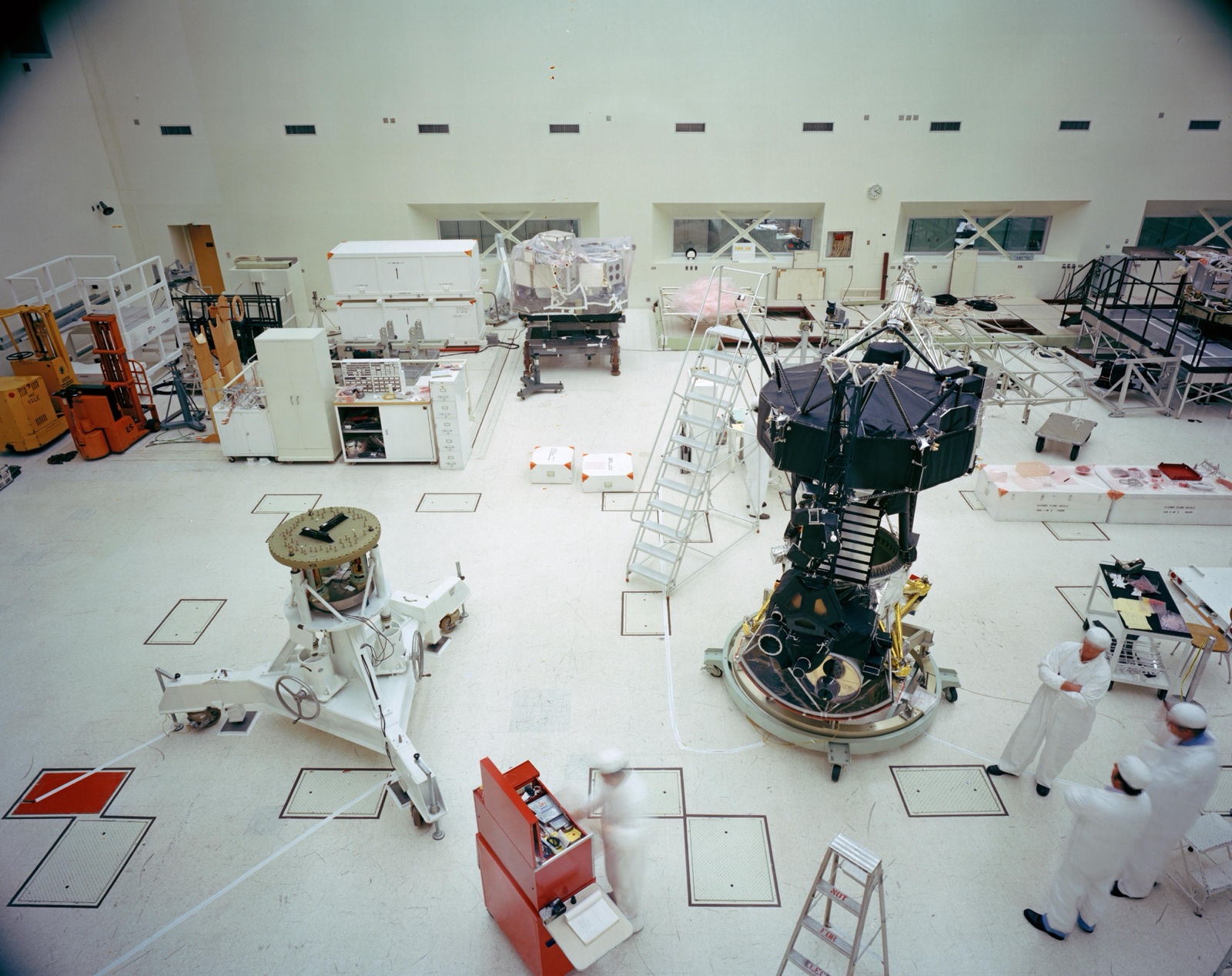
- NASA Science archive photograph PIA21476 — Original image record and Jan. 12, 1977, capture date.
- NASA media use guidelines — Basis for factual editorial reuse with attribution without implying endorsement.